As the sun sets over the Potomac this first week of May 2026, the United States finds itself at a historic and harrowing crossroads. The atmosphere is thick with a familiar, yet intensified, sense of dread—a combination of geopolitical brinkmanship in the Middle East and a relentless economic squeeze at home. The “May Heat,” as some political commentators are calling it, refers not to the spring weather, but to the boiling point reached by public frustration and international volatility.
The nation’s attention is split between two front lines: the turbulent waters of the Strait of Hormuz and the neon-lit boards of neighborhood gas stations. For the average American, the abstract maneuvers of the Fifth Fleet feel increasingly personal as the cost of a commute continues to skyrocket. This week, the intersection of foreign policy and domestic stability has become the defining challenge for the Trump administration.
Geopolitical Brinkmanship: The Iran Standoff
The latest developments in the Middle East have moved with a dizzying, often violent speed. Following a conflict that ignited in late February 2026, the United States and Israel have remained locked in a high-stakes military and diplomatic tug-of-war with Tehran. On Sunday, May 3, the situation reached a new fever pitch.
President Donald Trump officially rejected a 14-point proposal submitted by the Iranian regime intended to halt the current hostilities. The proposal reportedly offered a multi-stage de-escalation: an immediate ceasefire, the reopening of the Strait of Hormuz within thirty days, and a fifteen-year freeze on nuclear enrichment. However, the catch—one the administration found “unacceptable”—was the deferment of deep-seated nuclear negotiations and the immediate lifting of U.S. blockades before verification could occur.

“It’s not acceptable to me,” the President stated during an interview with Kan public broadcaster. “I’ve studied it, I’ve studied everything—it’s not acceptable.” The administration’s stance remains firm: Iran has yet to pay “a big enough price” for the regional instability that has crippled global trade since the start of the year.
Meanwhile, Tehran’s Revolutionary Guards have issued a counter-warning, suggesting that Washington faces a binary choice between an “impossible” military operation or accepting what they deem a “fair deal.” The psychological warfare is as intense as the kinetic, with state-run media in Iran portraying a defiant populace while U.S. intelligence points to a regime under extreme internal pressure.
Project Freedom: Escorts in the Strait
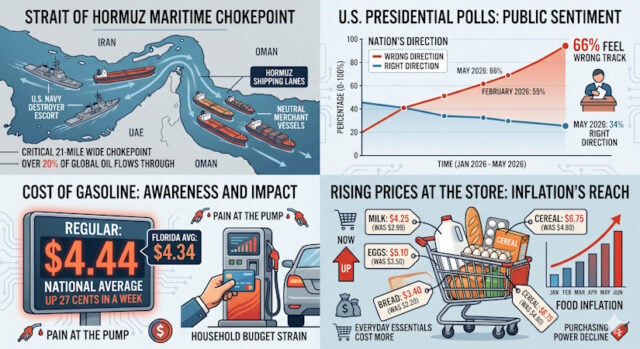
In response to the continued blockade of the Strait of Hormuz—a vital artery through which nearly 20% of the world’s oil supply flows—President Trump has announced a bold new maritime initiative dubbed “Project Freedom.”
Starting Monday morning, Middle East time, U.S. naval forces will begin “guiding” and escorting neutral merchant vessels out of the restricted waters of the Strait. Many of these ships, described by the President as “innocent bystanders,” have been stranded for weeks, with crews reportedly running low on food and essential supplies.
“This process is meant to free up people, companies, and countries that have done absolutely nothing wrong,” Trump posted on Truth Social. While the administration frames this as a humanitarian mission, the strategic implications are clear: the U.S. is challenging Iran’s “maritime regime” by force of presence. A senior Iranian official has already signaled that any U.S. interference in the Strait will be viewed as a breach of the standing (though fragile) ceasefire, raising the specter of a direct naval confrontation.
The Pain at the Pump: $4.44 and Rising
While the high seas are fraught with danger, the American domestic landscape is fraught with debt. The most visible symptom of the Iran conflict is the “ever-increasing” cost of energy. As of Sunday, May 3, 2026, the national average for a gallon of regular gasoline has hit $4.44, a staggering 27-cent jump in a single week.
This surge has pushed fuel costs to their highest levels in four years, reminiscent of the 2022 peaks but occurring in a much more volatile inflationary environment. In Florida, where long commutes and tourist transit are the lifeblood of the economy, the price is slightly lower than the national average but no less painful, sitting at $4.34 a gallon.
The economic ripple effect is profound. Logistics companies are already signaling “fuel surcharges” that will inevitably be passed on to consumers at grocery stores and retail outlets. The “energy tax” on the American family is now estimated to be hundreds of dollars more per month than it was at the start of the year, effectively wiping out wage gains made in other sectors.
A Nation in Discontent: The Polls
The combination of a distant war and a local economic crisis has manifested in a brutal polling landscape for the current leadership. Latest data indicates a profound “wrong direction” sentiment among the electorate. Approximately two-thirds of Americans (66%) now believe the country is on the wrong track.
This dissatisfaction is not confined to a single demographic. Independent voters, in particular, have expressed growing weariness with the “forever conflict” in the Middle East, even as they demand more aggressive action to lower domestic energy prices. A KFF Health Tracking Poll, which recently expanded its scope to general economic stressors, found that 64% of adults are now as worried about gas and transportation costs as they are about healthcare—a historic shift in public anxiety.
Approval ratings for the administration’s handling of the Iran crisis have slipped significantly, with 62% of respondents disapproving of the current military posture. The underlying message from the American public is one of exhaustion: a desire for the “Project Freedom” abroad to translate into economic freedom at home.
The Global Energy Market and OPEC+
The crisis has forced the hand of the global energy cartel. Saudi Arabia and Russia, along with five other OPEC+ nations, recently announced a production hike of 188,000 barrels per day for June. However, the effectiveness of this move is hampered by the exit of the United Arab Emirates from the body earlier this week, signaling a fracture in regional unity.
Despite the planned increase in production, Brent crude remains hovering near $106 a barrel. The market is pricing in the risk of a “Strait Closure” that could last through the summer. If “Project Freedom” succeeds in clearing the backlog of tankers without sparking a direct war, analysts expect a modest “peace dividend” in the markets. If it fails, or if a U.S. vessel is fired upon, experts warn that $5.00 gas could become the new national floor.
Conclusion: The Long Road Ahead
As the U.S. prepares to launch “Project Freedom” on Monday, the stakes could not be higher. President Trump is betting that a show of naval strength will break the Iranian blockade and eventually ease the pressure on American gas stations.
However, with two-thirds of the country skeptical of the nation’s direction and the average citizen paying $4.44 for the basic necessity of movement, the margin for error is razor-thin. The coming weeks will determine whether this is the beginning of a successful de-escalation or the prelude to a much larger, and much more expensive, global conflagration.
Sources Used and Links:
- The Hindu: Israel-Iran war updates: Trump announces ‘Project Freedom’ to help stranded ships out of Strait of Hormuz
- The Times of Israel: Trump: Latest Iran terms unacceptable; US on Monday to start guiding ships out of Hormuz
- Kurdistan24: Trump Announces ‘Project Freedom’ to Escort Neutral Ships Out of Strait of Hormuz
- Channel News Asia (CNA): Trump says US and Iran in ‘positive’ talks, unveils plan to escort Hormuz ships
- AAA Fuel Prices: Florida Average Gas Prices
- AAA Newsroom: Oil Prices Spike, National Average Up Nearly 30 Cents in One Week
- The Economic Times: Gas Prices Today May 3: Check latest rates in California, Texas, Florida, New York and Pennsylvania
- Pew Research Center: Public Opinion Polling and Data
- KFF Health Tracking Poll: Health Care Costs and the Midterms
Disclaimer
Artificial Intelligence Disclosure & Legal Disclaimer
AI Content Policy.
To provide our readers with timely and comprehensive coverage, South Florida Reporter uses artificial intelligence (AI) to assist in producing certain articles and visual content.
Articles: AI may be used to assist in research, structural drafting, or data analysis. All AI-assisted text is reviewed and edited by our team to ensure accuracy and adherence to our editorial standards.
Images: Any imagery generated or significantly altered by AI is clearly marked with a disclaimer or watermark to distinguish it from traditional photography or editorial illustrations.
General Disclaimer
The information contained in South Florida Reporter is for general information purposes only.
South Florida Reporter assumes no responsibility for errors or omissions in the contents of the Service. In no event shall South Florida Reporter be liable for any special, direct, indirect, consequential, or incidental damages or any damages whatsoever, whether in an action of contract, negligence or other tort, arising out of or in connection with the use of the Service or the contents of the Service.
The Company reserves the right to make additions, deletions, or modifications to the contents of the Service at any time without prior notice. The Company does not warrant that the Service is free of viruses or other harmful components.