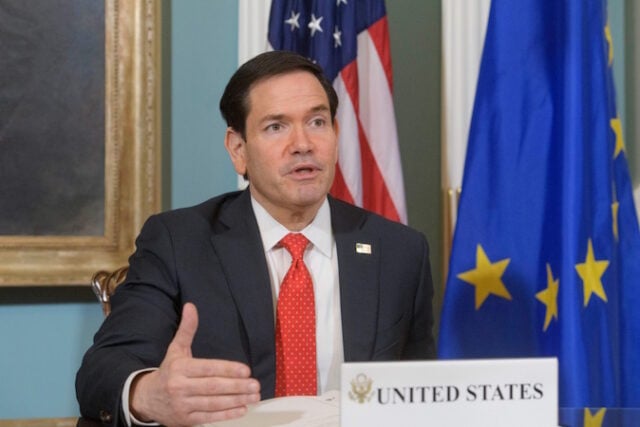
The cobblestone streets of Rome, usually a backdrop for timeless diplomacy and ancient grandeur, are set to host one of the most fraught diplomatic missions of the second Trump administration. On Thursday, May 7, 2026, U.S. Secretary of State Marco Rubio will arrive in the Italian capital not merely as a visiting dignitary but as a firefighter tasked with dousing the flames of a multi-front diplomatic conflagration.
At the heart of Rubio’s mission is an unprecedented “thaw” effort. The relationship between Washington, the Holy See, and the Italian Republic has spiraled into visible acrimony following a series of high-profile “blasts” from President Donald Trump. Rubio, a devout Catholic who has long positioned himself as a bridge between the American conservative movement and the Church’s traditional structures, now finds his personal faith and professional acumen put to the ultimate test.
The Papal Paradox: Trump vs. the First American Pope
The most striking feature of the current diplomatic crisis is its target: Pope Leo XIV. Elected in May 2025 following the passing of Pope Francis, Leo XIV made history as the first American ever to ascend to the Chair of Saint Peter. Initially, the Trump administration celebrated his election as a “great honor” for the United States. However, the honeymoon period was short-lived.
By the end of 2025, the American Pope had emerged as a formidable moral critic of the administration’s “Operation Epic Fury”—the ongoing conflict with Iran—and its hard-line domestic policies. The rift widened significantly in April 2026 when Pope Leo XIV utilized his platform during a four-nation tour of Africa to condemn “territorial expansionism” and “nationalist policies that ignore the plight of the migrant.”

President Trump responded with characteristic bluntness. In a series of social media posts and interviews, the President labeled the Pope “terrible” and “ineffective,” even suggesting that the Vatican’s “moral voice” was being used to mask a lack of political relevance. This verbal feud reached a fever pitch when the White House reportedly invoked the “Avignon” papacy in private communications—a reference some Vatican officials interpreted as a subtle military or political threat.
The Meloni Fallout: A Bridge Burned
While the clash with the Vatican is a spiritual and moral battle, the rift with the Italian government is a tactical and strategic one. For years, Prime Minister Giorgia Meloni was heralded as the “Trump whisperer” of Europe—a far-right leader who shared the President’s views on immigration and national sovereignty. She was seen as the vital bridge between the MAGA movement and the European Union.
That bridge appears to have burned. The breakdown began in earnest with Italy’s refusal to allow U.S. bombers to utilize a pivotal air base in Sicily for strikes against Iranian targets. Meloni, citing the need for European stability and Italy’s refusal to be dragged into an “unauthorized war,” effectively declared Italian neutrality in the conflict.
The President’s reaction was swift. In an interview with Corriere della Sera, Trump lamented, “I thought she had courage, but I was wrong.” He followed this by threatening to withdraw the nearly 13,000 U.S. troops currently stationed in Italy, echoing the recent drawdown of 5,000 troops from Germany. For Meloni, who has staked her premiership on being a respected international player, Trump’s public dismissal was a stinging rebuke. She responded by stating that true courage is “telling friends the truth” and acting in the national interest.
The Rubio Strategy: The Catholic Diplomat
Into this volatile mix steps Marco Rubio. His visit is meticulously timed to coincide with the one-year anniversary of Pope Leo XIV’s papacy. Rubio’s strategy is built on his unique identity. As a high-ranking Catholic official in a Republican administration, he possesses a degree of “ecclesial street cred” that other cabinet members lack.
Rubio has a history with Pope Leo; he attended the inaugural Mass in 2025 alongside Vice President JD Vance. His goal this week is to move beyond the rhetoric of the last month and find common ground on issues where the Vatican and the U.S. still align, such as the protection of Christian minorities in the Middle East and certain aspects of religious freedom.
However, the “thaw” is described by Italian media as “not impossible, but complicated.” Rubio must represent a President who demands total loyalty while speaking to a Pope who demands total moral consistency.
The Itinerary: A Delicate Dance
The Secretary’s schedule reflects the mission’s sensitivity. On Thursday, Rubio is slated for a private audience with the Pope and a high-level meeting with Cardinal Pietro Parolin, the Vatican’s Secretary of State. Parolin is known as a master of “Ostpolitik”—the art of patient, quiet diplomacy. This meeting will likely be the venue where the most difficult conversations regarding the Iran war and the “military threats” take place.
On Friday, the focus shifts to the Italian state. Rubio will hold talks with Foreign Minister Antonio Tajani and Defense Minister Guido Crosetto. These discussions will be dominated by the “base issue” in Sicily and the looming threat of troop withdrawals. Tajani, a seasoned diplomat himself, will likely seek assurances that the U.S. remains committed to the Atlantic Alliance despite the personal friction between their respective leaders.
The Meloni Question: A Snub in the Making?
The most glaring uncertainty of the trip remains whether Rubio will meet with Prime Minister Meloni herself. As of Sunday evening, Rubio’s request for a meeting had not been officially granted. In the world of high-stakes diplomacy, “uncertainty” often serves as a tactical tool.
If Meloni refuses the meeting, it will be seen as a direct signal to the White House that the Prime Minister is no longer willing to be the “bridge” if it means being a subordinate. Conversely, if the meeting is granted, it may signal that Meloni is willing to allow Rubio to act as a back channel to the President, bypassing the public social media attacks that have characterized the last few weeks.
Geopolitical Implications: Troops and Tariffs
The stakes of Rubio’s trip extend far beyond personal feelings. The U.S. military presence in Italy is one of the most significant in Europe. A withdrawal would not only weaken NATO’s southern flank but would also severely hamper U.S. logistics in the Mediterranean and the Middle East.
Furthermore, Italy remains under the shadow of U.S. tariffs. The economic strain of the “One Big Beautiful Bill Act” and subsequent trade tensions have left the Italian business community anxious. Rubio, who has often been more nuanced on trade than the President, may try to offer “carrots” in the form of trade exemptions if Italy can find a way to support U.S. security interests—even if that support stops short of direct military participation in Iran.
Conclusion: Thaw or Freeze?
Marco Rubio is walking a tightrope between the Apostolic Palace and the Palazzo Chigi. His mission is to convince the world that the U.S.-Italy-Vatican triad remains functional, despite the verbal grenades lobbed from the Oval Office.
Success for Rubio will not look like a joint press conference or a sudden policy reversal. It will look like a drop in temperature. If the Secretary can leave Rome with a commitment to “ongoing dialogue” and a temporary cessation of hostile rhetoric from both the Vatican press office and the President’s social media account, he will have achieved a minor miracle.
However, in 2026, where “courage” and “loyalty” are defined in radically different ways in Rome and Washington, the “thaw” may be short-lived. The world will be watching on Thursday to see if the American Pope and the Floridian Secretary can find a way to speak the same language.
Sources Used and Links:
- Dawn: US Secretary of State Rubio to visit Vatican, Rome after Trump’s row with Pope
- The Guardian: Marco Rubio to visit Rome, reportedly to ‘thaw’ US relations with Pope and Meloni
- Daily Sabah: Rubio to visit Vatican, Rome after Trump-Pope Leo tensions
- The National Herald: After Criticizing the Pope, Trump Slams Italy’s Meloni Over Lack of Support for Iran War
- Internazionale: Top US diplomat Rubio to meet with Pope Leo on Thursday, source says
- RBC-Ukraine: US-Italy tensions rise as Rubio prepares for high-stakes Rome visit
- Wikipedia: 2026 United States–Holy See rift
Disclaimer
Artificial Intelligence Disclosure & Legal Disclaimer
AI Content Policy.
To provide our readers with timely and comprehensive coverage, South Florida Reporter uses artificial intelligence (AI) to assist in producing certain articles and visual content.
Articles: AI may be used to assist in research, structural drafting, or data analysis. All AI-assisted text is reviewed and edited by our team to ensure accuracy and adherence to our editorial standards.
Images: Any imagery generated or significantly altered by AI is clearly marked with a disclaimer or watermark to distinguish it from traditional photography or editorial illustrations.
General Disclaimer
The information contained in South Florida Reporter is for general information purposes only.
South Florida Reporter assumes no responsibility for errors or omissions in the contents of the Service. In no event shall South Florida Reporter be liable for any special, direct, indirect, consequential, or incidental damages or any damages whatsoever, whether in an action of contract, negligence or other tort, arising out of or in connection with the use of the Service or the contents of the Service.
The Company reserves the right to make additions, deletions, or modifications to the contents of the Service at any time without prior notice. The Company does not warrant that the Service is free of viruses or other harmful components.