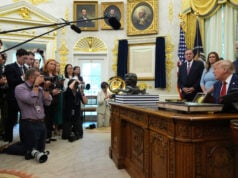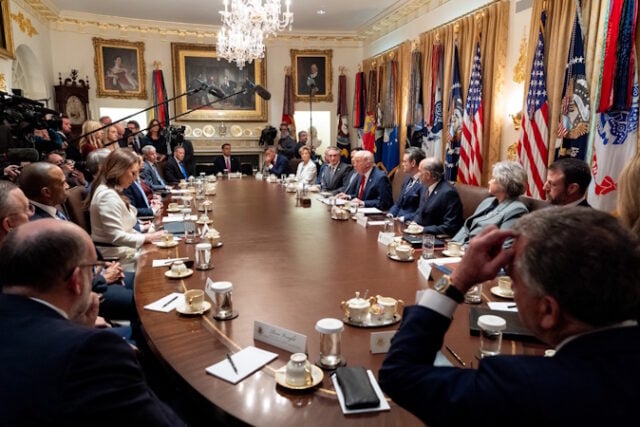
The White House has convened the full Cabinet, bringing together top officials for a comprehensive strategic session focused on international diplomacy and domestic policy initiatives. While initial planning centered around the historic presidential retreat at Camp David in the Maryland mountains, logistical dynamics shifted ahead of Wednesday’s meeting due to regional weather forecasts, prompting the administration to coordinate the pivotal session directly at the White House.
The assembly marks a significant moment for the administration, gathering every Cabinet member—including outgoing Director of National Intelligence Tulsi Gabbard—to harmonize executive strategies as multiple defining policy fronts converge simultaneously.
The Strategic Agenda: Balancing Diplomacy and Domestic Priorities
The meeting serves as an administrative junction to align various branches of the federal government on key initiatives. Executive discussions have been structured to cover a diverse range of pressing priorities, spanning from foreign conflict resolution to internal fiscal management.
Key Areas of Deliberation
- Foreign Policy and Middle East Security: To evaluate next steps in high-stakes diplomatic channels, manage fragile ceasefires, and outline responses to regional flashpoints.
- Economic Development: To assess the administration’s recent milestones regarding small business growth, economic stabilization, and navigating global trade fluctuations.
- Domestic Fraud Initiatives: To review updates and metrics from the administration’s Task Force to Eliminate Fraud, streamlining federal oversight.
High-Stakes Diplomacy: The Focus on Iran
At the absolute forefront of the Cabinet’s agenda is the tense, evolving situation regarding international negotiations with Tehran. Strategic talks have entered a decisive phase, requiring intensive deliberation among national security, defense, and intelligence heads.

   [ Fragile Regional Ceasefire ]
                 │
                 ▼
    [ U.S. Defensive Strikes ] ──► [ Camp David Planning / White House Session ]
                 ▲
                 │
   [ Demands for Sanctions Relief ]
The administration has been weighing complex options aimed at securing a broader, long-term agreement with Iran. Negotiators have reportedly been locked in discussions concerning highly sensitive geopolitical leverage points, including:
- The formal reopening and guaranteed security of commercial transit through the strategic Strait of Hormuz.
- The calibration of potential economic sanctions relief for Iran in exchange for verifiable diplomatic concessions.
- The framework for future bilateral or multilateral negotiations tied strictly to Iran’s nuclear capabilities.
While President Trump recently expressed optimism about the discussions, suggesting the parties involved could be nearing a notable breakthrough, the path forward remains highly contested. Iranian officials have publicly pushed back against the notion that a comprehensive agreement is imminent, highlighting persistent divisions over key terms.
Volatile Frontlines and Deterrence
The diplomatic push is occurring against a backdrop of active military friction. Just hours before the scheduled executive assembly, United States Central Command (CENTCOM) confirmed that American forces conducted localized “self-defense strikes” in southern Iran near the Strait of Hormuz.
“U.S. forces conducted self-defence strikes in southern Iran today to protect our troops from threats posed by Iranian forces,” stated CENTCOM spokesman Timothy Hawkins, noting that the military continues to exercise restraint while protecting assets during an ongoing, yet highly fragile, ceasefire.
According to military logs, the targeted operations focused on neutralization:
- Naval Threats: Limited strikes against Iranian vessels allegedly preparing to deploy maritime mines along critical commercial shipping lanes.
- Defensive Counters: Engagement of specific missile launcher positions located near Bandar Abbas to safeguard U.S. naval and aircraft operations in the region.
The defensive maneuvers have triggered sharp rhetoric from Iran’s Islamic Revolutionary Guard Corps, illustrating the precarious balance the Cabinet must strike between hard military deterrence and delicate diplomatic dialogue.
Intelligence and Domestic Nuances
The inclusion of outgoing Director of National Intelligence Tulsi Gabbard, whose tenure concludes at the end of June, underscores the gravity of the intelligence briefings under review. Gabbard has faced intense legislative scrutiny regarding the assessment of imminent threats and the economic fallout of potential shipping disruptions in the Middle East. During recent congressional testimonies, she emphasized the clear separation between raw intelligence gathering and executive policy decisions, leaving the ultimate strategic choices to the chief executive.
Simultaneously, the administration is keeping a sharp eye on domestic sentiment. With midterm elections on the horizon, Cabinet members are under pressure to clearly demonstrate how international stability directly affects local economic health, particularly energy prices, global supply chain integrity, and inflation.
Historical Venues and Political Context
The initial selection of Camp David carries profound historical weight. The secluded mountain retreat has traditionally been utilized by American presidents for the most sensitive national security negotiations and monumental diplomatic breakthroughs, such as the 1978 Camp David Accords.
Throughout his second term, President Trump has viewed the venue as a space for high-level strategy sessions. In June 2025, the location hosted senior officials for critical Middle East policy formulation, occurring just weeks before authorized operations targeting Iranian nuclear facilities. Shifting the physical meeting location to the White House due to impending thunderstorms alters the backdrop, but administration officials emphasize that the gravity and scope of the policy discussions remain entirely unchanged.
As the Cabinet convenes, the administration faces the delicate challenge of reconciling an “America First” domestic focus with complex, unavoidable entanglements abroad, rendering this unified executive session a defining moment for the country’s immediate political trajectory.
Sources Used and Links:
- WFIN / Fox Political News: Trump convenes rare Camp David Cabinet meeting as Iran deal pressure grows
- ANI News: Trump to convene rare Cabinet meeting at Camp David as US strikes trigger fresh Iran friction
- Livemint: Trump convenes rare Camp David cabinet meeting as Iran talks reach critical stage
- CBS News: Trump moves Cabinet meeting from Camp David to White House due to weather
- The Times of Israel: Trump to hold rare cabinet meeting at Camp David tomorrow to discuss Iran
- Iran International: Trump to hold Camp David cabinet meeting as Iran talks near crunch point – NY Post
Disclaimer
Artificial Intelligence Disclosure & Legal Disclaimer
AI Content Policy.
To provide our readers with timely and comprehensive coverage, South Florida Reporter uses artificial intelligence (AI) to assist in producing certain articles and visual content.
Articles: AI may be used to assist in research, structural drafting, or data analysis. All AI-assisted text is reviewed and edited by our team to ensure accuracy and adherence to our editorial standards.
Images: Any imagery generated or significantly altered by AI is clearly marked with a disclaimer or watermark to distinguish it from traditional photography or editorial illustrations.
General Disclaimer
The information contained in South Florida Reporter is for general information purposes only.
South Florida Reporter assumes no responsibility for errors or omissions in the contents of the Service. In no event shall South Florida Reporter be liable for any special, direct, indirect, consequential, or incidental damages or any damages whatsoever, whether in an action of contract, negligence or other tort, arising out of or in connection with the use of the Service or the contents of the Service.
The Company reserves the right to make additions, deletions, or modifications to the contents of the Service at any time without prior notice. The Company does not warrant that the Service is free of viruses or other harmful components.