WASHINGTON — In a rapid escalation that highlights the fragility of the current regional security environment, the United States military launched a fresh round of “self-defense” air strikes against an Iranian military facility late Wednesday. The targeted action followed the successful interception and downing of multiple Iranian attack drones by American forces operating in the region.
The military intervention occurred only hours after a critical, high-profile White House Cabinet meeting, where senior administration officials intensely debated the ongoing hostilities with Tehran alongside growing domestic anxieties regarding the rising cost of living and fuel prices.
Mid-Ceasefire Clashes Rip Through the Persian Gulf
According to official briefings provided by the Pentagon and U.S. Central Command (CENTCOM), the latest American operations were purely defensive in nature. They were designed to neutralize immediate, localized threats to U.S. personnel deployed across the volatile theater.

Military officials confirmed that Navy vessels and defensive anti-air systems detected and neutralized an incoming formation of Iranian attack drones. Almost immediately after the drone threat was mitigated, the U.S. military executed precision strikes on an Iranian military facility tied to the drone deployment.
This latest development marks another severe breach of the highly fragile, nominal ceasefire that officially went into effect on April 12. While designed to establish a cooling-off period for diplomatic backchannels, the ceasefire has been repeatedly tested by intense kinetic encounters in and around the strategic transit corridors of the Middle East.
Earlier this week, U.S. Central Command spokespersons reported carrying out similar self-defense strikes in southern Iran. Those operations targeted active missile launch sites and specialized Iranian small craft that were actively observed laying maritime mines across critical shipping lanes.
Recent Escalation Timeline (May 2026):
+-------------+------------------------------------------------------------+
| Date        | Operational Event                                          |
+-------------+------------------------------------------------------------+
| May 4       | U.S. forces destroy six IRGC small boats in Hormuz Strait.  |
| May 7       | U.S. strikes Iranian drone/missile hubs after destroyer    |
|             | harassment.                                                |
| May 8       | Navy F/A-18 jets strike smokestacks of two unladen tankers |
|             | violating the blockade.                                    |
| May 25      | CENTCOM strikes southern Iran missile sites and minelayers.|
| May 27      | U.S. downs attack drones; strikes Iranian base facility.   |
+-------------+------------------------------------------------------------+
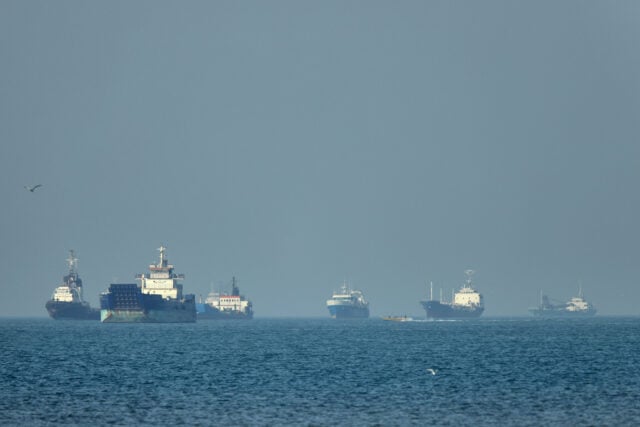
The Navy has maintained a rigorous blockade to prevent unauthorized vessels from entering or exiting primary Iranian ports. Navy Capt. Tim Hawkins, speaking for U.S. Central Command, emphasized that while the military is exercising operational restraint to preserve the potential for a diplomatic resolution, it will not hesitate to protect American lives.
“U.S. Central Command continues to defend our forces while using restraint during the ongoing ceasefire,” Hawkins noted in a formal brief earlier this week, an ethos that Pentagon officials indicated guided Wednesday’s late-night retaliatory strikes.
The View from the Cabinet: “Negotiating on Fumes”
The military action stands in sharp contrast to the highly confident diplomatic rhetoric emanating from the White House earlier in the day. During a comprehensive Cabinet meeting on Wednesday morning, President Donald Trump asserted to reporters and cabinet members that despite the ongoing skirmishes, a comprehensive peace deal to wind down the three-month-old war was rapidly approaching.
Trump told attendees that Iran is currently “negotiating on fumes” and remains desperate to secure a formal settlement that would lift the economically crippling maritime blockade. Over the preceding weekend, the President went as far as declaring on social media that Washington and Tehran had “largely negotiated” the foundational text of a settlement, though senior diplomatic aides subsequently cautioned that specific parameters remain in severe flux.
The administration’s primary objectives for a settlement are explicit:
- Secure the complete and verified reopening of the Strait of Hormuz to international commercial shipping.
- Enforce a significant, verifiable reduction in Iran’s domestic nuclear processing capabilities.
- Establish a 60-day extension of the current ceasefire to iron out long-term security frameworks.
Trump has publicly detailed his preferred mechanisms for dealing with Iran’s nuclear infrastructure, indicating that enriched uranium must either be physically transferred to the United States for destruction or destroyed in place under strict supervision by international regulatory bodies.
Furthermore, the White House has introduced a complex diplomatic prerequisite, suggesting that any final peace arrangement should mandate that secondary regional powers—including Saudi Arabia and Pakistan—simultaneously sign onto the Abraham Accords to normalize relations with Israel. This ambitious diplomatic framework has drawn skepticism from regional analysts, given Saudi Arabia’s long-standing insistence on a clear, viable pathway toward Palestinian statehood before establishing formal ties with Jerusalem.
Economic Ripples and Domestic Anxieties
While the White House remains focused on projecting a posture of “peace through strength” abroad, the Cabinet meeting spent considerable time addressing the deep political liabilities forming at home. The conflict has exerted immense pressure on global energy markets, driving the U.S. domestic national average for a gallon of gasoline toward the $4 mark—a steep $1 increase since the opening salvos of the war.
The compounding fuel costs have amplified broader inflationary pressures across the American economy, a trend that is severely darkening the electorate’s mood as critical midterm elections approach this November to determine control of Congress. Republican lawmakers have reportedly expressed deep anxiety that prolonged economic disruptions from the conflict could trigger severe voter blowback at the polls.
During the televised portions of the executive meetings, administration officials sought to downplay the systemic impacts of the war on the domestic cost of living, arguing that the U.S. economy remains highly resilient against global oil shocks. However, financial markets have reacted with visible unease to each subsequent military engagement in the Gulf. The price of Brent crude experienced sharp upward ticks following Wednesday’s drone interceptions, proving that energy traders remain highly skeptical of an imminent breakthrough.
The emerging peace deal has also exposed the White House to intense domestic criticism from political hardliners and defense hawks within the President’s own party. Critics argue that winding down the war under the currently proposed terms would allow Iran’s leadership to emerge from the three-month conflict battered but structurally intact, potentially emboldening Tehran over the long term.
As the Pentagon processes the intelligence data from Wednesday’s defensive strikes, the dual realities of volatile military engagements and severe domestic economic pressures continue to complicate the administration’s path toward an exit strategy.
Sources and Links:
- The Associated Press (AP) via WCNC News and News4JAX / [Las Vegas Sun](https://lasvegassun.com/news/2026/may/27/us-says-it-carried-out-defensive-strikes on-iran-m/)
- PBS NewsHour via PBS World News
- Navy Times via Navy Times Maritime Security News
- CBC News via CBC World News Coverage
Disclaimer
Artificial Intelligence Disclosure & Legal Disclaimer
AI Content Policy.
To provide our readers with timely and comprehensive coverage, South Florida Reporter uses artificial intelligence (AI) to assist in producing certain articles and visual content.
Articles: AI may be used to assist in research, structural drafting, or data analysis. All AI-assisted text is reviewed and edited by our team to ensure accuracy and adherence to our editorial standards.
Images: Any imagery generated or significantly altered by AI is clearly marked with a disclaimer or watermark to distinguish it from traditional photography or editorial illustrations.
General Disclaimer
The information contained in South Florida Reporter is for general information purposes only.
South Florida Reporter assumes no responsibility for errors or omissions in the contents of the Service. In no event shall South Florida Reporter be liable for any special, direct, indirect, consequential, or incidental damages or any damages whatsoever, whether in an action of contract, negligence or other tort, arising out of or in connection with the use of the Service or the contents of the Service.
The Company reserves the right to make additions, deletions, or modifications to the contents of the Service at any time without prior notice. The Company does not warrant that the Service is free of viruses or other harmful components.