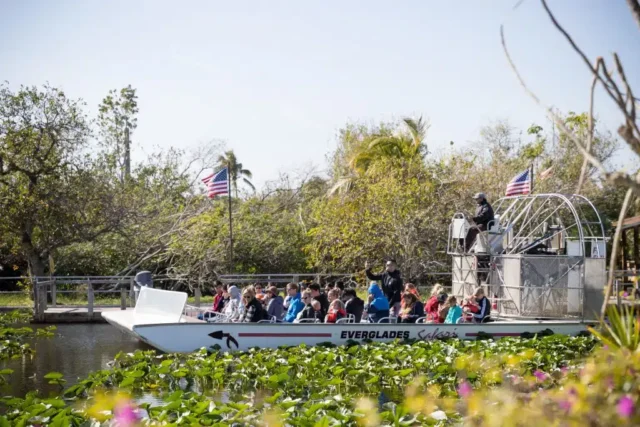
The Everglades isn’t just one landscape—it’s a mix of distinct ecosystems, each with its own look, wildlife, and purpose. The three most important are hammocks, mangroves, and sawgrass marshes.
Understanding the differences makes exploring the Everglades more meaningful and helps visitors recognize what they’re seeing.
HARDWOOD HAMMOCKS (TREE ISLANDS)

Some are just small patches of high ground
and others are in vast swamps.
What it is:
A slightly elevated island of dense hardwood trees surrounded by wetlands.

Key characteristics:
- Higher ground with drier conditions
- Thick, jungle-like canopy
- Protected from frequent flooding
Common plants:
- Mahogany
- Gumbo limbo
- Live oak
-

As the season becomes drier, alligators congregate in
smaller holes in the Everglades.Orchids and air plants
Wildlife:
- Raccoons
- Tree snails
- Birds and reptiles
MANGROVE FORESTS (COASTAL WETLANDS)

in the Everglades.
What it is:
Salt-tolerant trees growing in brackish or saltwater along the coast.
Key characteristics:
- Found where freshwater meets the ocean
- Tangled root systems
- Influenced by tides
Main types:
- Red mangrove
- Black mangrove
- White mangrove

Wildlife:
- Fish (snapper, tarpon)
- Crabs
- Birds
- Manatees nearby
Why they matter:
- Protect shorelines
- Reduce storm damage
- Support marine life
SAWGRASS MARSHES (THE “RIVER OF GRASS”)

for miles – it does!
What it is:
A vast freshwater marsh dominated by sawgrass.
Key characteristics:
- Slow-moving water
- Flat, open landscape
- Seasonal flooding
Common features:
- Sawgrass
- Sloughs
-

Birds love sawgrass marshes when looking for their next meal! Marl prairies
Wildlife:
- Alligators
- Wading birds
- Turtles
QUICK COMPARISON
Hammocks: Dry, forested islands
Mangroves: Coastal, saltwater trees
Sawgrass Marshes: Open freshwater wetlands
Disclaimer
Artificial Intelligence Disclosure & Legal Disclaimer
AI Content Policy.
To provide our readers with timely and comprehensive coverage, South Florida Reporter uses artificial intelligence (AI) to assist in producing certain articles and visual content.
Articles: AI may be used to assist in research, structural drafting, or data analysis. All AI-assisted text is reviewed and edited by our team to ensure accuracy and adherence to our editorial standards.
Images: Any imagery generated or significantly altered by AI is clearly marked with a disclaimer or watermark to distinguish it from traditional photography or editorial illustrations.
General Disclaimer
The information contained in South Florida Reporter is for general information purposes only.
South Florida Reporter assumes no responsibility for errors or omissions in the contents of the Service. In no event shall South Florida Reporter be liable for any special, direct, indirect, consequential, or incidental damages or any damages whatsoever, whether in an action of contract, negligence or other tort, arising out of or in connection with the use of the Service or the contents of the Service.
The Company reserves the right to make additions, deletions, or modifications to the contents of the Service at any time without prior notice. The Company does not warrant that the Service is free of viruses or other harmful components.