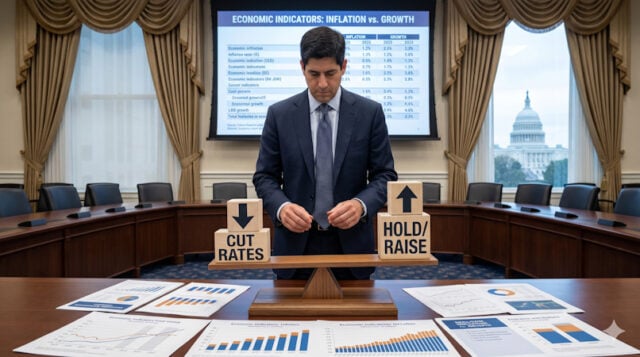
The passing of the monetary baton in Washington has rarely occurred under such an ominous sky. On May 13, 2026, the United States Senate narrowly confirmed Kevin Warsh as the 17th Chair of the Federal Reserve in a 54–45 vote—the most partisan and divisive confirmation in the history of the modern central bank. Taking office immediately following the expiration of Jerome Powell’s term on May 15, Warsh assumes control of a deeply fractured Federal Open Market Committee (FOMC).
His baptism by fire is scheduled for June 16–17, 2026, when he will preside over his first interest rate-setting meeting. He does so under intense executive scrutiny. President Donald Trump, who nominated the 56-year-old former Wall Street banker and academic, has maintained a relentless public campaign for aggressive interest rate cuts to stimulate economic growth. Warsh himself has historically echoed some of these sentiments, advocating for structural “regime change” at the central bank, a leaner Fed balance sheet, and a re-evaluation of monetary restrictions.
Yet, as the June meeting approaches, the macroeconomic landscape has rendered the prospect of an interest rate cut nearly impossible. A devastating war involving Iran in West Asia has triggered a structural supply-side shock. Oil prices are spiraling, supply chains are fracturing, and domestic commodity costs—from energy to everyday staples like beef—are soaring. April’s Consumer Price Index (CPI) print surged to a three-year high of 3.8% year-on-year, moving sharply away from the Fed’s sacred 2.0% target.
With the target federal funds rate currently sitting at a restrictive range of 3.50% to 3.75%, Warsh is trapped between a rock and a hard place. He must balance the aggressive political mandates of the administration that appointed him against the undeniable, stubborn mathematical reality of an economy flashing red-hot inflationary signals.

The Geometry of a Supply Shock: War, Oil, and Beef
To understand why a rate cut in June is mathematically and economically unfeasible, one must examine the transmission mechanisms of the current geopolitical crisis. The escalation of war in the Middle East, specifically involving Iran, has disrupted critical maritime trade routes and energy infrastructure.
The Energy Crisis
Energy prices are the ultimate upstream economic variable; when oil climbs, the cost of extracting, manufacturing, and transporting every single good in the global economy climbs with it. The April CPI report, released by the Bureau of Labor Statistics, shocked Wall Street with a month-on-month consumer price acceleration of 0.6%, following a brutal 0.9% increase in March. This pushed the headline annual inflation rate up to 3.8%.
The primary engine of this acceleration is the energy sector. Crude oil futures have sustained a massive premium as insurance markets price in the destruction of refining capacity and shipping vulnerabilities in West Asia. This energy shock acts as an un-elected tax on American consumers, driving up pump prices and eroding discretionary income.
Agriculture and the Cost of Living
The inflationary spike is not confined to fuel tanks. Broad-based commodity inflation has penetrated the grocery aisle, with beef and agricultural products experiencing steep upward price pressure. Agriculture faces a compounding crisis:
- The soaring cost of petroleum-based fertilizers.
- Elevated diesel prices required for transcontinental supply chains.
- Broader climate-driven structural shifts in livestock yields.
When structural supply shocks drive up the costs of non-discretionary items like fuel and food, inflation expectations run the risk of becoming unanchored. According to the May University of Michigan consumer sentiment survey, American consumer confidence in major financial institutions—specifically the Federal Reserve—has plummeted. Citizens are watching their purchasing power evaporate in real time. If the Fed were to cut interest rates in this environment, it would inject liquidity into an economy already suffering from insufficient supply, effectively throwing gasoline onto an inflationary fire.
The Fractured FOMC: A Legacy of Dissent
Even if Warsh desired to fulfill the White House’s wishes and push through an immediate interest rate cut, the Federal Reserve’s institutional architecture makes unilateral action impossible. The Fed Chair is not a monetary dictator; policy is dictated by a majority vote of the 12-member Federal Open Market Committee. Warsh inherits a committee that is more ideologically fragmented than it has been in over three decades.
At the April 29, 2026 meeting—the final policy session presided over by Jerome Powell—the Fed held interest rates steady at 3.50% to 3.75%. However, the vote was a historically chaotic 8–4 decision.
- Governor Stephen Miran (whom Warsh replaced on the Board of Governors) broke ranks to vote for an immediate 25-basis-point rate cut.
- Three other hawkish members formally dissented from the statement’s language, objecting to any implication that the central bank would automatically resume rate cuts in the near term.
This level of public dissent on the FOMC has not been seen since October 1992. It signals deep systemic anxiety within the central bank’s ranks regarding the path of inflation.
Furthermore, Warsh faces an unprecedented institutional dynamic: Jerome Powell is not leaving the building. While Powell’s term as Chair has concluded, he announced his intention to remain on the Fed’s Board of Governors as a voting member. Powell’s decision to stay ensures that the institutional memory of the “higher-for-longer” monetary framework will maintain an active, heavyweight voice inside the policy room. Powell and his cohort of traditionalists will view any premature pivot toward rate cuts as an abdication of the Fed’s dual mandate to ensure price stability.
The “Regime Change” Dilemma
During his highly contentious confirmation hearings before the Senate Banking Committee, Warsh faced intense scrutiny from lawmakers. Senator Elizabeth Warren famously lambasted him as a potential “sock puppet” for the executive branch, arguing that his sudden alignment with Trump’s low-rate rhetoric threatened the foundational independence of the American financial system. Warsh forcefully pushed back against these assertions, pledging under oath to maintain strict political independence and stating a desire to “take politics out of monetary policy and monetary policy out of politics.”
Instead of simple political compliance, Warsh has framed his vision for the Fed around a sophisticated structural overhaul, which he terms a fundamental “regime change.” The core tenets of the Warsh doctrine include:
1. Balance Sheet Reduction
Warsh has long criticized the post-2008 expansion of the Federal Reserve’s balance sheet. He argues that the massive accumulation of government debt and mortgage-backed securities distort free-market price discovery and create artificial asset bubbles. By aggressively drawing down the Fed’s multi-trillion-dollar portfolio, Warsh believes the central bank can reduce its footprints in the financial markets.
2. The Balance Sheet-to-Rate Tradeoff
In Warsh’s economic framework, a smaller balance sheet reduces systemic excess liquidity. Crucially, he posits that a structurally leaner balance sheet reduces the need for an aggressively high benchmark interest rate. In theory, by shrinking the asset portfolio, the Fed could maintain a lower nominal policy rate without triggering inflation.
3. Alternative Metrics
Warsh has expressed dissatisfaction with traditional backward-looking inflation gauges, hinting at a preference for real-time market indicators and asset-price metrics to judge the true velocity of money.
While this academic framework offers a cohesive theory for long-term structural reform, it crashes hard against the immediate realities of May 2026. A structural reduction of the balance sheet takes months, if not years, to safely execute without triggering a liquidity crisis in repo markets. It cannot counteract an immediate, war-driven supply shock that is driving headline CPI toward 4.0%.
Market Realities: What Investors Are Pricing In
Wall Street and international financial markets have already run the numbers, and the consensus is overwhelming: a June rate cut is completely off the table.
According to data compiled by the CME FedWatch Tool, which calculates the mathematical probability of FOMC policy outcomes based on Fed Funds futures pricing, investors see a 97% probability that the Fed will maintain the status quo at the June 17 meeting. Less than 3% of market participants believe a rate cut is possible.
Institutional strategists across the globe have aligned with this cautious outlook. Analysts at J.P. Morgan and ICICI Bank have released comprehensive research papers indicating that the Federal Reserve will likely maintain a strict status quo, freezing interest rates at 3.50% to 3.75% for the remainder of the 2026 calendar year. The underlying logic of these forecasts is uniform: core CPI (which strips out volatile food and energy) is sitting stubbornly at 2.8% year-on-year, while month-on-month core inflation is running at 0.4%. With all core indicators printing well above comfort thresholds, any loosening of financial conditions would risk a structural wage-price spiral reminiscent of the late 1970s.
For global investors, this means the era of cheap capital is not returning anytime soon. Fixed-income yields are locked into elevated bands, corporate borrowing costs will remain high, and commercial banking systems must continue to underwrite loans under restrictive monetary parameters.
The June Meeting: Warsh’s Immediate Strategic Playbook
When Kevin Warsh takes the gavel on June 16, his primary task will not be adjusting interest rates, but managing expectations and building institutional credibility. Given the narrow margins of his Senate victory and the cloud of skepticism surrounding his independence, his first policy statement and subsequent press conference will be scrutinized down to the comma.
Rather than fighting a losing battle for an immediate rate cut that his committee would almost certainly vote down, monetary analysts expect Warsh to deploy a three-pronged communications strategy:
| Strategic Objective | Tactical Execution |
| Establish Independence | Emphasize the data-dependent nature of the FOMC, explicitly referencing the April 3.8% CPI print to signal that the Fed will not capitulate to short-term political pressures while inflation remains uncontained. |
| Introduce the Reform Narrative | Shift the macroeconomic dialogue away from interest rates and toward the balance sheet. Warsh is expected to use the June minutes to lay the groundwork for accelerated quantitative tightening (QT), framing it as his primary tool for cooling systemic overheating. |
| Build Committee Consensus | Work to heal the deep rifts exposed during the historic April meeting. By matching the hawkish tone required by the current inflation data, he can build vital goodwill with institutional stalwarts like Jerome Powell, establishing the trust necessary to pass future structural reforms when the economic cycle finally turns. |
Conclusion: The Impossible Cut
Can the Federal Reserve cut interest rates in June 2026? The definitive answer is no.
Monetary policy is highly potent, but it cannot synthesize oil, it cannot breed cattle, and it cannot broker peace in West Asia. The inflationary pressures currently hammering the American consumer are structural supply-side shocks, compounded by resilient domestic demand. To lower the benchmark interest rate in the face of an oil shock, climbing beef prices, and a 3.8% CPI would be a historic policy error that would destroy what remains of the Federal Reserve’s institutional credibility.
Kevin Warsh is an economist who favors structural evolution and a long-term reduction in the central bank’s market footprint. However, as he steps into the most powerful economic role on earth, his theoretical ambitions must bow to immediate reality. The mathematical laws of inflation are absolute. For the new Fed Chair, the path forward requires an uncomfortable embrace of continuity: keeping rates steady, managing a deeply divided committee, and waiting out a global storm before he can ever hope to deliver the regime change he promised.
Sources Used and Links:
- U.S. House Committee on Financial Services: Chairman Hill Welcomes Kevin Warsh as New Federal Reserve Chairman
- Democracy Now!: U.S. Senate Votes to Confirm Kevin Warsh as Federal Reserve Chair
- Al Jazeera: Kevin Warsh confirmed as new US Federal Reserve chair amid controversy
- CBS News: How much sway will new Fed Chair Kevin Warsh really have over interest rates?
- The Guardian: US Senate confirms Kevin Warsh as Federal Reserve chair, replacing Jerome Powell
- The Guardian: US inflation jumped to 3.8% in April as war with Iran continues to drive up prices
- Chase Learning & Insights / J.P. Morgan: Kevin Warsh Is the New Chair of the Federal Reserve: Here’s What That Could Mean for Markets and Investors in 2026
- St. Louis Fed (FRED): Federal Funds Effective Rate (FEDFUNDS)
- ANI / ICICI Bank Research: US Fed likely to keep interest rates unchanged through 2026 amid inflation risks: Report
- Trading Economics: United States Fed Funds Interest Rate
Disclaimer
Artificial Intelligence Disclosure & Legal Disclaimer
AI Content Policy.
To provide our readers with timely and comprehensive coverage, South Florida Reporter uses artificial intelligence (AI) to assist in producing certain articles and visual content.
Articles: AI may be used to assist in research, structural drafting, or data analysis. All AI-assisted text is reviewed and edited by our team to ensure accuracy and adherence to our editorial standards.
Images: Any imagery generated or significantly altered by AI is clearly marked with a disclaimer or watermark to distinguish it from traditional photography or editorial illustrations.
General Disclaimer
The information contained in South Florida Reporter is for general information purposes only.
South Florida Reporter assumes no responsibility for errors or omissions in the contents of the Service. In no event shall South Florida Reporter be liable for any special, direct, indirect, consequential, or incidental damages or any damages whatsoever, whether in an action of contract, negligence or other tort, arising out of or in connection with the use of the Service or the contents of the Service.
The Company reserves the right to make additions, deletions, or modifications to the contents of the Service at any time without prior notice. The Company does not warrant that the Service is free of viruses or other harmful components.