Introduction: The Capital Remade in Stone and Steel
Washington, D.C., has long been governed by an unwritten architectural consensus. For over a century, the physical layout of the nation’s capital has adhered strictly to the classical guidelines of the 1791 L’Enfant Plan and the 1902 McMillan Plan. These design frameworks emphasized horizontal symmetry, low-slung neoclassical white marble facades, wide-open green vistas, and tightly regulated public spaces meant to convey a sense of democratic permanence.
However, in mid-May 2026, that traditional consensus is being fundamentally rewritten. Through an aggressive flurry of executive orders, surprise Truth Social announcements, and targeted legislative maneuvers, President Donald Trump is advancing a sweeping master plan to physically reshape the monumental core of Washington.
From a sprawling 250-statue sculpture garden along the Potomac River waterfront to a controversial permanent helipad carved into the historic South Lawn of the White House, the administration is driving forward a series of landmark infrastructure developments. These proposals build upon a highly contested portfolio of existing capital overhauls, including the ongoing demolition and reconstruction of the White House East Wing into a massive State Ballroom, the structural transformation of public parklands, and a striking aesthetic makeover of the National Mall’s most iconic water features.
As cranes gather over the monumental core and pink survey flags dot federal parklands, Washington finds itself at the center of a fierce battle involving historic preservationists, federal planning agencies, local municipal groups, and the executive branch. To supporters, these projects represent a necessary, bold reclamation of American civic pride and architectural excellence timed for the nation’s upcoming Semiquincentennial (250th anniversary) celebrations. To detractors, they represent an unprecedented, haphazard encroachment upon historic public lands that bypasses statutory review and fundamentally disrupts the democratic aesthetic of the capital.

The National Garden of American Heroes: Reshaping West Potomac Park
On Friday, May 15, 2026, President Trump officially reignited one of his most ambitious ideological and architectural initiatives from his first term: the creation of a massive, monument-scale outdoor pantheon. In an early morning social media statement, the President announced that the administration had formally selected a prime waterfront site within West Potomac Park to serve as the permanent home for the National Garden of American Heroes.
“I am proud to announce the site of the NATIONAL GARDEN OF AMERICAN HEROES. This magnificent exhibition of statues will be located in West Potomac Park, which we are transforming into one of the World’s most beautiful public spaces. Right now, it is a totally BARREN field of Prime Waterfront Real Estate along our Mighty Potomac River. When finished, West Potomac Park will be a World Class Masterpiece with elegant Landscaping, and adorned with Beautiful Statues, and be yet another one of my great projects to make Washington, D.C., the Safest and Most Beautiful Capital in the World.” — President Donald J. Trump, Truth Social
Origins and Conceptual Framework
The concept of the National Garden was first introduced by Trump in July 2020 during a speech at Mount Rushmore. Framed as a direct cultural counter-response to nationwide civil rights protests that saw the controversial removal of various historical monuments, the project languished during the Biden administration. However, following Trump’s re-election, the proposal was revived with significant structural momentum.
The updated 2026 plan calls for an expansive outdoor layout featuring life-size bronze and stone statues of roughly 250 historical American figures who made significant cultural, political, scientific, or military contributions. The expansive roster of figures slated for commemoration includes a highly diverse, cross-generational array of individuals drawn from early executive orders, such as:
- Founding Fathers & Political Leaders: George Washington, John Adams, Abraham Lincoln, and Ronald Reagan.
- Civil Rights Pioneers: The Rev. Martin Luther King Jr., Harriet Tubman, and Jackie Robinson.
- Scientists & Innovators: Albert Einstein, Nikola Tesla, and Amelia Earhart.
- Cultural Figures & Athletes: Walt Disney, Elvis Presley, and Kobe Bryant.
Geographic and Civic Conflict
The chosen location—West Potomac Park—is one of the most tightly regulated and historically sensitive corridors of federal land in the United States. Situated directly adjacent to the Tidal Basin, the site sits in close proximity to the Thomas Jefferson Memorial, the Franklin Delano Roosevelt Memorial, and the Martin Luther King Jr. Memorial.
The administration’s characterization of this area as a “barren field” has provoked sharp resistance from local Washingtonians and civic organizations. For decades, West Potomac Park has served as a critical recreational hub for District residents, hosting prominent adult sports leagues, multi-use running and biking trails, and public volleyball courts. Opponents argue that installing a massive, high-density sculpture garden will effectively eliminate vital recreational green spaces utilized by thousands of residents.
Furthermore, preservation groups like the National Mall Coalition have raised alarm over what they view as a fundamental misunderstanding of Washington’s urban layout. Judy Feldman, an art historian who chairs the coalition, publicly criticized the announcement, stating that the administration continues to view the historic National Mall purely as “empty real estate to be filled.” Feldman suggested that if the government wished to honor these figures, a more harmonious approach would involve distributing statues throughout the existing promenade between the Smithsonian museums, rather than constructing a closed, standalone monument complex that dominates the waterfront.
Funding and Governance Hurdles
The financial mechanics behind the sculpture garden remain complex and fluid. While Congress previously set aside approximately $40 million in federal funding for statue procurement under the sweeping tax and spending legislation passed last year, experts agree that the full landscape architecture, security infrastructure, and maintenance costs will far exceed that figure.
To bridge the gap, a newly incorporated private entity called the National Garden of American Heroes Foundation has begun aggressively circulating fundraising materials to prospective private donors. Spearheaded by veteran Trump fundraiser Meredith O’Rourke, the foundation is attempting to secure hundreds of millions of dollars in corporate pledges.
However, funding is only one component of the challenge. Under federal law, major commemorative works in Washington’s monumental core are legally required to undergo rigorous multi-stage review processes overseen by the National Capital Planning Commission (NCPC) and the U.S. Commission of Fine Arts (CFA). By declaring the site settled via executive decree, the administration is setting up an impending, high-stakes legal showdown over whether the White House can bypass these long-established statutory approval bodies.
The South Lawn Helipad: Trading Historic Pastoralism for Utility
As the administration seeks to push outward into public parklands along the Potomac, it is simultaneously advancing plans to make permanent structural modifications to the immediate grounds of the executive mansion itself. On May 17, 2026, reports surfaced via the Wall Street Journal and the Washington Post confirming that President Trump is actively moving forward with plans to construct a permanent, hard-engineered helipad on the White House South Lawn.
The Technical Problem: Scorched Earth
Unlike some of the administration’s more overtly ideological building initiatives, the helipad project is rooted in a stubborn, multi-billion-dollar military aviation flaw. For nearly two decades, the federal government has been working to fully transition the presidential helicopter fleet to the new VH-92A Patriot, manufactured by Sikorsky Aircraft (a subsidiary of defense contractor Lockheed Martin). The Marine Helicopter Squadron One (HMX-1) officially accepted the final aircraft of its 23-helicopter, $4.95 billion fleet nearly two years ago.
However, the VH-92A Patriot possesses a severe operational constraint when interacting with the White House grounds: its powerful propulsion systems utilize downward-directed exhaust vents that release extreme heat. When the aircraft attempts to land directly on the grass of the South Lawn, the intense thermal output severely burns and scorches the historic turf, leaving unsightly dead patches and compromising the integrity of the soil. Because of this issue, the military has historically been limited in its ability to deploy the VH-92A full-time at the executive mansion, frequently relying instead on older, legacy aircraft like the VH-3D Sea King, which is slated to remain in service through 2026.
The Proposed Solution and Aesthetic Pushback
To resolve this issue, Trump—a long-time aviation enthusiast and helicopter owner whose corporate branding has long relied on executive aircraft—is planning to install a permanent, structurally reinforced landing pad on the South Lawn, potentially as early as the summer of 2026.
The idea has exposed deep internal divisions regarding White House preservation. For decades, the image of Marine One gracefully touch down directly onto the soft, rolling green grass of the South Lawn has served as an iconic symbol of the American presidency. This tradition, which dates back to the administration of Dwight D. Eisenhower in 1957, was intentionally designed to present the White House not as an impenetrable, heavily fortified military bunker, but as a stately, pastoral home rooted in civilian life.
Installing a permanent concrete or asphalt pad directly on that historic expanse is viewed by preservationists as an unacceptable degradation of the grounds. Ray L’Heureux, a retired Marine Corps colonel who previously oversaw Marine One missions as the commander of HMX-1, spoke out strongly against the initiative:
“I understand the conversation coming up again. It always comes up. But it would be stupid from an aesthetic standpoint to install a helipad on the South Lawn because it is historic and the back yard of the White House. I do think that nothing there is broken—so don’t mess with it.” — Col. Ray L’Heureux (Ret.), The Washington Post
L’Heureux and other former officials argue that alternative technical mitigations exist, such as utilizing temporary, heavy-duty rolling mat systems deployed only during active flight operations. However, the administration appears poised to opt for cold practicality over historic preservation, moving forward with an engineered hardstand that critics argue replaces a classic “storybook fantasy” with corporate utility.
The White House State Ballroom: A Capital Project Cloaked in Litigation
The planned helipad represents only the latest intervention on the immediate White House grounds. It follows the administration’s most disruptive and high-profile domestic construction project to date: the complete demolition of the historic East Wing to make way for a sprawling, multi-million-dollar State Ballroom.
The Scope of the Project
First formally announced in July 2025, the project entails constructing a massive, 90,000-square-foot subterranean and semi-subterranean entertainment complex positioned directly adjacent to the main White House residence. The primary justification put forward by the administration is operational capacity; the historic East Room can safely accommodate only about 200 dinner guests, forcing the government to erect temporary, expensive outdoor tents on the lawn whenever hosting large-scale state dinners or international summits.
The new multi-level ballroom is designed to comfortably host up to 650 seated guests—effectively tripling the executive branch’s internal entertainment capacity. However, clearing the physical footprint for this structure required the total dismantling of the East Wing structure in October 2025, a move that simultaneously resulted in the complete removal of the historic Jacqueline Kennedy Garden.
The $1 Billion Funding Battle
The financial trajectory of the ballroom has become a major source of bipartisan contention in Congress. When the project was initial launched, President Trump insisted that the structure would cost roughly $200 million and would be funded exclusively via private donations from corporate leaders, requiring “not one dime” of taxpayer money. By early 2026, however, Trump revised his internal cost estimates upward, publicly citing “something less than $400 million.”
A partial donor list obtained by congressional investigators revealed that major technology giants and defense contractors—including Amazon, Google, Meta, and Microsoft—had pledged massive financial contributions to the ballroom’s construction foundation. This sparked intense ethical concerns among watchdog groups, who warned that private corporations were effectively funding capital improvements on the President’s personal residence, creating unprecedented avenues for political influence.
The political fight escalated significantly in May 2026 as Senate Republicans introduced an aggressive legislative push to secure a $1 billion federal appropriation dedicated to the ballroom. While the administration maintains that the core structural building costs remain privately covered, they argue that the massive scale of the excavation requires an extraordinary, unbudgeted expenditure for advanced Secret Service security infrastructure, anti-tunneling countermeasures, and blast-resistant subterranean reinforcement. House and Senate Democrats have fiercely vowed to block the multi-billion-dollar line item, labeling it an egregious bait-and-switch on American taxpayers.
The Judicial Halt
The aggressive construction timeline hit a major roadblock on March 31, 2026, when a federal judge issued a temporary injunction ordering an immediate halt to all preliminary excavation and structural work on the East Wing site. The court ruled in favor of preservationist groups, finding that the executive branch had failed to secure the explicit statutory authorizations and appropriations from Congress required to alter the National Historic Landmark’s structural footprint.
Despite the ongoing legal injunction and intense congressional gridlock, President Trump used his May 15, 2026, social media posts to project absolute confidence. Defying the court’s current restrictions, Trump announced that the administration has locked in a firm, official completion and grand opening date for the State Ballroom in September 2028. The Department of Justice is currently fast-tracking an appeal of the injunction, arguing that the President has inherent constitutional authority to manage and modernize the executive mansion.
From Triumphal Arches to Blue Pools: The Broader Capital Makeover
The ballroom, the sculpture garden, and the South Lawn helipad form the core of Trump’s building program, but they are flanked by several other highly visible, concurrent engineering projects designed to alter the visual character of Washington’s central axis.
| Project Name | Location | Primary Objective | Current Status (May 2026) |
| National Garden of American Heroes | West Potomac Park | Install 250 life-size statues of historical figures along the waterfront. | Site selected; private foundation fundraising underway. |
| White House State Ballroom | Former East Wing Site | Construct a 90,000-sq-ft subterranean entertainment venue for 650 guests. | Under judicial injunction; target completion set for Sept. 2028. |
| South Lawn Helipad | White House South Lawn | Install a permanent hardstand to handle VH-92A Patriot thermal exhaust. | Internal planning underway; construction targeted for summer 2026. |
| The Triumphal Arch | Memorial Circle (D.C./VA) | Erect a 250-foot monument celebrating America’s 250th birthday. | Preliminary site surveys and soil testing started; site fenced off. |
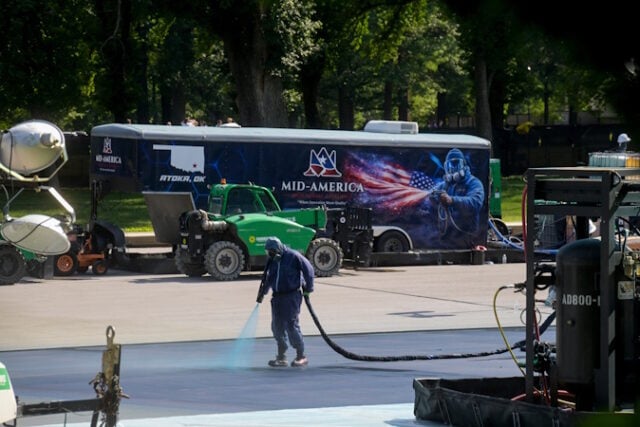
| Reflecting Pool Renovation | Lincoln Memorial | Repair structural leaks and apply a bright blue protective inner lining. | Active construction; coating currently being applied by crews. |
| East Potomac Golf Links | East Potomac Park | Reconstruct a historic public golf course into an elite championship venue. | Design blueprints released by Interior Department. |
The 250-Foot Triumphal Arch
In April 2026, White House Press Secretary Karoline Leavitt shocked the architectural community by announcing plans for a massive Triumphal Arch to be positioned at Memorial Circle, a highly visible transit nexus situated directly between the Lincoln Memorial and the entrance to Arlington National Cemetery.
The proposed structure is slated to stand a staggering 250 feet tall—a height that explicitly violates the strict restrictions of the Height of Buildings Act of 1910, which has historically capped building heights across the District to ensure the U.S. Capitol and the Washington Monument remain the dominant features of the skyline. The administration argues that because the arch sits on federal land managed by the National Park Service, it can be exempted from traditional municipal height limits.
By mid-May 2026, workers had already erected security fencing around portions of Memorial Circle. Construction crews have begun preliminary site surveys and core soil testing, leaving bright pink survey flags planted across the grass to outline the massive footprint of the arch. While the concept has received initial conceptual backing from select federal agency heads, it faces an impending wall of litigation from regional transportation planners and preservation groups who warn it will permanently disrupt the solemn visual corridor connecting the Lincoln Memorial to Arlington.
The Electric-Blue Reflecting Pool
Concurrently, the administration has enacted a sudden cosmetic transformation upon the nation’s most famous water feature: the Lincoln Memorial Reflecting Pool. Citing a critical need to address long-standing structural leaks and cracks within the pool’s concrete basin ahead of the July 4th Semiquincentennial, the White House initiated a rapid-fire renovation project.
However, rather than restoring the pool to its traditional, muted dark-gray stone aesthetic—which was historically designed to mirror the sky and the surrounding trees in a somber, glass-like reflection—Trump ordered workers to apply a flashy, vibrant blue protective coating and liner to the entire pool floor.
Visiting the active construction site on May 7, 2026, alongside Homeland Security officials, Trump defended the vivid aesthetic shift as a necessary modernization that would cost under $2 million. “It’s so important for our country,” Trump remarked, noting that the bright blue hue would make the water significantly more visually striking for global television broadcasts during the upcoming independence celebration fireworks display, which planners boast could shatter world records by eclipsing 800,000 individual shells.
Privatizing the East Potomac Golf Course
Further down the riverbank, the administration is moving to systematically dismantle the egalitarian nature of the city’s public athletic spaces. On May 14, 2026, Interior Secretary Doug Burgum officially unveiled comprehensive design blueprints to transform the East Potomac Golf Course from an accessible, historic municipal public course into an elite, “U.S. Open-caliber” championship venue.
While the Interior Department promises the redesigned course will bring world-class professional sporting events directly to the heart of the nation’s capital, the published blueprints offer almost no details on how the park’s heavily trafficked public running paths, biking trails, and affordable driving ranges will remain open to the general public. Local advocates view the move as part of a broader, systemic effort by the administration to replace accessible civic infrastructure with exclusive, high-security monumental installations.
Conclusion: A Capital Divided by Legacy
As Washington, D.C., moves deeper into 2026, the physical reality of the city is becoming a direct reflection of its polarized political landscape. President Trump’s aggressive infrastructure and architectural push represents an intentional effort to leave behind a permanent, tangible legacy stamped indelibly into the stone and soil of the federal city.
By driving multiple massive projects forward simultaneously—the West Potomac Park sculpture garden, the White House ballroom, the South Lawn helipad, the Triumphal Arch, and the newly vibrant blue Reflecting Pool—the administration is systematically challenging the decades-old statutory frameworks that have long protected the capital’s historic core from rapid executive modification.
Whether these dramatic interventions will ultimately be completed according to the President’s defiant timelines depends entirely on the outcome of a complex network of federal lawsuits, injunction appeals, and high-stakes funding battles currently playing out across the street from the very lawns, parks, and rivers the administration seeks to transform. For now, the capital remains a city under construction, caught in a profound philosophical debate over who truly owns the aesthetic identity of America’s monumental core.
Sources and Links Used
- Newsweek: Trump Sets Completion Date for Ballroom, Location for ‘Heroes’ Garden
- PBS NewsHour: Trump says sculpture garden honoring prominent Americans is planned for park along Potomac River
- The Spokesman-Review: Trump announces planned D.C. site for massive sculpture garden
- 930 WFMD / Fox News: Trump announces major new landmark project in DC’s West Potomac Park honoring America’s greatest heroes
- AP News: Trump says Potomac sculpture garden will honor 250 American heroes
- The Washington Post: Trump plans to build helipad at White House
- Investing.com: Trump plans to build helipad for White House South Lawn- WSJ
Disclaimer
Artificial Intelligence Disclosure & Legal Disclaimer
AI Content Policy.
To provide our readers with timely and comprehensive coverage, South Florida Reporter uses artificial intelligence (AI) to assist in producing certain articles and visual content.
Articles: AI may be used to assist in research, structural drafting, or data analysis. All AI-assisted text is reviewed and edited by our team to ensure accuracy and adherence to our editorial standards.
Images: Any imagery generated or significantly altered by AI is clearly marked with a disclaimer or watermark to distinguish it from traditional photography or editorial illustrations.
General Disclaimer
The information contained in South Florida Reporter is for general information purposes only.
South Florida Reporter assumes no responsibility for errors or omissions in the contents of the Service. In no event shall South Florida Reporter be liable for any special, direct, indirect, consequential, or incidental damages or any damages whatsoever, whether in an action of contract, negligence or other tort, arising out of or in connection with the use of the Service or the contents of the Service.
The Company reserves the right to make additions, deletions, or modifications to the contents of the Service at any time without prior notice. The Company does not warrant that the Service is free of viruses or other harmful components.