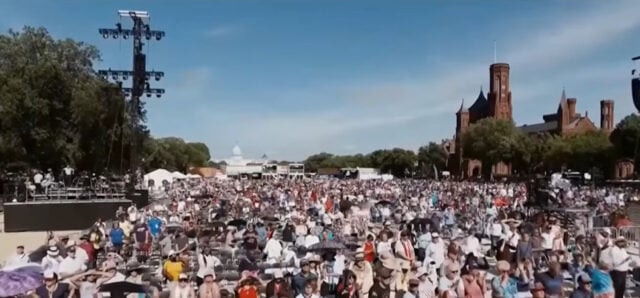
Under a sweltering late-spring sun on May 17, 2026, the National Mall in Washington, D.C., was transformed into a massive open-air sanctuary characterized by a potent convergence of religious fervor and hyper-partisan politics. Thousands of conservative Christians and loyal supporters of President Donald Trump gathered for a daylong prayer rally billed as “Rededicate 250: National Jubilee of Prayer, Praise & Thanksgiving.” The explicitly stated purpose of the gathering was a spiritual and civic rededication of the republic as “One Nation under God,” timed to coincide with the ongoing national celebrations marking the 250th anniversary of American independence.
However, beneath the banners of praise and the sounds of contemporary worship music lay a deeply controversial message. For the organizers, speakers, and thousands of attendees packed between the Capitol and the Washington Monument, the event was a public mandate to portray and reclaim the United States explicitly as a Christian nation. As high-ranking administration officials addressed the crowd alongside prominent evangelical leaders, the event solidified a growing movement to dismantle the traditional, secular boundaries between church and state, replacing them with an unambiguous vision of Christian nationalism.
The Visual Identity: Crosses, Columns, and Camouflage
The physical infrastructure of the rally left no doubt regarding its dual religious and nationalistic priorities. The main stage, constructed on Madison Drive between 7th and 9th Streets NW, was designed to mimic the architecture of a federal office building, featuring imposing grand columns. Set beneath these columns, however, were large, arched stained-glass windows flanking a prominent white cross. This deliberate blending of state architecture and sectarian religious iconography provided the literal and symbolic backdrop for every speaker who took the podium.

Throughout the crowd, the visual landscape was a sea of patriotic colors, religious symbols, and unmistakable markers of the MAGA political movement. Attendees wore red Trump hats, carried American flags, and hoisted customized banners displaying slogans such as “Jesus Make America Godly Again.” For many in attendance, the distinction between theological devotion and political loyalty had completely dissolved. The gathering felt less like a traditional church service and more like a mass political mobilization infused with the absolute moral certainty of an ideological crusade.
The crowds began streaming onto the Mall in the early morning hours, filling the grassy expanses with folding chairs, blankets, and motorized scooters. By noon, the air was thick with the sounds of thousands of voices singing along to Christian worship bands, punctuated by loud cheers whenever the current administration’s achievements were mentioned from the stage.
Political Architecture: The White House and Freedom 250
Unlike typical religious rallies organized independently by private ministries, “Rededicate 250” carried the official weight and backing of the executive branch. The event was orchestrated by Freedom 250, a public-private partnership backed directly by the Trump White House. This arrangement has drawn fierce criticism from congressional Democrats and constitutional watchdogs, who view the nonprofit entity as a Trump-controlled mechanism designed to bypass the official, bipartisan semiquincentennial commission chartered by Congress a decade ago to oversee the nation’s 250th-anniversary events.
The White House’s administrative fingerprints were visible throughout the program, which featured an array of Cabinet members and top Republican lawmakers. Security was exceptionally tight, with federal law enforcement cordoning off major thoroughfares surrounding the Mall to accommodate the massive influx of pilgrims.
The integration of state power and religious programming was total. Congressional critics have launched formal inquiries into the financial structures of Freedom 250, alleging that taxpayer resources and high-level federal coordination were improperly used to subsidize what amounted to a sectarian religious rally aimed exclusively at the president’s political base. For the administration, however, the event was defended as a legitimate expression of the nation’s historical heritage and a necessary step toward restoring moral order to a fractured country.
Trump’s Scriptural Mandate and the Oval Office Message
The emotional peak for many of the Trump loyalists in attendance arrived when the giant LED screens flanking the stage flickered to life to broadcast a special video message from President Donald Trump. Filmed inside the Oval Office, the footage showed the president reading a passage of scripture from the Old Testament—specifically, 2 Chronicles 7:14. It was the same historical footage utilized during a marathon Bible-reading initiative the previous month, repurposed here to deliver a specific message of national repentance and divine restoration.
“If my people, which are called by my name, shall humble themselves, and pray, and seek my face, and turn from their wicked ways,” Trump read from the text, “then will I hear from heaven, and will forgive their sin, and will heal their land.”
The crowd erupted into prolonged cheers as the image of the president reading scripture from the literal seat of American executive power reinforced their belief that the administration is actively executing a divine mandate. The video message served to bind the destiny of the Trump presidency directly to the spiritual survival of the country.
The rally also occurred in tandem with other White House initiatives targeted at conservative Christians, including the promotion of “Shabbat 250” just one day prior. While that initiative received mixed reviews from the broader American Jewish community—drawing support primarily from politically conservative Orthodox organizations while being questioned by progressive groups—it demonstrated a concerted effort by the administration to use the 250th anniversary of the nation to elevate religious traditionalism to the center of civic life.
Hegseth, Rubio, and the Rhetoric of Spiritual Warfare
The theme of national rededication was echoed and amplified by several of the administration’s highest-profile figures. Defense Secretary Pete Hegseth addressed the gathering via a pre-recorded video message, infusing overtly Christian theological language into his role as the leader of the nation’s military apparatus. Hegseth recounted the historical legend of George Washington “praying without ceasing” in the snows of Pennsylvania while his continental troops faced starvation and defeat.
“Let us pray as he did,” Hegseth exhorted the thousands gathered on the Mall. “Let us pray without ceasing. Let us pray for our nation on bended knee.”
Hegseth, a member of an ultra-conservative evangelical congregation, has frequently utilized bellicose, Christian rhetoric during his tenure, a tendency that has alarmed civil liberties advocates who worry about the sectarianization of the United States Armed Forces. His message on Sunday framed the defense and preservation of the American republic not merely as a matter of geopolitical strategy, but as an act of absolute submission to “our Lord and Savior Jesus Christ.”
Secretary of State Marco Rubio and House Speaker Mike Johnson were also prominently featured on the schedule, providing a unified front of executive and legislative leadership. Speaker Johnson, a staunch evangelical from Louisiana, has long argued that the American system of governance is unsustainable without a foundational anchoring in Judeo-Christian morality. The collective presence of these officials served a vital political function: it validated the conviction of the attendees that the levers of federal power are finally being aligned with divine law.
Reclaiming the Narrative: Embracing Christian Nationalism
For years, critics have used the term “Christian nationalism” as a pejorative to describe an ideology that seeks to merge American civic identity with specific Christian theological frameworks. At Sunday’s rally, however, that label was not rejected—it was openly embraced and celebrated from the stage.
The most direct defense of the ideology came from the Reverend Robert Jeffress, a prominent Southern Baptist pastor and a longtime, fiercely loyal evangelical adviser to Donald Trump. Speaking to the thousands assembled on the Mall, Jeffress confronted the mainstream media and secular critics directly.
“If being a Christian nationalist means loving Jesus Christ and loving America, count me in,” Jeffress declared, provoking a wave of thunderous applause from the crowd.
Jeffress and a succession of other conservative pastors argued extensively that the United States was explicitly founded as a Christian nation, presenting a historical narrative where the Constitution and the Bible are inextricably linked. This viewpoint holds that the country’s current social, economic, and political rifts are the direct result of secular forces forcing God out of public institutions, public education, and government policy.
Pastor Samuel Rodriguez added to this apocalyptic framing, declaring to the audience: “America is done with God, and God is not done with America.” The prevailing rhetoric throughout the day was one of urgent reclamation, a spiritual war between good and evil, truth and lies, light and darkness. The message was clear: to save the United States, its institutions must be re-anchored to a specific, conservative interpretation of the Christian faith.
| Speaker | Role / Affiliation | Core Message / Quote |
| Donald Trump | President of the United States | Read 2 Chronicles 7:14, linking national healing to spiritual repentance. |
| Pete Hegseth | Secretary of Defense | Invoked George Washington’s faith; called for the nation to pray on bended knee. |
| Rev. Robert Jeffress | Southern Baptist Pastor | Openly embraced Christian nationalism: “Loving Jesus Christ and loving America.” |
| Pastor Samuel Rodriguez | Evangelical Leader | Framed the rally as a divine turning point: “God is not done with America.” |
The Lineup: Evangelical Hegemony and Token Pluralism
The roster of religious leaders selected to guide the “Rededicate 250” jubilee reflected the core inner circle of the administration’s faith-based network. Prominent figures included Paula White-Cain, the head of the White House Faith Office, and evangelist Franklin Graham of Samaritan’s Purse. Both have been instrumental for over a decade in mobilizing the white evangelical Protestant vote that forms the bedrock of Trump’s political coalition.
The program also made an effort to project a broader theological front by including prominent Roman Catholic clerics, such as Cardinal Timothy Dolan of New York and Bishop Robert Barron. Their participation signaled a growing alignment between conservative evangelicals and traditionalist Catholics over shared grievances regarding abortion rights, LGBTQ+ protections, and perceived threats to religious liberty.
Notably, only one name on the extensive schedule represented a non-Christian faith tradition: Orthodox Jewish Rabbi Meir Soloveichik. Soloveichik, who serves alongside White-Cain, Graham, Dolan, and Barron on the Trump administration’s Religious Liberty Commission, provided a brief moment of interfaith representation. However, critics quickly pointed out that his inclusion was a strategic, token gesture designed to shield the event from charges of total Christian supremacy while maintaining a theological alignment with the conservative, right-leaning political grievances of the commission. The overwhelming focus, language, and aesthetic of the nine-hour event remained strictly, uncompromisingly evangelical.
Voices from the Mall: The Perspective of the Trump Faithful
For the ordinary citizens who traveled across the country to attend the rally, the event was a deeply validating experience. Many expressed a profound sense of cultural alienation, describing an America that they feel has become increasingly hostile to their traditional values and religious identity.
Denny Smith, a 72-year-old Rhode Island resident, rented a motorized scooter to traverse the vast distances of the National Mall in the intense heat. Dressed in patriotic attire, Smith dismissed the complex constitutional debates surrounding the event with simple certainty.
“It’s all about Jesus,” Smith said simply, looking out over the crowd. For him, the gathering was a beautiful, unified expression of faith that belonged naturally on the nation’s premier civic stage.
For younger attendees, the rally provided a rare sense of community in a culture they view as overwhelmingly secular. Alessandra Seawright, a 15-year-old from Santa Fe, New Mexico, traveled to Washington with her mother specifically for the jubilee. Seawright credited the media activism of conservative organizations, including the late activist Charlie Kirk—whose name was checked from the main stage—with helping her navigate her identity.
Events like “Rededicate 250,” Seawright explained, helped her feel less isolated and alone in her conservative Christian beliefs. Her perspective underscores the powerful role these massive gatherings play: they act as a sociological anchor, reinforcing a shared identity and translating personal religious convictions into a collective political force.
The Secular Counter-Offensive: The Golden Calf and “Democracy, Not Theocracy”
As the worship music echoed from the stage, the deep divisions splitting the nation were visibly manifested just outside the perimeter of the rally. A coalition of progressive organizations, secular advocacy groups, and mainstream religious leaders staged aggressive counter-programming throughout Washington to protest what they characterized as a dangerous, government-sanctioned assault on the United States Constitution.
Among the most provocative displays was a joint demonstration organized by the Freedom From Religion Foundation, which advocates for a strict separation of church and state, and the progressive Christian group Faithful America. The two organizations inflated a massive, conspicuous balloon near the National Mall depicting a golden calf wearing a distinct, Trump-like hair toupee—a pointed biblical allusion to the Book of Exodus and the sin of false idolatry.
“This is the government putting on a Christian nationalist event,” said Annie Laurie Gaylor, co-president of the Freedom From Religion Foundation. “It would have the founding fathers rolling in their graves.”
Progressive religious leaders were equally vocal in their condemnation of the event. The Reverend Adam Russell Taylor, a Baptist minister who leads the progressive Christian organization Sojourners, expressed deep concern over the long-term implications of the rally.
“We are deeply concerned that what is really being rededicated is a nation to a very narrow and ideological part of the Christian faith,” Taylor warned. “This completely betrays our nation’s fundamental commitment to religious freedom.”
The visual protest was not confined to daylight hours. On the Thursday evening preceding the rally, the Interfaith Alliance used high-powered projectors to display protest slogans directly onto the exterior marble walls of the National Gallery of Art. One projection read simply: “Democracy not theocracy.” Another declared: “The separation of church and state is good for both.”
Historical Friction and the Constitutional Debate
The central narrative advanced by the “Rededicate 250” rally—that the United States was founded as an explicitly Christian nation and must be legally and culturally reclaimed as such—stands in direct conflict with the consensus of modern historians and legal scholars. While the founding generation was undeniably influenced by Judeo-Christian morality, the legal framework they constructed in 1787 was deliberately and unprecedentedly secular.
The U.S. Constitution explicitly bars the establishment of any official religion via the First Amendment, while simultaneously guaranteeing the free exercise of all faiths or no faith at all. Historians point out that the omission of any mention of Jesus Christ or Christianity in the founding documents was an intentional choice designed to protect the young republic from the bloody sectarian conflicts that had devastated Europe for centuries.
Furthermore, secular and minority religious groups point out that the “Christian Nation” narrative effectively erases the rich diversity of America’s population throughout its history. By framing true American identity as inherently Christian, the ideology implicitly relegates non-Christian citizens—including Jews, Muslims, Hindus, Buddhists, and the rapidly growing demographic of the non-religious—to a secondary class of citizenship. The deployment of cabinet officials like Pete Hegseth to utilize sectarian prayer as an official function of state power represents, to critics, a dangerous step toward making theological conformity a prerequisite for full inclusion in the American civic experiment.
Conclusion: The Fracture on the Mall
As the sun set behind the Lincoln Memorial, casting long shadows across the thousands of empty chairs and discarded program pamphlets, the “Rededicate 250” jubilee came to a close. The charter buses lined up along the avenues reloaded their passengers, preparing for the long journeys back to towns and cities across the country. The physical crowd dispersed, but the profound ideological fracture it highlighted remains wider than ever.
The rally demonstrated that the fusion of Christian identity and the Trump political movement is no longer a fringe element of American politics; it is an organized, state-backed effort to redefine the very nature of the republic. By using the milestone of the nation’s 250th anniversary to host a nine-hour demonstration of Christian nationalism, the administration has signaled that it views religious traditionalism not merely as a private virtue, but as a core pillar of national governance.
As the country moves deeper into its semiquincentennial year, the battle over this narrative will undoubtedly intensify. For the thousands of Trump supporters who stood on the Mall, today was a triumphant first step toward reclaiming a lost heritage. For their opponents, it was a chilling glimpse into a potential future where the American constitutional promise of religious freedom is sacrificed in favor of a exclusionary, state-sanctioned faith. The National Mall, having hosted centuries of civic debate, remains the primary ideological battleground where the definitions of American liberty continue to be fiercely contested.
Sources Used
- National Catholic Reporter Article: Thousands flock to the National Mall in Washington for an America-themed prayer rally (Stanley, 2026)
- The Times of Israel Article: Mass DC prayer event with top White House officials seeks to reclaim US Christian roots (Agencies, 2026)
- PBS NewsHour Article: Crowds pack into Washington’s National Mall for prayer rally (Associated Press, 2026)
- The Guardian Article: Thousands gather in Washington DC for daylong America-themed prayer rally (Planas, 2026)
- Official Event Directory (Washington.org) Event Page: Rededicate 250: National Jubilee of Prayer, Praise, and Thanksgiving (Freedom 250, 2026)
Disclaimer
Artificial Intelligence Disclosure & Legal Disclaimer
AI Content Policy.
To provide our readers with timely and comprehensive coverage, South Florida Reporter uses artificial intelligence (AI) to assist in producing certain articles and visual content.
Articles: AI may be used to assist in research, structural drafting, or data analysis. All AI-assisted text is reviewed and edited by our team to ensure accuracy and adherence to our editorial standards.
Images: Any imagery generated or significantly altered by AI is clearly marked with a disclaimer or watermark to distinguish it from traditional photography or editorial illustrations.
General Disclaimer
The information contained in South Florida Reporter is for general information purposes only.
South Florida Reporter assumes no responsibility for errors or omissions in the contents of the Service. In no event shall South Florida Reporter be liable for any special, direct, indirect, consequential, or incidental damages or any damages whatsoever, whether in an action of contract, negligence or other tort, arising out of or in connection with the use of the Service or the contents of the Service.
The Company reserves the right to make additions, deletions, or modifications to the contents of the Service at any time without prior notice. The Company does not warrant that the Service is free of viruses or other harmful components.