It felt like the entire world took a collective sigh of relief just over a week ago. On June 17, 2026, Washington and Tehran signed a major memorandum of understanding (MOU)—an interim ceasefire designed to finally pause an incredibly unpopular, destructive war that has spent months tanking the global economy, sending oil prices through the roof, and costing thousands of lives. For a few days, it looked like diplomacy might actually win.
Instead, we are right back where we started.
For the second day in a row, American warplanes are lighting up the skies over southern Iran, pounding military infrastructure in response to a chaotic chain reaction of drone strikes, naval standoffs, and broken promises in the world’s most sensitive maritime chokepoint. The ceasefire isn’t just fraying; it is actively imploding. If you’re trying to figure out how a hard-fought peace deal unraveled in less than forty-eight hours, here is exactly what went down and why things are escalating so quickly.

U.S. Navy and Air Force fighter jets conducted strikes tonight on 10 Iranian military targets at multiple locations in and near the Strait of Hormuz for Iran’s drone attack on M/T Kiku. pic.twitter.com/Z0TLZRqmF6
— U.S. Central Command (@CENTCOM) June 28, 2026
https://t.co/CckXLJSpah pic.twitter.com/NoMQ7cNtN5
— U.S. Central Command (@CENTCOM) June 27, 2026
How It All Came Undone in the Strait of Hormuz
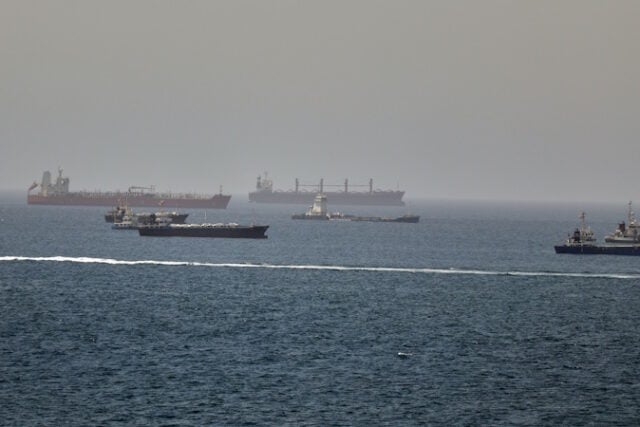
To understand why American bombs are falling near the Iranian coast again, you have to look at a narrow, 21-mile-wide strip of water: the Strait of Hormuz. Roughly a fifth of the world’s petroleum passes through this chokepoint. Under the June 17 agreement, the Strait was supposed to open up safely to international shipping. But there was a massive catch that the diplomatic teams couldn’t quite smooth over.
The U.S. and a multinational maritime body overseen by the U.S. Navy have been pushing an alternative shipping lane that hugs the southern coast of the strait, safely within Omani waters. The goal was simple: keep commercial vessels away from the direct jurisdiction and naval harassment of Iran’s Revolutionary Guard. Iran, however, saw this alternative route as a direct challenge to its regional leverage. They claimed the U.S.-backed Omani lane was “completely dangerous,” a thinly veiled warning that any captain bold enough to use it would be swimming at their own risk.
They weren’t bluffing. The timeline of the collapse reveals a rapid, tit-for-tat escalation:
Thursday, June 25, 2026: The Spark
A Singapore-flagged container ship named the M/V Ever Lovely was quietly exiting the Strait of Hormuz along the Omani coast. Suddenly, a one-way attack drone slammed into the vessel. While nobody on board was injured and the ship managed to keep moving, the message was loud and clear. President Donald Trump immediately took to social media, blasting the drone strike as a “foolish violation” of the newly minted ceasefire. Behind the scenes, the Pentagon went to war footing.
Friday, June 26, 2026: The First Wave
The U.S. military waited less than 24 hours to punch back. On Friday evening, six American warplanes roared over the Persian Gulf and targeted four specific locations along the Iranian coast, primarily around the southern port town of Sirik. According to U.S. Central Command (CENTCOM), these precision airstrikes successfully wiped out Iranian missile and drone storage facilities, alongside coastal radar networks used to track commercial ships.
Tehran didn’t back down. Iran’s paramilitary forces acknowledged the strikes near their pier in Sirik and immediately fired back, launching retaliatory strikes against U.S. military installations scattered across the Middle East. At the same time, Iran warned neighboring Gulf states that “outsourcing their security” to Washington would only make them less secure.
Saturday, June 27, 2026: Day Two of the Crisis
If the White House hoped Friday’s strikes would serve as a deterrent, they got their answer early Saturday morning. At around 4:30 AM Eastern Time, a massive Panama-flagged oil tanker called the M/T Kiku, loaded to the brim with more than two million barrels of crude oil, was navigating the Strait of Hormuz. Another one-way attack drone—widely attributed to Iranian forces—streaked out of the sky and hit the tanker.
Once again, the crew miraculously escaped injury, and no oil spilled into the gulf. But for Washington, hitting a tanker carrying millions of barrels of crude oil crossed a definitive red line. The ceasefire was officially a dead letter.
The Pentagon Drops the Hammer: Inside Saturday’s Airstrikes
By Saturday evening, CENTCOM forces launched a second, significantly heavier wave of airstrikes against Iranian territory. This wasn’t just a repeat of Friday’s warnings; it was a highly coordinated campaign meant to systematically degrade Iran’s ability to wage a shadow war at sea.
According to official Pentagon briefings, Saturday’s strikes expanded far beyond simple drone warehouses. U.S. aircraft systematically hunted down and destroyed:
- Military Surveillance Infrastructure: The eyes and ears monitoring the international shipping lanes.
- Communication Systems: Command-and-control hubs used to order quick-strike drone operations.
- Air Defense Sites: Radar and missile batteries designed to protect Iranian installations from American jets.
- Minelayer Capabilities: Specialized naval assets capable of dropping hidden explosives into the shipping channels.
The primary targets were concentrated once again in southern Iran, around the village of Tahrui near the strategic port of Sirik. Local reports and state television within Iran confirmed massive explosions echoing across the coastline as the secondary detonations of stored munitions cooked off late into the night.
The Escalating Rhetoric: Words Get Dangerous
As the military hardware clashes in the Gulf, the political rhetoric coming out of Washington has turned incredibly dark. The days of cautious diplomatic phrasing are entirely gone, replaced by blunt, existential warnings.
Vice President JD Vance, who has been heavily involved in leading the delicate negotiations over the past few weeks, laid out the administration’s stance on social media. He noted that if Tehran had issues with how the ceasefire terms were being interpreted, they should “pick up the phone” and talk it out. Instead, they chose drones. “Violence will be met with violence,” Vance warned.
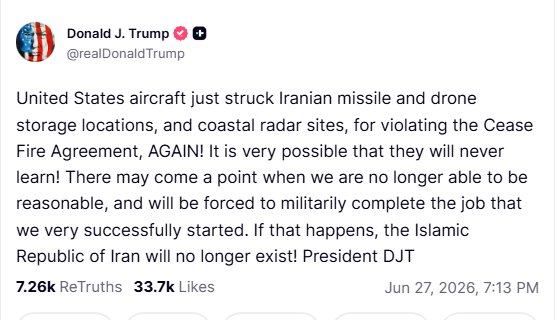
President Trump took things a massive step further. Writing on Truth Social in the wake of the second night of bombing, he made it clear that American patience has run entirely thin.
“There may come a point when we are no longer able to be reasonable, and will be forced to militarily complete the job that we very successfully started,” Trump wrote. “If that happens, the Islamic Republic of Iran will no longer exist.”
It’s an astonishingly severe ultimatum, even by modern standards. It signals that the White House is no longer looking at this as a minor border skirmish or a series of isolated maritime enforcement actions. They are viewing it as an active slide back into an all-out, regime-threatening war.
The Broader Mess: Ripples Across West Asia
What makes this two-day flare-up so incredibly frustrating for regional diplomats is that it is completely overshadowing progress made on other fronts. Just as the U.S.-Iran deal was falling apart, a massive, historic breakthrough was happening right next door in Lebanon.
On Friday, June 26, Israel and Lebanon signed a U.S.-brokered “framework agreement” in Washington after five intense rounds of talks. The deal was supposed to pave the way for a full Israeli withdrawal from southern Lebanon, with the Lebanese Armed Forces moving in to backfill the positions previously held by the Israel Defense Forces (IDF).
But in a region where everything is interconnected, the chaos in Iran is already bleeding into the Lebanon agreement. The deal explicitly includes a process aimed at disarming Hezbollah—the powerful, heavily armed militant group explicitly backed, funded, and supplied by Iran. Unsurprisingly, Hezbollah’s leader, Naim Qassem, immediately rejected the framework, accusing the Lebanese government of surrendering its national sovereignty.
To make matters worse, Israel’s far-right National Security Minister, Itamar Ben Gvir, publicly slammed the deal from the other side, calling it a “big mistake” and arguing that the Lebanese government can never be trusted to actually strip Hezbollah of its weapons. Add in the fact that Israeli airstrikes just hit the southern Lebanese town of Nabatieh al-Fawqa via drones and warplanes on Sunday morning, and you can see how quickly the entire region’s delicate diplomatic scaffolding is turning to ash.
What Happens to Global Trade Now?
For everyday folks who don’t closely track geopolitical chess moves, the immediate question is: How is this going to hit my wallet?
When the initial ceasefire was signed on June 17, global oil prices instantly plunged back down to pre-war levels. It was a massive win for global supply chains and consumer gas prices. Now, with tankers like the M/T Kiku actively being hunted by drones and the U.S. Navy forced to provide heavy-handed “safe passage coordination,” that economic stability is completely gone.
The International Maritime Organization (IMO) briefly tried to set up a permanent framework for shipping through the safe Omani route, but following the attack on the Kiku, they have been forced to temporarily pause those plans. If the Strait of Hormuz becomes a hot combat zone for a third or fourth consecutive day, insurance rates for commercial ships will skyrocket, shipping companies will choose to take massive, expensive detours around Africa, and energy prices worldwide will spike again.
Where Do We Go From Here?
Right now, we are sitting on a knife’s edge. Under the original interim deal, both Washington and Tehran technically had a 60-day window to hash out the incredibly complex details of a permanent peace—including the future of Iran’s nuclear program, its stockpile of highly enriched uranium, and the thorny issue of shipping tolls.
But you can’t negotiate a nuclear treaty while exchanging airstrikes and drone attacks. CENTCOM has made it clear that American forces remain “vigilant, lethal, and ready” to protect commercial shipping by any means necessary. Meanwhile, Iran’s Revolutionary Guard appears entirely unwilling to give up its historic chokehold on the Strait of Hormuz, even if it means risking full-scale military ruin.
The next 24 hours are critical. If Iran blinks and stops the drone swarms, the diplomats might find a way to drag both sides back to the table. If another drone hits another ship tomorrow morning, the region won’t just be looking at the collapse of a ceasefire—it will be looking at the opening salvos of a devastating war.
Sources and Links:
- Al Jazeera: US launches second night of strikes against Iran after ship struck by drone
- AP News: US military says it struck multiple targets in Iran as ceasefire is strained by 2nd day of attacks
- The Guardian: US says it struck targets in Iran over ‘continued aggression’ against shipping
- U.S. Central Command (CENTCOM): U.S. Strikes Iran in Response to Attack on Commercial Vessel
- The Hindu: West Asia war LIVE: U.S. conducts further strikes against ‘multiple targets’ in Iran
Disclaimer
Artificial Intelligence Disclosure & Legal Disclaimer
AI Content Policy.
To provide our readers with timely and comprehensive coverage, South Florida Reporter uses artificial intelligence (AI) to assist in producing certain articles and visual content.
Articles: AI may be used to assist in research, structural drafting, or data analysis. All AI-assisted text is reviewed and edited by our team to ensure accuracy and adherence to our editorial standards.
Images: Any imagery generated or significantly altered by AI is clearly marked with a disclaimer or watermark to distinguish it from traditional photography or editorial illustrations.
General Disclaimer
The information contained in South Florida Reporter is for general information purposes only.
South Florida Reporter assumes no responsibility for errors or omissions in the contents of the Service. In no event shall South Florida Reporter be liable for any special, direct, indirect, consequential, or incidental damages or any damages whatsoever, whether in an action of contract, negligence or other tort, arising out of or in connection with the use of the Service or the contents of the Service.
The Company reserves the right to make additions, deletions, or modifications to the contents of the Service at any time without prior notice. The Company does not warrant that the Service is free of viruses or other harmful components.