The Lincoln Memorial Reflecting Pool, historically a serene canvas mirroring the sky and the Washington Monument, has transformed into a vivid, pea-green spectacle. The dramatic shift occurred just two weeks after the completion of a fast-tracked $14.2 million beautification initiative championed by President Donald Trump. Designed to ready the capital for the upcoming 250th anniversary of the United States, the project aimed to coat the historically gray concrete basin in a vibrant, “American flag blue” industrial rubber liner.
Instead, a combination of soaring June temperatures, stagnant water, and sudden ecological developments triggers an aggressive algae bloom. Visitors and residents flocking to the National Mall find a neon-hued body of water that critics describe as resembling “vomit,” rather than the pristine monument promised by the administration. Compounding the aesthetic failure, massive sheets of the newly applied blue polymer coating have begun to separate from the concrete floor, peeling away and floating listlessly on the pool’s surface.
                        _ _ _ _ _ _ _ _ _ _ _ _
                       |                       |
                       |   Algae Overgrowth    |
                       | (Scenedesmus Genus)  |
                       |_ _ _ _ _ _ _ _ _ _ _ _|
                                   |
                                   v
                        _ _ _ _ _ _ _ _ _ _ _ _
                       |                       |
                       |  Hydrogen Peroxide    |
                       |   Chemical Deluge     |
                       |_ _ _ _ _ _ _ _ _ _ _ _|
                                   |
                                   v
                        _ _ _ _ _ _ _ _ _ _ _ _
                       |                       |
                       |  Polymer Layer Peels  |
                       |  & Basin Turns Green  |
                       |_ _ _ _ _ _ _ _ _ _ _ _|
Ecological Realities and the “New Pond” Effect
The rapid discoloration began almost immediately after officials refilled the reservoir on June 4. Limnologists and aquatic ecologists point to a predictable ecological phenomenon frequently referred to as “New Pond Syndrome.” When a large, open-air body of water is thoroughly cleaned, refilled with fresh city water, and subjected to direct sunlight without established biological competition, opportunistic organisms thrive.

Testing commissioned by independent laboratories identifies the primary culprit as Scenedesmus, a highly resilient genus of green algae. Though completely harmless to human health, the microscopic plants multiplied exponentially under the oppressive mid-June heat wave.
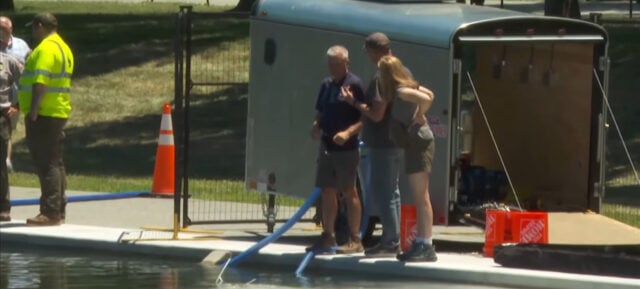
In a frantic bid to restore the intended blue hue before the public took notice, National Park Service (NPS) personnel deployed skimmers and vacuum equipment. Under direction from the Department of the Interior, workers poured large volumes of concentrated hydrogen peroxide directly into the water. This chemical blitz, meant to bleach and kill the blooms alongside a newly installed $1.7 million “nanobubbler” filtration system, inadvertently dissolved the bonding agents beneath the rubber liner. Within forty-eight hours, the patriotic blue floor began to shred into floating debris.
Redirection, Allegations, and Political Blame
Faced with a highly visible logistical blunder on the National Mall, President Trump took to his Truth Social platform to reject any narrative of administrative failure. Rather than attributing the issue to rapid installation or chemical oversights, the president blamed a combination of political adversaries, elements of the media, and covert saboteurs.
In a series of weekend posts, Trump acknowledged “real problems” at the historic site but asserted without evidence that malicious actors deliberately vandalized the landmark. He alleged that unknown individuals snuck past federal security to pour destructive chemicals into the basin to “destroy and demean our beautiful work.”
“No different than the chemicals that were used on the National Mall, they used something similar in the Reflecting Pool,” Trump claimed in his public statement, promising that the perpetrators would face “years in jail.”
The president singled out ABC News Chief Washington Correspondent Jonathan Karl, accusing the reporter of active physical sabotage. Karl had recently filmed a televised segment standing alongside the pool, during which he reached down to demonstrate the fragile state of the project by moving a detached, floating flap of the rubber liner back and forth. Trump characterized this reporting as a criminal act, claiming that Karl was caught “trying to rip the rubber off of the surface.”
The administration’s efforts to redirect blame extended to previous executive terms. A spokesperson for the Department of the Interior released an official statement contrasting the current situation with the actions of past leadership. The statement claimed that the new nanobubbler filtration array had successfully neutralized an environmental issue that “plagued every pool reopening since 1922, most infamously, the Obama pool reopening.” In 2012, the Obama administration oversaw a sweeping $34 million structural overhaul designed to fix structural sinking and systemic leaks that cost the city roughly 16 million gallons of water annually.
Law Enforcement Interventions and Public Fallout
The rhetoric surrounding the green water quickly manifested in real-world legal action on the National Mall. U.S. Park Police heightened security around the perimeter of the pool, leading to the high-profile arrest of David Hearn, a 67-year-old cyclist and three-time U.S. Olympic canoeist.
Hearn was placed in handcuffs and charged with a misdemeanor count of destruction of government property after he paused his bicycle ride to inspect the peeling material. Speaking to reporters following his release, Hearn denied committing any acts of vandalism, explaining that he merely reached into the water out of pure curiosity to feel the texture of the failing polymer layer.
| Metric | Project Reality |
| Initial Estimated Cost | $1.5 Million |
| Final Renovation Total | $14.2 Million |
| Filtration Contract Cost | $1.7 Million |
| Primary Algae Genus | Scenedesmus |
| Target Completion Date | U.S. 250th Anniversary |
The procurement process behind the project has invited intense institutional scrutiny. Federal contracting logs reveal that the $1.7 million water-purification contract was awarded on a no-bid basis to an environmental firm owned by John Cafaro, a prominent Ohio businessman, major political donor, and Mar-a-Lago neighbor. Public records show Cafaro previously pleaded guilty to federal campaign finance violations and a conspiracy case involving corporate bribery.
As federal maintenance crews continue utilizing industrial vacuums to clear dead organic matter from the bottom of the basin, the Trump administration insists the biological crisis is “75% gone” and will be fully remedied within days. For the thousands of tourists walking between the Washington Monument and the Lincoln Memorial, however, the capital’s centerpiece remains a murky, emerald reminder of the ongoing conflict between political ambition and the natural environment.
Sources and Links:
- The Guardian: “Trump acknowledges ‘real problems’ at reflecting pool after $14m makeover, blaming ‘vandalism’” https://www.theguardian.com/us-news/2026/jun/20/trump-reflecting-pool-renovation-vandalism
- The Guardian: “Algae thwarts Trump’s $14.2m attempt to turn reflecting pool ‘American flag blue’” https://www.theguardian.com/us-news/2026/jun/16/algae-trump-lincoln-memorial-reflecting-pool
- Washington Examiner: “Trump blames ABC reporter and vandals for peeling Reflecting Pool and algae growth” https://www.washingtonexaminer.com/news/white-house/4617547/trump-blame-abc-reporter-vandal-reflecting-pool/
- Washington Examiner: “US Park Police arrest former Olympian for vandalism of Reflecting Pool” https://www.washingtonexaminer.com/news/white-house/4617632/us-park-police-arrest-olympian-vandal-reflecting-pool/
- Washington Examiner: “‘American flag blue’ coating apparently peeling off in Lincoln Memorial Reflecting Pool” https://www.washingtonexaminer.com/news/white-house/4614945/lincoln-reflecting-pool-blue-paint-peeling-algae/
- FOX 5 DC: “Reflecting Pool looks ‘like vomit,’ visitors say; crews continue cleaning job” https://www.fox5dc.com/news/washington-dc-reflecting-pool-cleanup-19-june-2026
- The Independent: “Trump administration blames Obama after ‘blue’ Reflecting Pool turns green after $14M refurb” https://www.independent.co.uk/news/world/americas/us-politics/trump-obama-reflecting-pool-washington-green-b2996395.html
- Hindustan Times: “Donald Trump blames ‘vandalism’ after admitting ‘real problems’ with $14.2M Reflecting Pool makeover” https://www.hindustantimes.com/world-news/us-news/donald-trump-blames-vandalism-after-admitting-real-problems-with-14-2m-reflecting-pool-makeover-101781987983999.html
Disclaimer
Artificial Intelligence Disclosure & Legal Disclaimer
AI Content Policy.
To provide our readers with timely and comprehensive coverage, South Florida Reporter uses artificial intelligence (AI) to assist in producing certain articles and visual content.
Articles: AI may be used to assist in research, structural drafting, or data analysis. All AI-assisted text is reviewed and edited by our team to ensure accuracy and adherence to our editorial standards.
Images: Any imagery generated or significantly altered by AI is clearly marked with a disclaimer or watermark to distinguish it from traditional photography or editorial illustrations.
General Disclaimer
The information contained in South Florida Reporter is for general information purposes only.
South Florida Reporter assumes no responsibility for errors or omissions in the contents of the Service. In no event shall South Florida Reporter be liable for any special, direct, indirect, consequential, or incidental damages or any damages whatsoever, whether in an action of contract, negligence or other tort, arising out of or in connection with the use of the Service or the contents of the Service.
The Company reserves the right to make additions, deletions, or modifications to the contents of the Service at any time without prior notice. The Company does not warrant that the Service is free of viruses or other harmful components.