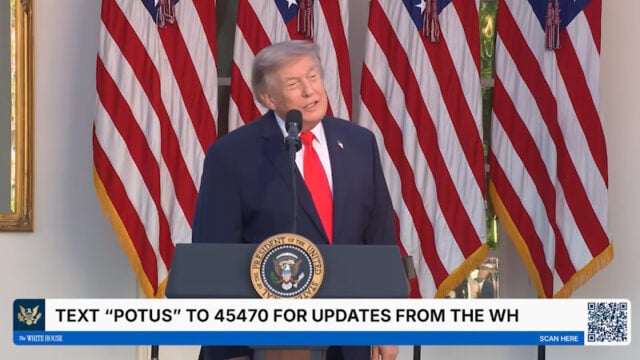
President Donald Trump turned the historic, recently renovated Rose Garden into an open-air dining room, rolling out the red carpet for dozens of farmers, ranchers, and agricultural producers from more than a dozen states.
Dubbed the “Rose Garden Club” dinner, the evening was part political charm offensive, part policy victory lap, and part damage control. With a menu featuring fresh produce straight from the White House Kitchen Garden and honey from the executive mansion’s own beehive, the event was designed to feel intimate, celebratory, and deeply American.
But beneath the casual, Mar-a-Lago-style setup of patio tables, chairs, and umbrellas set out over the newly paved garden lawn, there was a palpable tension. The administration is working hard to shore up support in rural communities, where recent economic strains, international conflicts, and volatile markets have begun to chip away at the president’s traditional base.

Charms, Chops, and the “Rose Garden Club”
The atmosphere of the dinner reflected Trump’s signature hosting style. Having paved over parts of the traditional grassy lawn to create a stone patio setup reminiscent of his private Florida resort, Trump used the space to mingle directly with the people who grow the nation’s food.
He wasn’t the only high-profile figure working the crowd. The guest list was a star-studded rollout of his cabinet and top administrative officials, emphasizing just how much weight the White House is throwing behind agricultural policy right now. Attendees dined alongside Treasury Secretary Scott Bessent, Agriculture Secretary Brooke Rollins, Health and Human Services Secretary Robert F. Kennedy Jr., and Centers for Medicare & Medicaid Services Administrator Mehmet Oz. Lawmakers from major agricultural states were also out in full force.
White House spokeswoman Olivia Wales set the tone for the evening, stating that Trump is incredibly proud to host the nation’s growers and framing him as the ultimate champion for rural America.
For many of the farmers in attendance, the recognition itself was a massive honor. The administration used the dinner to spotlight the Working Families Tax Cuts package, which allows agricultural producers to fully expense expensive farm equipment and structures. They also leaned heavily into the recent expansion of the federal estate and gift tax exemption to $15 million—a massive talking point for family-owned operations worried about passing land down to the next generation without being forced to liquidate assets.
The Elephants in the Garden: War and Volatility
While the White House kitchen was serving up homegrown honey, the conversations around the tables frequently drifted toward tougher economic realities. Rural America has been a vital cornerstone of Trump’s political coalition, but the road has been incredibly rocky for many family farms lately.
The geopolitical fallout from recent international conflicts—most notably a war involving Iran—has hit the agricultural sector hard. The conflict spiked global energy prices right during the crucial spring planting season, sending the cost of diesel fuel and essential fertilizers skyrocketing. Additionally, lingering friction from broader trade disputes has caused deep, potentially long-term disruptions to American soybean exports, leaving many growers holding empty bags.
Political strategists have noted that these compounding economic pressures are starting to register in the data. Public opinion polling in rural areas has shown a noticeable dip in the administration’s net approval ratings over the last few months. While the cultural tie between Trump and rural voters remains incredibly strong, sustained hits to the family pocketbook make it harder to maintain unwavering enthusiasm. Some pollsters warn that the danger for the administration isn’t necessarily farmers switching parties, but rather frustrated voters choosing to sit out upcoming elections altogether.
Recognizing this vulnerability, the White House recently requested an additional $11 billion in farm aid from Congress, a massive financial cushion intended to help growers weather the current economic storms.
A Wild Card on the Menu: The Iran Proposal
The true surprise of the evening came when President Trump grabbed the microphone and pivoted to global diplomacy, introducing a controversial new plan that left policy analysts and foreign diplomats spinning.
Trump claimed that the United States is moving toward a process where it will essentially take unfrozen Iranian financial assets and mandate that they be spent directly on American agricultural goods. Describing Iran as a “lovely country” that is currently “having a hard time with food,” Trump insisted that Tehran would become a massive new market for US growers.
According to the president, initial financial relief tied to an international Memorandum of Understanding (MoU) would include roughly $500 million earmarked strictly for American goods. Trump insisted that no direct cash would ever touch the hands of the Iranian government. Instead, the frozen funds would flow directly into America’s heartland to purchase massive quantities of wheat, soybeans, and corn.
Vice President JD Vance echoed the sentiment, arguing that if Iranian assets are going to be unfrozen anyway, the administration is going to ensure they go toward feeding everyday people abroad while making American farmers richer in the process.
The Global Pushback
As you can imagine, the announcement did not go over quietly on the international stage.
Almost immediately, Iran’s Parliamentary Speaker, Mohammad Bagher Ghalibaf, took to social media to aggressively dispute the White House’s narrative. In a pointed post on X, Ghalibaf dismissed the claims of unfrozen assets being used to buy US crops as entirely false. He fired back with harsh rhetoric, stating that the only crop Iran is harvesting from the United States is “decades of mistrust,” calling it “organic, abundant, and homegrown” while labeling US exports as nothing more than GMO soybeans and broken promises.
Closer to home, agricultural economists are also watching the proposal with a healthy dose of skepticism. While the idea of a massive new buyer for corn and wheat sounds fantastic on paper, executing a complex international commodity trade using frozen assets in the wake of a military conflict is incredibly complicated.
For the farmers leaving the Rose Garden on Thursday night, the dinner was a powerful reminder of their political clout. Whether the evening’s grand promises of multi-million-dollar grain deals with foreign adversaries materialize or stall out in diplomatic gridlock remains to be seen. But one thing is absolutely certain: the battle for the American heartland is officially in full swing.
Sources and Links:
- DVIDS (Defense Visual Information Distribution Service): President Trump Participates in a Rose Garden Club Dinner with American Farmers
- ANI News: “Iran having hard time with food”: Trump claims share from unfrozen Iranian assets
- NPR (National Public Radio): Trump works to woo farmers in aftermath of Iran war
- Fox News / WFIN: Trump will welcome farmers and ranchers to White House dinner to celebrate trade, tax wins
- Associated Press / FOX43: Trump Launches ‘Rose Garden Club’ at White House Dinner
Disclaimer
Artificial Intelligence Disclosure & Legal Disclaimer
AI Content Policy.
To provide our readers with timely and comprehensive coverage, South Florida Reporter uses artificial intelligence (AI) to assist in producing certain articles and visual content.
Articles: AI may be used to assist in research, structural drafting, or data analysis. All AI-assisted text is reviewed and edited by our team to ensure accuracy and adherence to our editorial standards.
Images: Any imagery generated or significantly altered by AI is clearly marked with a disclaimer or watermark to distinguish it from traditional photography or editorial illustrations.
General Disclaimer
The information contained in South Florida Reporter is for general information purposes only.
South Florida Reporter assumes no responsibility for errors or omissions in the contents of the Service. In no event shall South Florida Reporter be liable for any special, direct, indirect, consequential, or incidental damages or any damages whatsoever, whether in an action of contract, negligence or other tort, arising out of or in connection with the use of the Service or the contents of the Service.
The Company reserves the right to make additions, deletions, or modifications to the contents of the Service at any time without prior notice. The Company does not warrant that the Service is free of viruses or other harmful components.