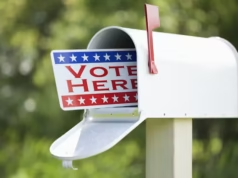
The U.S. Postal Service won’t deliver mail ballots in states that refuse to turn over lists of voters under a proposed rule, the agency’s chief executive said Wednesday, angering Democrats who warn the decision will disenfranchise voters.
Postmaster General David Steiner defended the rule at a Senate hearing and dismissed accusations that the Postal Service was acting politically after President Donald Trump signed an executive order in March restricting voting by mail.
“If a state refuses to turn its absentee voter list over to the federal government, will the Postal Service still mail its ballots under this proposed rule?” Sen. Gary Peters, a Michigan Democrat, asked Steiner.

“Under our proposed regulation, no,” Steiner replied.
Steiner’s testimony, before the Senate Homeland Security & Governmental Affairs Committee, marked the clearest acknowledgment yet by a federal official that the rule threatens to upend voting by mail across the country.
If the rule takes effect and Democratic-led states refuse to comply, the requirements would effectively limit mail voting to Republican-led states during the November midterm elections to decide control of Congress.
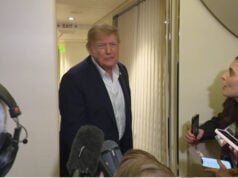
The Postal Service put forward the rule after Trump ordered Steiner to require states to submit lists of anticipated mail voters to the agency as a condition of having ballots delivered.
Trump cancels signing ceremony
The executive order is one of several steps the Trump administration has taken this year to influence how elections are administered, along with the Department of Justice suing states to obtain sensitive voter data.
Underscoring the depth of Trump’s interest, as Steiner was speaking Wednesday morning the president abruptly called off a U.S. Capitol ceremony to sign a bipartisan housing bill because of the Senate’s refusal to pass the SAVE America Act. The legislation would require voters to show documents, such as a birth certificate or passport, proving their citizenship.
“Now we have this new rule you’ve put out saying that states have to turn over their voting rolls and you, the U.S. Postal Service, will decide who’s approved to send their ballot through the mail,” Sen. Elissa Slotkin, a Michigan Democrat, said. “It’s just another backdoor way of trying to influence this election.“
Slotkin said Trump’s decision to cancel the housing bill signing demonstrated the “level of obsession this president has” over elections.
Turning over names
Every state would have to provide the names of residents expected to vote by mail. Additionally, eight states and Washington, D.C., hold elections by mailing ballots to all voters, meaning election officials would have to provide information on every voter. Those states include California, Colorado, Hawaii, Nevada, Oregon, Utah, Vermont and Washington.
Trump and his aides argue the restrictions are needed to combat noncitizen voting, which occurs very rarely. Democrats and voting rights groups have sued over the order, arguing it’s an unconstitutional assertion of presidential authority over state-run elections. No judge has yet halted it.
Steiner sought to place himself outside the controversy and said, in response to a question, that the Postal Service would adhere to a court order blocking the rule if one were issued. Asked about the legal authority underlying the rule, he said he would “have to defer that to the courts to understand the authority.”
Steiner, who became the postmaster general in July 2025, cast the rule as primarily focused on best practices for election mail, a description that understates the proposal’s scope, which postal experts call unprecedented.
“I’m not a political person and the Postal Service is not a political organization,” Steiner said.
Dems urge Steiner to withdraw rule
Democrats expressed sharp disagreement with Steiner and accused him of folding to Trump’s efforts to exercise more control over elections. Steiner answers to the USPS Board of Governors, not the president, and his critics say he is endangering the agency’s independence by complying with the executive order.
Every Senate Democrat, as well as two independents who caucus with the party, on Tuesday signed a letter to Steiner urging him to withdraw the rule. The letter warns that aside from the rule’s legal and constitutional problems, it’s not feasible for state and local election officials to meet its requirements.
“The proposed regulation demands that the Postal Service set up an entirely new system and database to process and transmit millions of absentee ballots that is secure and accessible to every American election official, just months prior to a general election,” the letter says.
At Wednesday’s hearing, GOP senators mostly steered clear of the mail ballot rule, instead focusing on the official topic, the Postal Service’s finances. But Sen. Bernie Moreno, an Ohio Republican, accused Democrats of hypocrisy over their past support of the “For the People Act.”
The sweeping bill, offered when Democrats last controlled Congress, would have required states to offer same-day voter registration and expand mail voting. Opponents said it amounted to nationalized elections.
“Three years later, all of them are testifying, ‘It’s outrageous, President Trump is trying to nationalize elections.’ No, he’s not, he’s trying to get rid of voter fraud,” Moreno said, adding that Democrats had now “dug up from their bottom desk drawer” the Constitution.
“Should we get back to post office stuff now?” Moreno said.
“Absolutely,” Steiner replied.
Disclaimer
Artificial Intelligence Disclosure & Legal Disclaimer
AI Content Policy.
To provide our readers with timely and comprehensive coverage, South Florida Reporter uses artificial intelligence (AI) to assist in producing certain articles and visual content.
Articles: AI may be used to assist in research, structural drafting, or data analysis. All AI-assisted text is reviewed and edited by our team to ensure accuracy and adherence to our editorial standards.
Images: Any imagery generated or significantly altered by AI is clearly marked with a disclaimer or watermark to distinguish it from traditional photography or editorial illustrations.
General Disclaimer
The information contained in South Florida Reporter is for general information purposes only.
South Florida Reporter assumes no responsibility for errors or omissions in the contents of the Service. In no event shall South Florida Reporter be liable for any special, direct, indirect, consequential, or incidental damages or any damages whatsoever, whether in an action of contract, negligence or other tort, arising out of or in connection with the use of the Service or the contents of the Service.
The Company reserves the right to make additions, deletions, or modifications to the contents of the Service at any time without prior notice. The Company does not warrant that the Service is free of viruses or other harmful components.