The Naval Flashpoint: Destruction of Iranian Small Boats
On the afternoon of May 4, 2026, the Strait of Hormuz once again became the epicenter of global military tension. Following an attempt by the Islamic Revolutionary Guard Corps (IRGC) to reassert a blockade on the vital waterway, U.S. naval forces engaged and successfully destroyed seven Iranian small boats. These vessels, according to the State Department, were engaged in “aggressive maneuvering” designed to harass commercial shipping and enforce what the U.S. characterizes as “illegal tolls” on international trade.
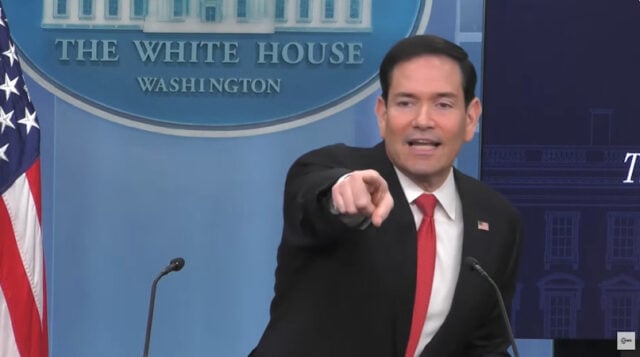
Secretary of State Marco Rubio, addressing the press just hours after the engagement, framed the incident not as an escalation but as a necessary defensive maneuver. “The United States is not seeking a war with Iran, but we will not allow the Iranian regime to hold the world’s economy hostage,” Rubio stated. He emphasized that the U.S. is currently in a defensive mode, responding to an Iranian posture that has become increasingly belligerent since the start of Operation Epic Fury on February 28.
The Anatomy of the Skirmish
The engagement occurred near the island of Qeshm, where Iranian swarming tactics were met with precision fire from U.S. littoral combat ships.
- Vessels involved: 7 IRGC fast-attack craft.
- Outcome: All 7 boats were neutralized; no U.S. casualties reported.
- U.S. Rationale: Protection of freedom of navigation and prevention of sea-mine placement.
Economic Aftershocks: Gas Prices and the Global Market
The immediate fallout of the Hormuz skirmish was felt at gas pumps across America. On May 5, the national average price of a gallon of regular gasoline rose to $4.48, a three-cent jump overnight. In states like California, prices have surged past $6.13, reflecting the market’s anxiety over a potential total closure of the Strait.

The economic consequences are even more dire for the Iranian people. Despite the regime’s bravado, the internal Iranian economy is in a state of freefall:
- Food Inflation: Exceeding 70%.
- Currency Devaluation: The Rial has lost over half its value in the last twelve months.
- Protests: Widespread unrest continues across all 31 provinces, spurred by water shortages and basic infrastructure failures.
Secretary Rubio noted that if the regime invested the “billions of dollars it spends on terrorist groups” into its own people, the current humanitarian crisis could have been avoided.
Diplomatic Offensive: The Italy Trip and the Vatican
Amidst the naval conflict, Secretary Rubio is scheduled for a high-stakes trip to Italy and the Vatican from May 6 to 8. This visit is viewed as a “thawing” mission to repair relations following recent criticisms exchanged between the Trump administration and Pope Leo, the first U.S.-born pontiff.
Rubio’s agenda in Rome includes:
- Meeting with Pope Leo: To discuss humanitarian corridors and the moral implications of the ongoing conflict.
- Strategic Alignment with Italy: Meeting with Deputy PM Antonio Tajani to ensure the NATO alliance remains unified despite Italy’s previous criticisms of U.S. strikes.
- Security Cooperation: Addressing the shared threat of state-sponsored terrorism and Mediterranean security.
Legal and Strategic Framework: The War Powers Act and UN Resolutions
The U.S. is currently operating under the War Powers Act, with Secretary Rubio and the administration maintaining that the destruction of Iran’s navy and missile launchers is a defensive necessity. “Our objectives are clear,” Rubio said in a recent interview. “We are eliminating the threat of Iran’s short-range ballistic missiles and the capacity of their navy to disrupt global trade.”
The Proposed UN Resolution
At the United Nations, a new resolution drafted under Chapter 7 of the UN Charter is being circulated by the U.S. and Gulf allies. The resolution demands:
- An immediate halt to attacks on commercial shipping.
- The disclosure of all sea mine placements.
- The establishment of a humanitarian corridor in the Strait.
If passed, this resolution would allow for military enforcement to ensure the Strait remains open, regardless of Iranian opposition.
Conclusion: A Defensive Line in the Sand
Secretary Rubio has remained steadfast: the U.S. will not be the aggressor, but it will not be a passive observer. As he heads to Italy, the dual tracks of decisive military defense and aggressive diplomacy define the American strategy. The world watches the Strait of Hormuz, where seven small boats represent the latest chapter in a struggle for regional stability and economic survival.
Sources Used and Links:
- The Guardian: Middle East tensions back to the brink with president’s new threats against Iran
- The Guardian: Marco Rubio to visit Rome, reportedly to ‘thaw’ US relations with Pope and Meloni
- AP News: Proposed UN resolution threatens Iran with sanctions if it doesn’t allow freedom of navigation
- WTVB / Reuters: Rubio to travel to Italy May 6-8, State Dept says after tensions with pope
- House of Commons Library: Iran: What challenges face the country in 2026?
- WCNC: Gas prices rise nearly 3 cents, continuing daily climb as tensions flare in Strait of Hormuz
- U.S. Department of State: [suspicious link removed]
- The White House: President Trump’s Clear and Unchanging Objectives Drive Decisive Success Against Iranian Regime
- Times Now / YouTube: Iranians Hitting Us Everywhere, Rubio’s Big Nuclear Declaration On Iran
Disclaimer
Artificial Intelligence Disclosure & Legal Disclaimer
AI Content Policy.
To provide our readers with timely and comprehensive coverage, South Florida Reporter uses artificial intelligence (AI) to assist in producing certain articles and visual content.
Articles: AI may be used to assist in research, structural drafting, or data analysis. All AI-assisted text is reviewed and edited by our team to ensure accuracy and adherence to our editorial standards.
Images: Any imagery generated or significantly altered by AI is clearly marked with a disclaimer or watermark to distinguish it from traditional photography or editorial illustrations.
General Disclaimer
The information contained in South Florida Reporter is for general information purposes only.
South Florida Reporter assumes no responsibility for errors or omissions in the contents of the Service. In no event shall South Florida Reporter be liable for any special, direct, indirect, consequential, or incidental damages or any damages whatsoever, whether in an action of contract, negligence or other tort, arising out of or in connection with the use of the Service or the contents of the Service.
The Company reserves the right to make additions, deletions, or modifications to the contents of the Service at any time without prior notice. The Company does not warrant that the Service is free of viruses or other harmful components.