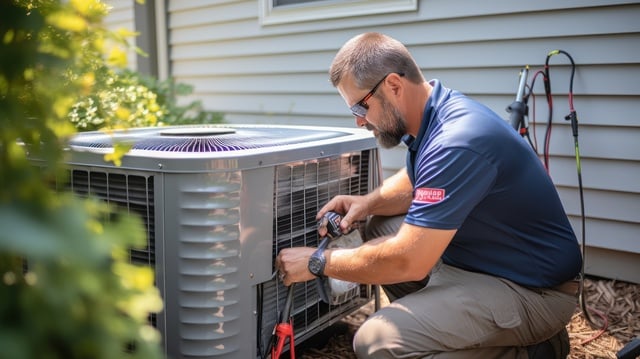
In Florida, air conditioning is not a seasonal convenience; it is a year-round necessity. When summer settles in and temperatures hold above 90 degrees for weeks at a stretch, the state’s heating and cooling contractors face a familiar surge: phones ringing without pause, emergency repair requests piling up, and technicians spread across more service calls than a standard schedule can absorb. For many HVAC businesses, the busiest stretch of the year is also the most chaotic, and the distance between demand and capacity often decides whether a company grows or merely gets by. More and more, that distance is being closed not by hiring additional office staff, but by software built to absorb the rush.
The Hidden Bottleneck Isn’t Labor. It’s Dispatching
Ask most HVAC owners what limits them during peak months and the instinctive answer is technicians. There are only so many trained hands, and seasoned ones are hard to find. Yet a quieter bottleneck often does more damage: dispatching. When a single overwhelmed coordinator is juggling inbound calls, juggling the day’s route, and fielding “where is my technician” questions all at once, the entire operation slows. Calls go to voicemail. Appointments get double-booked. A technician finishes early in one neighborhood while another races across town for a job that could have been handled nearby.
This is the problem a growing category of AI HVAC dispatch software is designed to solve. Rather than replacing the people who run a shop, these tools take over the repetitive, time-sensitive coordination work that tends to break down under volume: answering and triaging calls, matching jobs to the right technician, and adjusting the schedule in real time as the day shifts. The aim is straightforward: keep the pipeline moving when human attention is the scarcest resource in the building.
Why Peak Season Breaks Traditional Dispatching
Florida’s climate makes the math unforgiving. Cooling systems here run for far more of the year than in most of the country, and demand does not arrive in a gentle curve. A single heat wave can trigger a wave of breakdowns within days, and homeowners with no air conditioning are not patient customers. They call the first company that answers, and if that company cannot pick up or cannot offer a same-day slot, they move down the list.

Manual dispatching was never built for that kind of spike. A coordinator who comfortably manages 20 calls a day may suddenly face 60, and every minute spent on hold-music limbo or scheduling guesswork is a minute a competitor is closing the sale instead. The result is a paradox many contractors know well: the periods of highest demand are also the periods when the most revenue slips away, not because the work isn’t there, but because the business cannot route itself fast enough to capture it.
What AI Dispatching Actually Does
The phrase “artificial intelligence” can suggest something more abstract than what these systems deliver day to day. In practice, the functions are concrete and operational.
The first is call handling. Many platforms can answer inbound calls automatically, capture the customer’s details, identify the nature of the problem, and book an appointment without a human ever touching the phone, which is useful at 7 a.m., after hours, or whenever the office line is already tied up. Missed calls, one of the most common sources of lost HVAC revenue, drop sharply.
The second is intelligent scheduling. Instead of slotting jobs into the next open box on a calendar, the software weighs technician location, skill set, job type, and traffic to assign work in a way that minimizes wasted drive time. A diagnostic visit in one area gets paired with nearby calls rather than scattered across the map.
The third is real-time adjustment. When a job runs long or an emergency comes in, the system can re-sequence the day’s route on the fly and notify both the technician and the affected customers. That responsiveness is precisely what tends to collapse under manual coordination during a rush.
Taken together, these capabilities let a small dispatch team behave like a much larger one, which is the difference many Florida shops need during the months when their phones never stop.
The Business Case: Missed Calls Are Missed Revenue
For HVAC owners weighing whether the technology is worth it, the clearest measure is the cost of doing nothing. Industry observers have long noted that a meaningful share of inbound service calls go unanswered during busy periods, and in a market where a new air conditioning system can run into the thousands of dollars, even a handful of missed calls a week adds up quickly over a season.
There is also the matter of reputation. Florida’s home-services market is crowded and competitive, and online reviews carry real weight. A customer left sweating through a Saturday because no one returned their call is not only lost business; they are a potential negative review that follows the company into future searches. Faster, more reliable response is, in that sense, both a sales tool and a defensive one.
None of this means a contractor should expect a vending-machine outcome. Pricing models, integration with existing field-service systems, and the learning curve for office staff all vary, and the technology works best when a business already has reasonably clean data and clear service workflows for the software to build on.
A Tool, Not a Cure-All
It is worth keeping expectations grounded. AI dispatching does not pour refrigerant, diagnose a failing compressor, or reassure an anxious homeowner the way a skilled technician can. What it changes is the coordination layer, the connective tissue between a ringing phone and a van pulling into a driveway. For operations already strained at that layer, the improvement can be significant; for a one-truck shop with a manageable call volume, the case is weaker.
The contractors most likely to benefit are mid-sized and growing companies that have outgrown a single dispatcher but are not yet large enough to staff a full call center. For them, the technology offers a way to scale capacity without scaling payroll at the same rate, a particularly attractive proposition heading into a Florida summer.
Looking Ahead
The broader shift here is not unique to HVAC. Across home-service industries, from plumbing to pest control, businesses are adopting automation to handle the parts of the job that don’t require a wrench. But few industries feel seasonal pressure as sharply as cooling does in a state where the heat rarely lets up. For Florida’s HVAC companies, the question is increasingly less about whether to modernize dispatching and more about how soon, because when the next heat wave hits, the businesses that answer first are the ones that win the work.
Disclaimer
Artificial Intelligence Disclosure & Legal Disclaimer
AI Content Policy.
To provide our readers with timely and comprehensive coverage, South Florida Reporter uses artificial intelligence (AI) to assist in producing certain articles and visual content.
Articles: AI may be used to assist in research, structural drafting, or data analysis. All AI-assisted text is reviewed and edited by our team to ensure accuracy and adherence to our editorial standards.
Images: Any imagery generated or significantly altered by AI is clearly marked with a disclaimer or watermark to distinguish it from traditional photography or editorial illustrations.
General Disclaimer
The information contained in South Florida Reporter is for general information purposes only.
South Florida Reporter assumes no responsibility for errors or omissions in the contents of the Service. In no event shall South Florida Reporter be liable for any special, direct, indirect, consequential, or incidental damages or any damages whatsoever, whether in an action of contract, negligence or other tort, arising out of or in connection with the use of the Service or the contents of the Service.
The Company reserves the right to make additions, deletions, or modifications to the contents of the Service at any time without prior notice. The Company does not warrant that the Service is free of viruses or other harmful components.