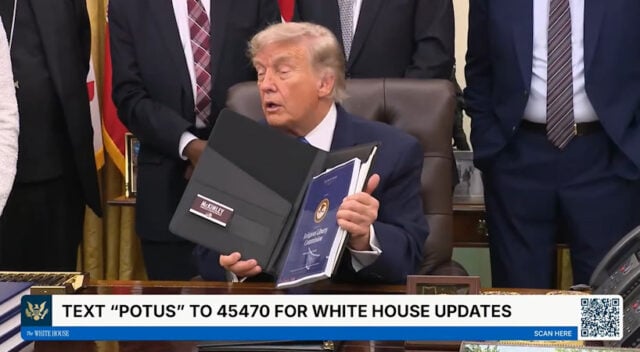
It was a quiet Friday afternoon in Washington on June 26, 2026, when a 224-page document landed on the Resolute Desk in the Oval Office. Surrounded by a circle of prominent faith leaders, conservative legal minds, and key political allies, President Donald Trump officially accepted the draft report from his administration’s controversial Religious Liberty Commission. The scene was rich with political theater, but the text inside that binder represents one of the most aggressive attempts to rewrite the rules of American public life in over a century.
Hours later, speaking to a roaring crowd at the Faith & Freedom Coalition gathering in Washington, Trump didn’t hold back. Boasting about the freshly minted recommendations, he told his supporters, “We saved religion, it was going down.” He accused the previous administration of carrying out a “reign of persecution” against people of faith and framed this new report as an essential shield to protect the faithful from government overreach.
But depending on who you ask, this document is either a long-overdue restoration of America’s foundational rights or a dangerous roadmap designed to turn the United States into a right-wing theocracy.
Swapping the Wall for a Bridge
For generations, the “separation of church and state” has been treated as a bedrock principle of American law. It’s a phrase that traces back to a letter written by Thomas Jefferson, and it has guided decades of Supreme Court decisions aimed at keeping the mechanisms of government completely distinct from any single religious faith.

The Religious Liberty Commission’s report takes dead aim at that very wall.
Instead of a dividing line keeping church and state at arm’s length, the report argues that Americans should view religion as an “essential support” to the republic. The commission explicitly labels the traditional, strict separation framework as a legal error and a historical misapplication. In its place, the authors urge the federal government to start building “bridges” between faith communities and state power.
During the Oval Office presentation, the commission’s chairman, Texas Lieutenant Governor Dan Patrick, took the rhetoric even further. Patrick, who has long been a vocal proponent of injecting Christian values into public spaces, declared that the phrase “separation of church and state” had been weaponized for decades to “batter and hammer people of faith.” Standing beside the president, Patrick insisted that from this day forward, “that phrase should have no power over people of all faiths ever again in America.”
The report tries to temper this radical shift by clarifying that it isn’t calling for a full-blown theocracy or the total erasure of all distinctions between church and state. Instead, it frames its philosophy as a balancing act—honoring the tension between the First Amendment’s two major components: the clause that guarantees the free exercise of religion and the clause that forbids the government from establishing an official state church. However, critics argue that by systematically dismantling the historical interpretation of the Establishment Clause, the commission is leaving the door wide open for state-sponsored religious favoritism.
Inside the Recommendations: What the Commission Wants
So, what does this bridge-building look like in practice? The 224-page report doesn’t just deal in high-minded legal theory; it lays out a highly specific wishlist of policy changes that would fundamentally alter public schools, the military, healthcare systems, and tax codes across the nation.
1. The Demise of the Johnson Amendment
One of the most significant and long-standing goals of Donald Trump’s political movement is the outright elimination of the Johnson Amendment. For decades, this provision in the U.S. tax code has barred tax-exempt non-profit organizations—including churches and houses of worship—from endorsing or opposing political candidates. The commission’s report calls for an end to this restriction, arguing that it unfairly muzzles pastors and religious leaders who want to guide their congregations on political matters. If enacted, this change would allow a tidal wave of tax-deductible money and explicit partisan politicking to flow directly through America’s pulpits.
2. Rewriting the Rules of Public Education
Public schools are a major battleground in this report. The commission recommends that public school spaces be allowed to feature prominent religious imagery and displays, explicitly calling out the Ten Commandments as an appropriate addition to classrooms. It also pushes for robust “parental opt-outs” from school lessons that conflict with a family’s religious beliefs, alongside an aggressive expansion of private school vouchers that route public tax dollars into faith-based education systems.
Furthermore, the report states that public officials or school administrators who attempt to restrict an employee’s religious expression must provide a written explanation that clearly identifies how the Constitution was violated. The goal is clear: create a legal environment in which school districts are too afraid of lawsuits to restrict staff prayer or religious messaging.
3. Military Compensations and Vaccine Pushback
In a nod to the lingering cultural battles of the pandemic era, the report demands that the federal government streamline its religious accommodation process and financially compensate military service members who were discharged for refusing the COVID-19 vaccine on religious grounds. This is a highly targeted policy that signals a formal federal validation of vaccine skepticism rooted in religious conscience.
4. Conscience Protections in Healthcare
The report outlines sweeping guidelines to protect doctors, nurses, and other healthcare workers from being coerced into participating in medical procedures that violate their faith. In the context of 2026, this translates directly into protecting medical professionals who object to providing reproductive healthcare or gender-affirming treatments, allowing them to deny service without fear of losing their jobs or facing civil rights lawsuits.
5. Civic Honors and Public Markers
To cement faith into the visible fabric of the nation, the commission recommends creating new national honors, including a Presidential Medal of Religious Liberty and First Freedom Hero Awards. It also calls for federal historic sites to install exhibits and markers celebrating the foundational role of religion in American history.
How the Commission Was Built
To understand the weight of this document, you have to look back at how this group was formed. President Trump established the Religious Liberty Commission by executive order on May 1, 2025, housing it directly under the Department of Justice. The explicit goal was to advise the White House Faith Office and the Domestic Policy Council on how to aggressively expand religious protections.
Trump stacked the panel with ideologically aligned conservative figures. Alongside Chairman Dan Patrick and Vice Chair Dr. Ben Carson, the panel featured prominent figures like Kelly Shackelford, the President and CEO of First Liberty Institute, and Bishop Robert Barron of the Catholic Diocese of Winona-Rochester.
Over the course of a year, the commission held a series of hearings—frequently hosted at the Museum of the Bible in Washington—where they listened to testimonies from over 100 witnesses. They heard from public school teachers, military chaplains, healthcare workers, and foster parents who claimed they had faced professional ruin, intimidation, or social ostracization for maintaining conservative religious stances on everything from vaccine mandates to pronoun usage in the classroom.
Speaking at the White House, Vice Chair Ben Carson praised Trump’s commitment to these witnesses, stating that the president has done more than anyone else in modern history to defend the faithful. “Our founding document says that our rights come from our creator and not from government,” Carson remarked, warning against those who try to divorce the country from its religious heritage.
The Gathering Storm of Backlash
Unsurprisingly, the release of the report immediately ignited a political firestorm. Civil liberties groups, progressive faith leaders, and secular advocacy organizations quickly united to condemn the document as an illegitimate tool of Christian Nationalism.
The backlash was swift and fierce. The Reverend Paul Raushenbush, president of the Interfaith Alliance, released a blistering statement calling the report a “wishlist of divisive, unpopular ideas far-right religious groups have pushed for years.” Raushenbush and other critics pointed out a glaring double standard in the commission’s work: while the 224-page report goes into extensive detail about anti-Christian bias and left-wing antisemitism, it fails to make a single mention of the rising tide of Islamophobia across the country.
“Religious freedom only for some is religious freedom for none,” Raushenbush argued, accusing the Trump administration of wielding faith as a political weapon rather than protecting America’s genuine religious diversity.
On Capitol Hill, Representative Jared Huffman, co-chair of the Congressional Freethought Caucus, released a scathing video response, labeling the panel a “sham commission” packed with extremists. Huffman warned that the recommendations represent a direct assault on the secular government that has protected Americans from religious tyranny for 250 years.
“We are a country of many faiths and people with no faith,” Huffman said. “That’s what religious freedom is all about.”
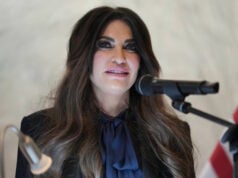
The report’s rollout has also been plagued by internal and external legal drama. A coalition of advocacy groups, including Americans United for Separation of Church and State, has filed a total of seven lawsuits against the commission. They argue the panel violates federal law because it completely lacks the ideological and religious diversity required of federal advisory boards. Even within the commission, cracks appeared: Carrie Prejean Boller, a former Miss California appointed as a commissioner, publicly accused Chairman Dan Patrick of religious discrimination, claiming she was wrongfully terminated from the panel because of her specific Catholic views.
What Happens Next?
Because this document is technically a draft, the administration has opened up a public comment period that will run until July 12, 2026. This window gives the public—and a small army of constitutional lawyers—a chance to weigh in before the guidelines are finalized.
The timing of this release is no accident. Dropping this sweeping reimagining of American liberty right as the United States prepares to celebrate its massive 250th anniversary sets the stage for a defining legal and cultural battle. If Donald Trump moves forward with turning these recommendations into official Department of Justice directives and executive orders, it will trigger an unprecedented wave of litigation that will likely head straight to a highly conservative Supreme Court.
For over two centuries, America has balanced on the wire between public faith and secular governance. If this report becomes reality, that wire isn’t just changing shape—it’s being replaced entirely.
Sources and Links:
- The Washington Post: Trump’s Religious Liberty Commission takes aim at church-state separation
- Associated Press: A Trump commission urges ‘bridges’ between church and state in sweeping draft report
- First Liberty Institute: Religious Liberty Commission Delivers Report to President Trump in the Oval Office
- Interfaith Alliance: Trump’s Draft “Religious Liberty Report” Is About Politicizing Faith, Not Upholding Religious Freedom for All
- Eurasia Review: White House Religious Liberty Commission Presents Recommendations
- U.S. House of Representatives (Rep. Jared Huffman): Rep. Huffman Responds to Trump Administration Commission’s Report to Tear Down Wall Between Church and State
- Americans United for Separation of Church and State: Religious Liberty Commission | Americans United
- U.S. Department of Justice: Religious Liberty Commission Page
Disclaimer
Artificial Intelligence Disclosure & Legal Disclaimer
AI Content Policy.
To provide our readers with timely and comprehensive coverage, South Florida Reporter uses artificial intelligence (AI) to assist in producing certain articles and visual content.
Articles: AI may be used to assist in research, structural drafting, or data analysis. All AI-assisted text is reviewed and edited by our team to ensure accuracy and adherence to our editorial standards.
Images: Any imagery generated or significantly altered by AI is clearly marked with a disclaimer or watermark to distinguish it from traditional photography or editorial illustrations.
General Disclaimer
The information contained in South Florida Reporter is for general information purposes only.
South Florida Reporter assumes no responsibility for errors or omissions in the contents of the Service. In no event shall South Florida Reporter be liable for any special, direct, indirect, consequential, or incidental damages or any damages whatsoever, whether in an action of contract, negligence or other tort, arising out of or in connection with the use of the Service or the contents of the Service.
The Company reserves the right to make additions, deletions, or modifications to the contents of the Service at any time without prior notice. The Company does not warrant that the Service is free of viruses or other harmful components.