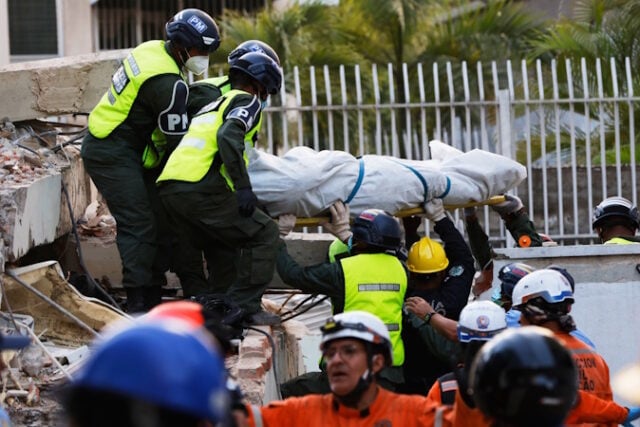
The situation unfolding in Venezuela right now is nothing short of heartbreaking. Just three days after a rare and terrifying “doublet” earthquake sequence shattered the north-central region of the country, desperation has completely taken over the streets. Neighbors are standing side-by-side with international rescue crews, digging through shattered concrete with their bare hands. Every single minute counts, and the window to find survivors trapped beneath collapsed buildings is rapidly closing.
What happened on Wednesday evening, June 24, 2026, has completely rewritten the country’s modern seismic history. Within a span of less than a minute, two massive earthquakes struck near the Caribbean coast. Seismologists call this a doublet event—a quick one-two punch where one major quake triggers another massive shock almost immediately. The first tremor measured a staggering 7.2 magnitude, initially classified as a foreshock. Just 39 seconds later, an even more violent 7.5 magnitude mainshock tore through the Earth. It is the most powerful earthquake sequence to hit Venezuela in more than a century, and the shallow depth of these tremors meant that the energy exploded right at the surface, maximizing the destruction.

The True Toll of the Doublet
As of Saturday night, official reports confirm that at least 1,430 people have lost their lives, and more than 3,238 others are hospitalized with severe physical traumas and crush injuries. But the most staggering number—and the one driving the absolute agony of families on the ground—is the count of the missing.
Depending on the database, anywhere from 51,000 to over 68,900 people remain entirely unaccounted for. While government officials suggest some of these numbers reflect communication blackouts and duplicate reports due to jammed cellular networks, independent tracking networks and United Nations emergency coordinators fear the worst. Hundreds, if not thousands, of residents are believed to be buried deep beneath the pancaked remains of apartment complexes and high-rise towers.
Because June 24 was a major national holiday in Venezuela—commemorating the Battle of Carabobo—most families were gathered at home rather than at work or school. When the ground began to roll at 6:04 PM local time, thousands were caught completely off guard inside high-density housing towers. Many simply did not have the time to evacuate before the second, larger 7.5 magnitude shock brought entire structures down.
Surviving the Aftermath on the Streets
The epicenters were officially mapped in the Veroes municipality within the state of Yaracuy, striking along the active San Sebastián fault system. However, the physical destruction concentrated heavily in the capital city of Caracas and the coastal state of La Guaira, which has officially been designated a disaster zone.
In upscale neighborhoods like Altamira and Los Palos Grandes, high-rises suffered catastrophic structural failures. One 22-story residential building in Altamira completely collapsed into a mountain of dust and debris. In the coastal area of Catia La Mar, over 200 housing towers are severely compromised. Walls have collapsed outward, columns have shattered, and roads have been split wide open by the violent strike-slip fault movement.
Right now, millions of people are living out in the open. They are sleeping on sidewalks, in public squares, and in makeshift tents. The fear of ongoing aftershocks—including a notable 4.5 magnitude tremor on Friday—has left residents terrified to even step inside buildings that managed to survive the initial shocks. To make matters worse, authorities had to shut off the regional gas supply to prevent massive explosions among the ruins, leaving families without power or cooking capabilities. Water systems are heavily disrupted, and local food supplies are dangerously low. In some hard-hit coastal communities, isolated incidents of desperation have broken out, with people swarming local shops for basic necessities like toilet paper, bread, and clean drinking water.
A Snapshot of the Emergency
| Key Indicator | Current Status & Impact Data |
| Confirmed Casualties | 1,430+ fatalities; 3,238+ localized hospital injuries |
| Reported Missing | Estimated between 51,000 and 68,900 people unaccounted for |
| Seismic Magnitudes | 7.2 foreshock followed 39 seconds later by a 7.5 mainshock |
| Worst-Hit Zones | Caracas (Altamira, Los Palos Grandes) and La Guaira state |
| Economic Loss | Estimated by the UN at $4.7 billion to $8.7 billion (4-8% of GDP) |
The International Rescue Effort Begins
Despite the incredible political and economic hurdles the region has faced over recent years, international humanitarian aid is finally beginning to break through. The capital’s primary airport, Simón Bolívar International Airport, suffered severe runway and terminal damage during the quakes, completely halting initial air traffic. However, round-the-clock emergency engineering teams managed to clear and reopen two functional runways on Saturday.
By Saturday evening, 17 international flights carrying more than 1,600 specialized search-and-rescue personnel had landed. Elite teams from Mexico, the United States, Brazil, El Salvador, and France are now deployed across the rubble piles alongside specialized search dogs.
The scene on the ground is intense. In La Guaira, Mexican military rescuers could be seen climbing over precarious slabs of cracked concrete, calling out into narrow voids: “We are rescuers from the Mexican military, if there is anyone down there still alive, make noise or scream. Now!” Every few minutes, a wave of absolute silence washes over the crowds as handlers listen for a faint tapping or a dog’s bark signifying a life saved.
Global relief agencies are moving swiftly to prevent a secondary health crisis. Organizations like Samaritan’s Purse have dispatched large cargo planes loaded with blankets, solar lights, and emergency shelter materials. Crucially, they are airlifting an Emergency Field Hospital capable of treating over 100 patients a day, outfitted with full operating rooms and a critical care unit to relieve the region’s completely overwhelmed medical infrastructure. Direct Relief is also funneling massive shipments of wound care supplies, antibiotics, and surgical packs to first responders who are handling severe crush injuries.
Ground-Level Realities and Tensions
While the arrival of foreign aid brings a glimmer of hope, community tensions are incredibly high. Many local residents feel completely abandoned by the central government’s response, pointing out that local firefighters, police, and military cadets lacked the heavy machinery, tools, and training required for a disaster of this scale. In many neighborhoods, families spent the first 48 hours completely on their own, using car jacks and iron bars to pry loved ones out of the debris.
The emotional weight of the tragedy is devastating. Local media outlets have captured stories of residents like Omar Reyes, who shared that roughly 20 members of his extended family were killed when their building collapsed. Walking through the wreckage where two of his children remain buried, he whispered, “I’ve been left alone in this life.”
Others, like Diana Sandrano, refuse to stop searching the ruins of her brother’s apartment building. Even as the critical 72-hour survival window passes, she told reporters she will stay out on the rubble for as long as it takes because her brother deserves a future.
The recovery road for Venezuela will be measured in years, if not decades. The United Nations estimates the immediate structural and economic damage sits between $4.7 billion and $8.7 billion—a crushing 4 to 8 percent of the country’s entire GDP. For now, the focus remains entirely on the physical piles of rubble, where thousands of families are holding onto hope for a miracle.
Sources and Links:
- Wikipedia: 2026 Venezuela earthquakes
- PBS News: Desperation mounts in Venezuela as the earthquake death toll rises to 1,430
- CBS News: Venezuela death toll rises as search for earthquake survivors enters 3rd day
- World Vision: 2026 Venezuela earthquakes: Fast facts, FAQs, and how to help
- Samaritan’s Purse: Samaritan’s Purse Responding to Venezuela Quakes
- Direct Relief: Venezuela Earthquakes 2026 | Disaster Response – Direct Relief
Disclaimer
Artificial Intelligence Disclosure & Legal Disclaimer
AI Content Policy.
To provide our readers with timely and comprehensive coverage, South Florida Reporter uses artificial intelligence (AI) to assist in producing certain articles and visual content.
Articles: AI may be used to assist in research, structural drafting, or data analysis. All AI-assisted text is reviewed and edited by our team to ensure accuracy and adherence to our editorial standards.
Images: Any imagery generated or significantly altered by AI is clearly marked with a disclaimer or watermark to distinguish it from traditional photography or editorial illustrations.
General Disclaimer
The information contained in South Florida Reporter is for general information purposes only.
South Florida Reporter assumes no responsibility for errors or omissions in the contents of the Service. In no event shall South Florida Reporter be liable for any special, direct, indirect, consequential, or incidental damages or any damages whatsoever, whether in an action of contract, negligence or other tort, arising out of or in connection with the use of the Service or the contents of the Service.
The Company reserves the right to make additions, deletions, or modifications to the contents of the Service at any time without prior notice. The Company does not warrant that the Service is free of viruses or other harmful components.