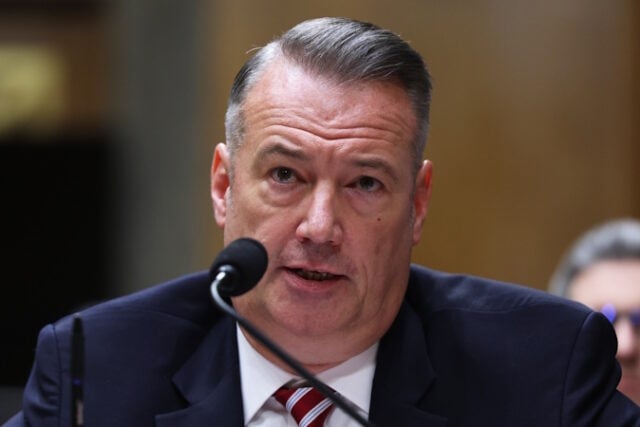
On April 16, 2026, the Department of Homeland Security (DHS) confirmed that Todd Lyons, the acting director of U.S. Immigration and Customs Enforcement (ICE), will step down from his post effective May 31, 2026. The departure marks the end of a turbulent 14-month tenure defined by a radical shift in federal immigration enforcement, constitutional legal battles, and mounting personal strain on the agency’s leadership. Lyons, a veteran of both the U.S. Air Force and the federal law enforcement community, has been a central figure in President Donald Trump’s second-term agenda to execute the largest mass deportation operation in American history.
DHS Secretary Markwayne Mullin, who himself took office recently following the high-profile ouster of Kristi Noem, praised Lyons in a formal statement, describing him as a “great leader” who “jumpstarted an agency that had not been allowed to do its job for four years.” Mullin credited Lyons with the removal of “murderers, rapists, pedophiles, terrorists, and gang members,” asserting that American communities are safer as a result of his leadership. Lyons’ stated reason for departure is a desire to spend more time with his family and pursue opportunities in the private sector, yet his resignation comes on the heels of reports indicating severe internal pressure and health-related issues.
A Career Built on Enforcement
Todd Lyons’ trajectory to the top of ICE began in the military and local law enforcement. Born around 1973, Lyons served in the United States Air Force from 1993 to 2006, seeing deployments in South Korea and Europe. Following the September 11 attacks, he was recalled to active duty, serving as an antiterrorism and force protection liaison for the Special Operations Command Central. This background in security and tactical operations would later become the hallmark of his approach to immigration enforcement.
Lyons joined ICE’s Enforcement and Removal Operations (ERO) division in 2007, starting as an immigration enforcement agent in Dallas, Texas. Over the next two decades, he climbed the ranks, serving as Chief of Staff in Dallas and later as the Field Office Director in Boston, where he oversaw operations across six New England states. His reputation as an efficient, mission-focused administrator caught the attention of the Trump transition team following the 2024 election. Though initially bypassed for the acting directorship in favor of Caleb Vitello, Lyons was named the new acting director of ICE on March 9, 2025, after Vitello was reassigned.

The “Amazon Prime” Vision for Deportation
Upon taking the helm, Lyons immediately signaled a shift toward what he described as a “business-like” approach to removals. At the Border Security Expo in April 2025, Lyons articulated a vision that shocked civil rights advocates but galvanized the administration’s base. He argued that the mass deportation operation should function with the logistical precision of a global tech giant.
“We need to get better at treating this like a business,” Lyons stated, “where this mass deportation operation is something like you would see and say, like Amazon trying to get your Prime delivery within 24 hours. So trying to figure out how to do that with human beings.”
This analogy became the foundational philosophy of his leadership. Under Lyons, ICE sought to industrialize the process of tracking, detaining, and removing noncitizens. This included the pursuit of the “Detention Reengineering Initiative,” a massive project aimed at retrofitting warehouses into detention centers to accommodate a rapidly growing population of detainees. Funded by the “One Big Beautiful Act”—a legislative package providing nearly $75 billion in supplemental funding—Lyons oversaw plans to add over 90,000 “beds” to the system, a move critics described as the creation of “Amazon-style human warehouses.”
Constitutional Challenges and the “Secret Memo”
The most significant legal controversy of Lyons’ tenure emerged in May 2025, when a whistleblower leaked a confidential memorandum authored by Lyons. The document authorized ICE officers to use administrative warrants—internal agency documents signed by ICE supervisors rather than judicial warrants signed by a judge—to enter private residences.
Historically, the Fourth Amendment has been interpreted to require a judicial warrant or consent for federal agents to enter a private home. Lyons’ memo, however, asserted that the DHS Office of General Counsel had determined that administrative warrants alone were sufficient for arrests subject to final orders of removal. The policy was reportedly distributed through verbal briefings rather than written training manuals to avoid a paper trail.
The memo prompted immediate backlash from members of Congress and civil liberties groups. Representative Luz Rivas and Senator Richard Blumenthal were among those who condemned the policy as a “blunt disregard for constitutional rights.” Legal challenges argued that the policy transformed ICE into a “spearhead to our democracy’s decline,” shifting the nation toward a state of “rule by force.” Despite the outcry, Lyons defended the practice as a necessary tool for the “intelligence-driven targeted enforcement” required by the administration’s quotas.
The Minneapolis Tragedy: Renee Good and Alex Pretti
The human cost of this aggressive enforcement strategy came into sharp focus in January 2026. During a series of immigration raids in Minneapolis, Minnesota, two U.S. citizens were fatally shot by federal agents in separate incidents within weeks of each other.
On January 7, 37-year-old Renee Nicole Macklin Good was shot in the head by an ICE officer after she stopped her car to witness an enforcement action. While the administration claimed she had attempted to strike an officer with her vehicle, video footage later surfaced suggesting she was stationary and non-threatening at the time of the shooting. Further reports indicated that ICE officers blocked a nearby physician from administering life-saving care to Good, who still had a pulse for several minutes after being shot.
Weeks later, on January 24, Alex Jeffrey Pretti, an ICU nurse, was killed by CBP and ICE agents while attempting to help a civilian who had been pepper-sprayed. Witnesses reported that Pretti was disarmed and restrained when he was shot multiple times in the back. The deaths of two American citizens at the hands of immigration agents triggered a “public health emergency” declaration in the city and intensified the national debate over the “culture of impunity” within the agency under Lyons’ direction.
Internal Pressures and Health Issues
Beneath the veneer of aggressive efficiency, Lyons reportedly struggled with the immense weight of the administration’s demands. In March 2026, Politico published a report detailing that Lyons had been hospitalized at least twice for stress-related issues over a seven-month period. One incident described Lyons becoming so distressed during a high-stakes enforcement operation that bodyguards were forced to bring a portable defibrillator to his side.
Sources within the administration alleged that Stephen Miller, a senior advisor to the President, exerted relentless pressure on Lyons through daily 10 a.m. phone calls. Miller was reported to frequently yell at Lyons for failing to meet the “insanely high” deportation quotas set by the White House. While the White House dismissed these reports as “inaccurate trash” and Lyons himself attributed his health visits to “military deployment VA issues,” the image of an agency head under siege persisted.
A Leadership Void in a Polarized Era
Lyons’ departure leaves a massive leadership vacuum at ICE at a time when the agency is central to the country’s political identity. His tenure coincided with a period where ICE agents were even deployed to bolster TSA security at airports amid a congressional budget impasse, a move that brought the realities of immigration enforcement to every traveler in America.
As of April 16, no successor has been named. Finding a replacement will be one of the first major challenges for Secretary Mullin, who must find a leader capable of sustaining the administration’s “Amazon Prime” efficiency while navigating the minefield of constitutional litigation and public outcry. Lyons’ resignation effective May 31 represents not just the end of a personal chapter for a career officer, but a potential turning point for an agency that has become the most visible and controversial arm of the federal government.
Sources Used and Links:
- MS NOW: Acting ICE Director Todd Lyons resigns
- Associated Press / WKMG: ICE acting director Todd Lyons will resign at end of May, DHS says
- Wikipedia: Todd Lyons – Wikipedia
- U.S. Immigration and Customs Enforcement (ICE): ICE Leadership – Todd M. Lyons
- House of Representatives (Bio): Todd M. Lyons Senior Official Bio
- First Coast News: Acting ICE Director Todd Lyons to leave Homeland Security
- National Immigration Law Center (NILC): ICE Wants to Stash People in Amazon-style Warehouses
- House Oversight Democrats: MN Oversight Report – Shooting of Renee Good and Alex Pretti
- The New Republic: ICE Chief Hospitalized as Stephen Miller Keeps Yelling at Him
- WFMD / Fox News: White House blasts POLITICO report on acting ICE chief hospitalizations
- Congresswoman Luz Rivas (Official Letter): February 19, 2025 The Honorable Todd Lyons Letter regarding “Secret Memo”
Disclaimer
Artificial Intelligence Disclosure & Legal Disclaimer
AI Content Policy.
To provide our readers with timely and comprehensive coverage, South Florida Reporter uses artificial intelligence (AI) to assist in producing certain articles and visual content.
Articles: AI may be used to assist in research, structural drafting, or data analysis. All AI-assisted text is reviewed and edited by our team to ensure accuracy and adherence to our editorial standards.
Images: Any imagery generated or significantly altered by AI is clearly marked with a disclaimer or watermark to distinguish it from traditional photography or editorial illustrations.
General Disclaimer
The information contained in South Florida Reporter is for general information purposes only.
South Florida Reporter assumes no responsibility for errors or omissions in the contents of the Service. In no event shall South Florida Reporter be liable for any special, direct, indirect, consequential, or incidental damages or any damages whatsoever, whether in an action of contract, negligence or other tort, arising out of or in connection with the use of the Service or the contents of the Service.
The Company reserves the right to make additions, deletions, or modifications to the contents of the Service at any time without prior notice. The Company does not warrant that the Service is free of viruses or other harmful components.