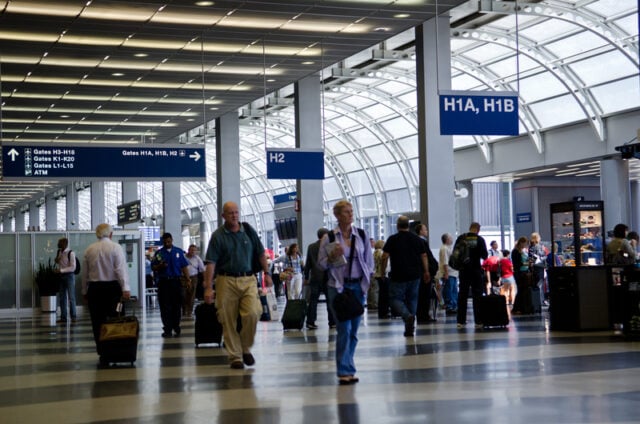
CHICAGO — The Federal Aviation Administration (FAA) has issued a sweeping mandate requiring airlines at Chicago O’Hare International Airport (ORD) to slash their schedules by more than 300 flights per day this summer. The emergency order, announced on Thursday, April 16, 2026, aims to prevent a “catastrophic” breakdown of the national aviation network as air traffic reaches record-breaking levels amidst persistent staffing shortages and critical runway construction.
According to federal officials, the FAA will restrict O’Hare to a maximum of 2,708 daily operations—inclusive of arrivals and departures—from May 17 through October 24, 2026. This cap represents a sharp reduction from the 3,080 flights daily that carriers had planned for the peak summer season, a nearly 12% cut that will force United Airlines and American Airlines to dismantle portions of their recently expanded schedules.
A “Turf War” Collides with Reality
The decision to intervene follows months of escalating tensions between the FAA and the airport’s two primary tenants. United and American Airlines have been engaged in what industry analysts describe as a “scheduling turf war,” with both carriers aggressively adding capacity to O’Hare in a bid to dominate the nation’s second-busiest hub.
For the summer of 2026, planned flight volumes at ORD were set to increase by approximately 15% over 2025 levels. However, the FAA and the Department of Transportation (DOT) determined that these schedules were “unrealistic” given the current infrastructure constraints.

“If you book a ticket, we want you and your family to have the certainty that you’ll fly without endless delays and cancellations,” said U.S. Transportation Secretary Sean Duffy in a statement accompanying the order. “We successfully turned Newark Liberty International into the most on-time airport in the Tri-State Area by fixing overcapacity. Applying that same strategy at O’Hare will reduce delays and make this busy summer travel season a little easier.”
The FAA initially proposed a stricter cap of 2,608 flights per day, but after intense negotiations with the Chicago Department of Aviation (CDA) and airline executives, the agency settled on 2,708. This compromise allows for roughly 100 more daily flights than O’Hare’s peak in 2025, but falls far short of the “blockbuster” summer airlines had envisioned.
The Anatomy of a Capacity Crisis
The FAA’s decision to trigger its statutory delay-reduction authority under Section 41722 was driven by a “perfect storm” of operational hurdles.
- Taxiway Construction: Ongoing projects under the O’Hare Modernization Program have resulted in the closure of critical taxiways, significantly slowing the movement of aircraft between the gates and the runways. This “constrained taxiway environment” reduces the airport’s ability to handle high-frequency “banks” of flights—the periods where dozens of planes land and take off in a short window to facilitate passenger connections.
- Controller Shortages: Despite an aggressive national hiring campaign—which has notably targeted “gamers” for their spatial awareness and multitasking skills—the Chicago Terminal Radar Approach Control (TRACON) and O’Hare tower remain understaffed. The FAA is currently training thousands of new controllers, but many are still months away from full certification.
- Historical Performance: In the summer of 2025, only slightly more than half of O’Hare’s flights arrived or departed on time. Federal officials feared that adding 400 more daily flights to an already struggling system would lead to “widespread operational disruption.”
National and International Ripple Effects
As one of the world’s most critical aviation hubs, O’Hare’s performance dictates the flow of air traffic across the entire United States. When a storm or a scheduling bottleneck grounds planes in Chicago, the impact is felt from New York to Los Angeles.
The National Airspace System (NAS)
The FAA warned that without these cuts, O’Hare would likely experience “gridlock” that would spill over into the National Airspace System. Because O’Hare is a primary connecting point for domestic travel, a two-hour delay in Chicago can cause a flight in Phoenix to be canceled due to crew timing out or aircraft being out of position. By limiting O’Hare’s capacity, the FAA is essentially sacrificing volume to preserve the reliability of the broader network.
International Consequences
The cuts are expected to have a significant impact on transatlantic and transpacific travel. O’Hare is a major gateway for international carriers like Lufthansa, British Airways, and ANA. The airport has already seen disruptions; just days ago, on April 14, 2026, O’Hare recorded over 400 disruptions, including broken transatlantic routes to Frankfurt and Munich.
While the FAA’s order primarily targets domestic frequency, the reduction in slots means fewer opportunities for international passengers to connect to regional U.S. cities. This could lead to higher fares for international travelers and may force some carriers to reroute passengers through other hubs like Washington Dulles or New York-JFK.
What This Means for Summer Travelers
For the millions of passengers planning to travel through Chicago this summer, the FAA order is a double-edged sword.
- Fewer Cancellations, More Certainty: The primary goal of the cap is to ensure that the flights that do remain on the schedule actually take off. By aligning the schedule with the airport’s physical capacity (roughly 2,800 operations per hour, according to the FAA), the agency hopes to eliminate the “rolling delays” that often plague peak travel days.
- Reduced Options and Higher Fares: With approximately 300 to 370 daily flights being removed from the system, passengers will have fewer choices. Direct flights to smaller regional airports are often the first to be cut when airlines are forced to consolidate. Basic economic principles suggest that lower supply coupled with high summer demand will lead to a spike in ticket prices.
- Rebooking Chaos: Airlines must now begin identifying which flights to cancel and notifying ticket holders. Passengers booked on mid-day or late-evening “fringe” flights may find themselves moved to earlier slots or rerouted through other hubs.
The “Gamer” Recruitment Strategy
In an unusual move to address the long-term staffing root of these issues, the FAA has launched a high-profile recruitment campaign aimed at the younger generation. Under Secretary Duffy, the agency has identified gamers as a prime demographic for air traffic control, citing their “hard skills” in multitasking and spatial awareness.
“Gamers represent a growing demographic of young adults who have many of the skills it takes to be a successful controller,” the FAA stated in its recruitment materials. The agency is opening a new application round on Friday, April 17, offering six-figure salaries to those who pass the rigorous 3.5-hour cognitive skills assessment. However, these new recruits will not be ready in time to alleviate the pressure on O’Hare this summer.
Airline and City Reactions
Surprisingly, both United and American Airlines issued statements that were cautiously supportive of the FAA’s intervention, perhaps recognizing that a summer of chaos would be more damaging to their brands than a summer of reduced capacity.
American Airlines stated that the order would “improve reliability and reduce delays for customers,” while United applauded a “solution that makes sense for everyone who cares about O’Hare’s success.”
The Chicago Department of Aviation also expressed appreciation for the FAA’s “thoughtful approach,” ensuring that the limits do not extend beyond the 2026 summer season and do not fall below the actual operational levels seen in 2025.
Conclusion
The “Great Summer Cut” at O’Hare marks a pivotal moment in U.S. aviation policy. It represents a shift from a laissez-faire approach to airline scheduling toward a more interventionist “reliability-first” model. While travelers may face higher prices and fewer flight times, the FAA is betting that a shorter, more reliable schedule is better than an ambitious one that fails to deliver. As May 17 approaches, all eyes will be on the runways of Chicago to see if this drastic reduction can truly fix the nation’s most congested airspace.
Sources Used and Links:
- CBS News Chicago: FAA orders Chicago O’Hare International Airport to cut over 300 planned flights daily between May and October
- KSAT / AP News: Federal officials order flight cuts at Chicago O’Hare to reduce airport delays
- Daily Herald: FAA cuts more than 370 daily flights at O’Hare this summer, citing safety, efficiency
- The Points Guy: FAA orders flight reductions at Chicago’s O’Hare this summer
- DLA Piper: FAA initiates scheduling reduction process at Chicago ORD for Summer 2026
- FAA.gov: Safe Skies. Strong Careers. We’re Hiring Air Traffic Controllers.
- Travel Tourister: Chicago O’Hare Chaos: 400+ Disruptions as Storms & Strikes Hit ORD
- Built In: Attention Gamers: The FAA Wants to Hire You for Six-Figure Air Traffic Jobs.
Disclaimer
Artificial Intelligence Disclosure & Legal Disclaimer
AI Content Policy.
To provide our readers with timely and comprehensive coverage, South Florida Reporter uses artificial intelligence (AI) to assist in producing certain articles and visual content.
Articles: AI may be used to assist in research, structural drafting, or data analysis. All AI-assisted text is reviewed and edited by our team to ensure accuracy and adherence to our editorial standards.
Images: Any imagery generated or significantly altered by AI is clearly marked with a disclaimer or watermark to distinguish it from traditional photography or editorial illustrations.
General Disclaimer
The information contained in South Florida Reporter is for general information purposes only.
South Florida Reporter assumes no responsibility for errors or omissions in the contents of the Service. In no event shall South Florida Reporter be liable for any special, direct, indirect, consequential, or incidental damages or any damages whatsoever, whether in an action of contract, negligence or other tort, arising out of or in connection with the use of the Service or the contents of the Service.
The Company reserves the right to make additions, deletions, or modifications to the contents of the Service at any time without prior notice. The Company does not warrant that the Service is free of viruses or other harmful components.