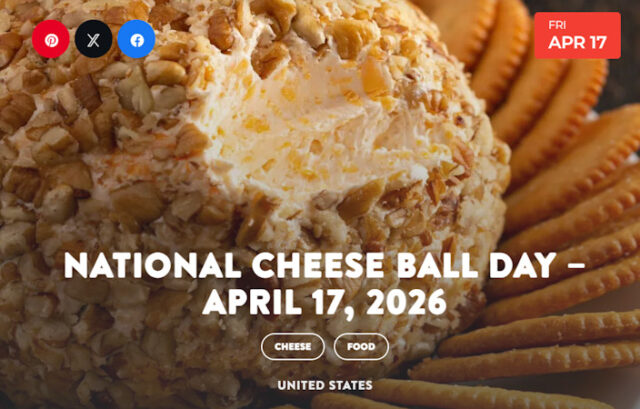
April 17 recognizes the food holiday National Cheese Ball Day.
- 1801 – The town of Cheshire, MA, sent a 1,000-pound cheese ball to the White House as a gift for the new President Thomas Jefferson.
- 1930s – The airy, crunchy style of cheeseball snack traces back to industrial experiments in the 1930s, when Midwestern animal‑feed plants discovered that moistened cornmeal forced through a heated extruder puffed into light, irregular shapes.
- 1943 – At the Flakall Corporation in Wisconsin, Edward Wilson and coworkers develop a process of extruding heated, moistened cornmeal that puffs as it exits the machine, then coat the curls with cheese, creating one of the first cheese-flavored puffed corn snacks.
- 1944 – The recipe for cheese balls is printed for the first time in the cookbook “Food of My Friends” by Virginia Safford.
- 1948 – By the late 1940s, companies such as Elmer’s Fine Foods in New Orleans begin selling commercial cheese curls and puffs, helping establish the airy, cheese-coated corn snack category that later includes ball-shaped cheese puff snacks
- 1950s – Cream cheese–based cheese balls and logs, often mixed with grated cheese and rolled in nuts or herbs, spread through midcentury American cookbooks and women’s magazines, turning molded cheese spreads into cocktail party and holiday buffet fixtures.
- 1981 – Planters introduces Cheez Balls, a canned, neon-orange, ball-shaped puffed corn snack coated in cheese powder, helping cement the cheese ball as not only a creamy party spread but also a familiar crunchy snack food in the United States.
- 2002 – Cheese ball enthusiast and comedian Amy Sedaris writes a play about cheese balls titled “The Book of Liz.”
- 2003 – Cheese balls get a bad rep, with Amanda Hesser writing in “The New York Times,” “Cheese balls tend to be associated with shag rugs and tinsel, symbols of the middle-class middlebrow.”
- 2018 – After being discontinued for several years, Kraft Heinz brings Planters Cheez Balls back to U.S. store shelves for a limited run, drawing on consumer nostalgia and renewing attention to the bright-orange cheese ball snack.
- A cheese spread in the shape of a ball served with crackers, most often around Christmas in the U.S. This cheese ball is commonly made with softened cream cheese and other ingredients.
- Cheese puffs are a puffed corn snack coated with a mixture of cheese or cheese-flavored powders. Cheese puffs are manufactured by extruding heated corn dough through a die that forms the particular shape, most likely a ball shape.
- Cheese is a generic term for a diverse group of milk-based food products. Cheese is produced throughout the world in wide-ranging flavors, textures, and forms. There are over 2000 varieties.
- Cheddar cheese is dyed orange to give it an appealing color. White cheddar is closer to its natural color.
- Cheese is one of the oldest foods, dating back 4,000 years to ancient Egypt.
- Cheese takes up about 1/10 of the volume of the milk it was made from.
- The terms “Big Wheel” and “Big Cheese” originally referred to those who were wealthy enough to purchase a whole wheel of cheese.
- The term “cheese ball” can also refer to the puffed orange snack sold in the snack aisle.
- A “cheeseball” also refers to someone trying to be funny or corny
- A cheese spread in the shape of a ball, usually served around Christmas in the United States
- Cheese balls and cheese puffs are related but not the same.
- Bocconcini, an Italian cheese in the shape of a ball
- Cheese puffs, a processed snack made from puffed corn and cheese, sometimes ball-shaped
- A synonym for “cheesy”
- A Midwestern United States slang term for breaded and fried cheese curds
- Cheesey songs;
- Alvin and the Chipmunks 2 (2007)
- Cheese Please (2017) by Fred Molin
- Wrecking Ball (2013) Miley Cyrus
- Mice Eat Cheese (2001) Modest Mouse
- Great Balls of Fire (1961) Jerry Lee Lewis
- Cheesy Love Song (2020) The Lazy Eyes
Sources:

Joy of Kosher
Disclaimer
Artificial Intelligence Disclosure & Legal Disclaimer
AI Content Policy.
To provide our readers with timely and comprehensive coverage, South Florida Reporter uses artificial intelligence (AI) to assist in producing certain articles and visual content.
Articles: AI may be used to assist in research, structural drafting, or data analysis. All AI-assisted text is reviewed and edited by our team to ensure accuracy and adherence to our editorial standards.
Images: Any imagery generated or significantly altered by AI is clearly marked with a disclaimer or watermark to distinguish it from traditional photography or editorial illustrations.
General Disclaimer
The information contained in South Florida Reporter is for general information purposes only.
South Florida Reporter assumes no responsibility for errors or omissions in the contents of the Service. In no event shall South Florida Reporter be liable for any special, direct, indirect, consequential, or incidental damages or any damages whatsoever, whether in an action of contract, negligence or other tort, arising out of or in connection with the use of the Service or the contents of the Service.
The Company reserves the right to make additions, deletions, or modifications to the contents of the Service at any time without prior notice. The Company does not warrant that the Service is free of viruses or other harmful components.