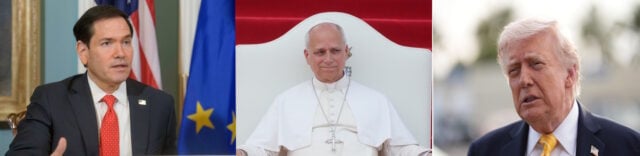
If you’re Marco Rubio right now, you might be wondering if someone in the scheduling department has a dark sense of humor. Imagine this: you are the Secretary of State, a devout Catholic, and you’re packing your bags for a high-stakes trip to the Vatican and the Italian capital. Your goal is to smooth over some of the roughest diplomatic waters in decades. But just as you’re reaching for your passport, your boss—President Donald Trump—decides to hop on a popular radio show and lob a rhetorical grenade right over the Tiber River.
This isn’t just a minor disagreement about trade or tariffs. This is a full-blown, public “assailing” of the Holy See. On the very eve of Rubio’s departure to meet with Pope Leo XIV and Italian Prime Minister Giorgia Meloni, President Trump hasn’t just criticized the Pope; he’s practically accused him of being a security threat. And let’s be honest, it’s not exactly the kind of “pre-game” hype a diplomat wants when they’re trying to build bridges in the Eternal City.
The Interview That Set Rome Ablaze
The sparks started flying during an interview with conservative commentator Hugh Hewitt on Monday. In what has become a recurring theme for the 47th President, Trump didn’t hold back when the conversation turned toward the Vatican. The point of contention? Iran. Specifically, the ongoing “Iran war” and the Pope’s outspoken opposition to military escalation.
Trump told Hewitt that the Pope “would rather talk about the fact that it’s OK for Iran to have a nuclear weapon.” He followed that up with an even sharper jab: “I think he’s endangering a lot of Catholics and a lot of people.” Now, if you’ve followed the Vatican at all, you know that Pope Leo—the first American-born pontiff, hailing from Chicago—has actually spent a good chunk of his papacy calling for the total abolition of nuclear weapons. But in the world of high-stakes political messaging, those nuances often get lost in the shuffle.

For Rubio, these comments aren’t just “noise.” They are the new baseline for his meeting on Thursday. Instead of walking into the Apostolic Palace to talk about humanitarian aid or the imprisonment of Catholic activist Jimmy Lai in China, Rubio is now walking into a room where the first thing on everyone’s mind is the fact that the U.S. President thinks the guy across the table is making the world less safe.
Pope Leo XIV: The Chicagoan at the Crossroads
To understand why this is so explosive, you have to look at the man in the white cassock. Pope Leo XIV isn’t your typical European intellectual. He’s a Chicago native, and since his election last year, he’s shown a very “American” penchant for directness. He has emerged as one of the most vocal critics of the administration’s foreign policy, particularly concerning the conflict in Iran and the mass deportation of migrants.
Just yesterday, while at Castel Gandolfo, the Pope fired back—though in true papal fashion, he didn’t name Trump directly. He told reporters, “The mission of the church is to preach the Gospel, to preach peace. If anyone wants to criticize me for announcing the Gospel, let him do it with the truth.” It was a polite way of saying, “Check your facts, Mr. President.”
The friction here is deep. Trump has previously called Leo “weak on crime” and “terrible on foreign policy.” He even went as far as to suggest that the Church only picked an American Pope as a strategic move to “deal with” him. It’s a fascinating dynamic: a President who prides himself on “America First” clashing with an American Pope who is preaching a globalist, pacifist “Gospel First” message.
Marco Rubio’s Impossible Balancing Act
This brings us back to Secretary Rubio. He’s often the “calmer of storms” in this administration, tasked with explaining the President’s “maximum pressure” rhetoric to skeptical European allies. But this time, it’s personal. Rubio is a practicing Catholic. He’s been to the Vatican at least three times in the last year. He was there for Pope Leo’s inaugural mass, and he’s clearly invested in maintaining a functional relationship with the Holy See.
On Tuesday, Rubio stood at the White House and did his best to perform some world-class rhetorical gymnastics. He told reporters that Trump’s criticisms were “rooted in his opposition to Iran potentially obtaining a nuclear weapon.” He essentially tried to separate the intent of the President (preventing a nuclear Iran) from the target of the President (the Pope’s stance).
“I cannot understand why anyone would think that it’s a good idea for Iran to ever have a nuclear weapon,” Rubio said, pivoting the conversation away from the insult and back to the policy. But will that pivot work in Rome? Pope Leo has already stated that God “does not listen to the prayers of those who wage war.” That’s a pretty high wall for even a seasoned diplomat like Rubio to climb.
The Meloni Factor: A Relationship Gone Cold
It’s not just the Vatican that Rubio has to worry about. On Friday, he’s scheduled to meet with Prime Minister Giorgia Meloni. Not long ago, Meloni was seen as one of Trump’s closest ideological allies in Europe. They shared a populist, conservative vision that seemed to align perfectly.
But lately, that relationship has hit a rough patch. Meloni has become a vocal critic of the Iran war, and she didn’t take kindly to Trump’s attacks on the Pope. In fact, she’s even chided the President for his rhetoric. This is a significant shift. When your most reliable partner in Southern Europe starts telling you that you’ve gone too far, you know the diplomatic climate has shifted.
Italian Foreign Minister Antonio Tajani also weighed in on social media, calling Trump’s comments “neither acceptable nor helpful to the cause of peace.” So, when Rubio sits down with the Italian leadership, he won’t just be talking about NATO budgets or Mediterranean security; he’ll be trying to convince them that the United States is still a stable, predictable partner, despite the headlines.
Why Does This Matter? The Big Picture
You might be asking, “Why does a spat between a President and a Pope matter in 2026?” Well, there are a few big reasons:
- The Midterms: Congressional elections are coming up. The “Catholic vote” in the U.S. is a massive, diverse, and often decisive bloc. When the President attacks the head of the Church—especially a popular, American-born Pope—it makes some conservative Catholics very uncomfortable.
- The Iran Conflict: The Vatican still holds immense soft power and diplomatic channels that the U.S. doesn’t always have. If the U.S. wants a resolution to the Iran war that doesn’t involve total regional collapse, having the Vatican as a mediator (or at least a neutral party) is invaluable.
- The Moral Narrative: Trump’s recent social media activity—like that briefly-posted image likening himself to Jesus (which he later claimed was him as a “doctor”)—has created a narrative of “secular vs. sacred” that the administration is struggling to manage.
What to Expect on Thursday
When the doors to the private library at the Vatican open on Thursday morning, all eyes will be on the body language between the Secretary of State and the Holy Father. The official agenda includes “mutual interests in the Western Hemisphere” and “the situation in the Middle East.” But the real agenda is about whether these two massive powers—the White House and the Holy See—can find a way to disagree without being disagreeable.
Rubio is a pro. He’ll likely emphasize their shared goals: fighting for religious freedom in Africa and getting humanitarian aid to those who need it. He might even bring up Jimmy Lai, hoping to find common ground in defending persecuted Christians in China.
But as long as the “assailing” continues from the Oval Office, Rubio’s “fence-mending” mission will feel a lot like trying to paint a house while someone else is throwing mud at the walls. It’s going to be a long trip to Rome.
Sources Used and Links:
- America Magazine: “Trump attacks Pope Leo again ahead of Marco Rubio’s Vatican visit” https://www.americamagazine.org/vatican-dispatch/2026/05/05/trump-pope-leo-marco-rubio/
- Associated Press (AP News): “Trump again assails Pope Leo, potentially complicating Rubio’s visit to the Vatican this week” https://apnews.com/article/trump-rubio-pope-iran-19fac7bba8f7c9b4d59630b7d5537868
- France 24: “Italian media reports US top diplomat Rubio to meet Pope Leo” https://www.youtube.com/watch?v=t0ed4oiFe5g
- The Washington Post: “Rubio to meet with Pope Leo amid Trump’s clash with pontiff on Iran” https://www.washingtonpost.com/world/2026/05/03/rubio-pope-trump-vatican/
- National Catholic Reporter: “Ahead of Rubio meeting with pope, Trump says Leo is ‘endangering a lot of Catholics'” https://www.ncronline.org/news/ahead-rubio-meeting-pope-trump-says-leo-endangering-lot-catholics
- Catholic Review: “Trump renews attacks on Pope Leo over Iran war, accuses him of endangering Catholics” https://catholicreview.org/trump-renews-attacks-on-pope-leo-over-iran-war-accuses-him-of-endangering-catholics/
- PBS News: “Rubio to meet with Pope Leo in Vatican City amid tensions with Trump” https://www.pbs.org/newshour/politics/rubio-to-meet-with-pope-leo-in-vatican-city-amid-tensions-with-trump
- White House (Official Site): “Secretary of State Marco Rubio Briefs Members of the Media, May 5, 2026” https://www.whitehouse.gov/videos/secretary-of-state-marco-rubio-briefs-members-of-the-media-may-5-2026/
Disclaimer
Artificial Intelligence Disclosure & Legal Disclaimer
AI Content Policy.
To provide our readers with timely and comprehensive coverage, South Florida Reporter uses artificial intelligence (AI) to assist in producing certain articles and visual content.
Articles: AI may be used to assist in research, structural drafting, or data analysis. All AI-assisted text is reviewed and edited by our team to ensure accuracy and adherence to our editorial standards.
Images: Any imagery generated or significantly altered by AI is clearly marked with a disclaimer or watermark to distinguish it from traditional photography or editorial illustrations.
General Disclaimer
The information contained in South Florida Reporter is for general information purposes only.
South Florida Reporter assumes no responsibility for errors or omissions in the contents of the Service. In no event shall South Florida Reporter be liable for any special, direct, indirect, consequential, or incidental damages or any damages whatsoever, whether in an action of contract, negligence or other tort, arising out of or in connection with the use of the Service or the contents of the Service.
The Company reserves the right to make additions, deletions, or modifications to the contents of the Service at any time without prior notice. The Company does not warrant that the Service is free of viruses or other harmful components.