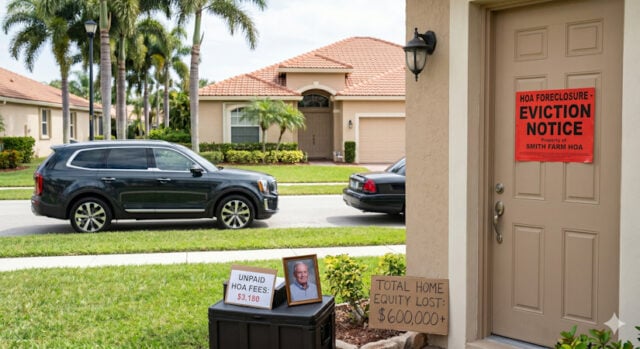
On a humid morning in April 2026, the quiet streets of a Lake Worth neighborhood became the scene of a tragedy that has become increasingly common in the Florida real estate market. Deborah Megna, a 63-year-old woman suffering from failing health, was not just losing her home—she was losing her life’s savings. As Palm Beach County sheriff’s deputies arrived to execute an eviction order, the situation turned dire; Megna, overwhelmed and ailing, had to be carried out on a stretcher and rushed to a nearby hospital.
The catalyst for this total displacement was not a massive mortgage default or a complex financial fraud. It was a debt of just $3,180.
According to a detailed investigation by the Florida Bulldog, Megna’s plight serves as a chilling case study in how easily South Florida homeowners can be separated from their hard-earned equity through a combination of aggressive Homeowners Association (HOA) tactics and “alternative” legal procedures that critics say are designed to favor corporate scavengers over residents. Megna’s six-year legal nightmare began with a relatively small lien for unpaid fees to her HOA, Smith Farm. By the time the dust settled, she had been evicted from a mortgage-free house, likely losing more than $600,000 in unencumbered equity.
The Mechanics of Equity Stripping
The Florida Bulldog reports that the “alarming” nature of the Megna case is rooted in a specific exploitation of Florida’s public-notice and foreclosure laws. In a typical foreclosure, a property is sold at a public auction to the highest bidder, with the proceeds first paying off the debt and the “surplus” funds—the remaining equity—going back to the homeowner. However, a loophole allows lien holders to utilize “alternative” procedures for these auctions.

With a judge’s approval, these procedures essentially transform what should be a transparent public auction into a private sale. “The lien-holding sellers aren’t doing anything illegal; they’re simply exploiting a law that gives them all the cards,” the Florida Bulldog noted, quoting legal experts familiar with the matter.
In many of these “alternative” auctions, the date and location are not widely publicized, leading to “one-bidder” scenarios. In some instances, corporate entities with insider knowledge can secure properties for nominal amounts—sometimes as low as $100—effectively seizing a valuable asset while leaving the homeowner with nothing. For Megna, her property was acquired by First York Capital LLC, a Boca Raton-based entity that moved quickly to secure possession of the Lake Worth residence.
A Disproportionate Punishment
The central outrage of the Megna case, as highlighted by her attorney Margherita Downey, is the gross disproportionality between the financial “misdeed” and the punishment. Megna owned her home outright; there was no mortgage. The $600,000 in value was her safety net.
“What began for Megna with a $3,180 lien for unpaid homeowners association (HOA) fees has morphed into a full-on nightmare,” the Florida Bulldog report stated. “She’s not only evicted from her mortgage-free house, she’s likely to lose $600,000 in equity.”
The judicial system’s role in this process has come under fire. Critics argue that judges who sign off on these alternative auction procedures are inadvertently facilitating predatory behavior. By allowing sales to happen “offline” or with minimal public notice, the court system effectively helps “shadowy buyers” reap wildly excessive profits at the expense of vulnerable individuals.
The human cost was evident the morning after Megna’s eviction. Her advocate, Gail Waitkin, filed an affidavit stating that the new owner’s agents prevented Megna’s team from retrieving personal valuables, including jewelry and even $35,000 worth of dental implants. It was a total erasure of a woman’s personal and financial existence, all stemming from a debt that could have been settled for a fraction of the home’s value.
The Political Stranglehold
Efforts to reform these predatory practices have faced stiff opposition in Tallahassee. State Senator Ileana Garcia, R-Miami, has been a vocal proponent of closing these loopholes, attempting to introduce legislation that would protect homeowner equity and ensure more transparent auction processes.
However, these efforts have repeatedly stalled. Garcia pointed the finger directly at the legal establishment. In a statement to the Florida Bulldog, Garcia blamed the Florida Bar’s real estate practice section for “bamboozling” reform language she had added to a recent bill.
“The Florida Bar managed to bamboozle it!” Garcia said, expressing frustration at the influence of professional associations that may benefit from the current, albeit lopsided, legal framework.
The lawyer who spoke to the Bulldog on condition of anonymity echoed this sentiment, suggesting that “bad actors” are simply replicating this predatory model across the state, year after year, because the law allows it. The financial incentives for corporate entities to monitor HOA lien filings and “snatch” equity are simply too great to ignore without legislative intervention.
Due Process and the “Surplus” Mystery
A major component of Megna’s ongoing legal battle is the question of due process. Her attorney, Margherita Downey, argues that Megna was never legally served in the foreclosure case, a fundamental violation of her rights. If a homeowner is not properly notified that their property is being auctioned, they lose the opportunity to pay the debt, sell the home themselves, or protect their equity.
Furthermore, there is the issue of “surplus funds.” Under Florida law, a foreclosed homeowner is entitled to any money left over after the debts are paid. However, in the “alternative” auction model, where properties sell for a pittance to a single bidder, there is often no surplus generated. The “value” is captured entirely by the buyer who gets a $600,000 home for a fraction of its worth, rather than the homeowner receiving the difference between the sale price and the debt.
To date, Megna has not received a single cent from the January sale of her home. Meanwhile, the original $3,180 judgment has ballooned to nearly $18,000 due to interest, late fees, and legal costs—a mountain of debt that, while significant, still pales in comparison to the half-million dollars in equity that has vanished.
A Growing Crisis in the Sunshine State
The Megna case is not an isolated incident. Across South Florida, from the high-rises of Miami to the suburban enclaves of Palm Beach County, HOAs wield immense power. Designed to maintain community standards, these associations have increasingly become a primary driver of foreclosures. When combined with “equity-stripping” auction tactics, the result is a systemic transfer of wealth from individual residents to corporate investment firms.
Advocates for homeowners are calling for a mandatory “equity protection” clause in Florida law, which would require that any foreclosure sale of a property with significant equity be conducted with maximum public exposure, or perhaps require a minimum bid based on a percentage of the appraised value.
Without such protections, the “alternative” procedures will continue to turn the court system into a marketplace for “one-bidder auction bargains.” As the Florida Bulldog report concluded, the current system allows a homeowner’s life savings to be wiped out over a bill that is often less than the cost of a used car.
For Deborah Megna, the next stop is the appellate court. Her legal team is fighting to overturn the sale based on the lack of service and the inherent unfairness of the auction process. But as she recovers from her eviction in a hospital bed, the message to other Florida homeowners is clear: in the battle between a resident’s equity and the legal loopholes of the state, the homeowner is currently standing on very shaky ground.
The ease with which corporate entities can separate a citizen from their home serves as a stark warning. Until the “bamboozling” in Tallahassee stops and the “offline” auctions are brought back into the light of day, the equity of every Florida homeowner remains at risk of being the next “bargain” for a shadowy buyer.
Source:
Florida Bulldog: https://www.floridabulldog.org/2026/04/alarming-so-fla-foreclosure-shows-ease-separating-homeowners-from-equity/
Disclaimer
Artificial Intelligence Disclosure & Legal Disclaimer
AI Content Policy.
To provide our readers with timely and comprehensive coverage, South Florida Reporter uses artificial intelligence (AI) to assist in producing certain articles and visual content.
Articles: AI may be used to assist in research, structural drafting, or data analysis. All AI-assisted text is reviewed and edited by our team to ensure accuracy and adherence to our editorial standards.
Images: Any imagery generated or significantly altered by AI is clearly marked with a disclaimer or watermark to distinguish it from traditional photography or editorial illustrations.
General Disclaimer
The information contained in South Florida Reporter is for general information purposes only.
South Florida Reporter assumes no responsibility for errors or omissions in the contents of the Service. In no event shall South Florida Reporter be liable for any special, direct, indirect, consequential, or incidental damages or any damages whatsoever, whether in an action of contract, negligence or other tort, arising out of or in connection with the use of the Service or the contents of the Service.
The Company reserves the right to make additions, deletions, or modifications to the contents of the Service at any time without prior notice. The Company does not warrant that the Service is free of viruses or other harmful components.