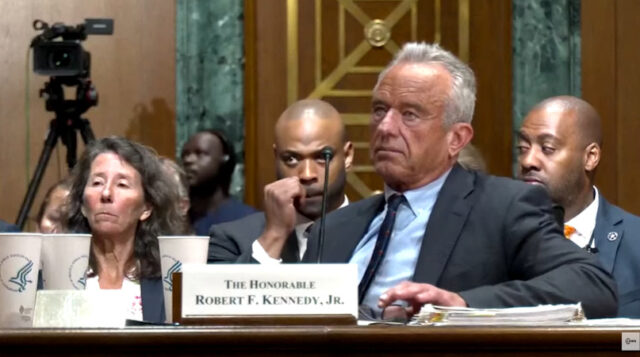
The marble halls of the Dirksen Senate Office Building have witnessed many a political skirmish, but few in recent memory have matched the sustained, high-decibel vitriol directed at Health and Human Services (HHS) Secretary Robert F. Kennedy Jr. during his testimony before the Senate Finance Committee today. Ostensibly convened to discuss the administration’s $111.1 billion FY 2027 budget request, the hearing quickly devolved into a comprehensive indictment of Kennedy’s first year at the helm of the nation’s health apparatus.
From the opening gavel, it was clear that the “honeymoon period” for the controversial Secretary had not just ended—it had been incinerated. Ranking Member Ron Wyden (D-OR) set a scorched-earth tone, accusing Kennedy of using his “once-in-a-lifetime platform” to sow doubt among parents while “ducking, bobbing, and weaving” to avoid accountability for a 2025 measles outbreak that was the worst the United States has seen in three decades.
The Great Vaccine Pivot
Perhaps the most jarring moment of the day came when Kennedy, a man who built a career on skepticism regarding the childhood vaccine schedule, appeared to execute a total 180-degree turn under intense questioning from Senator Michael Bennet (D-CO).
Bennet, citing the record-high number of childhood flu deaths in 2025, pressed Kennedy on whether he still believed the flu vaccine was “destroying children’s brains.” Kennedy’s response was a study in rhetorical retreat. “We’re making sure that we follow the science,” he stated, before being cornered on the measles vaccine. When asked point-blank if the MMR (Measles, Mumps, and Rubella) shot is vital to American public health, Kennedy replied, “That’s my position. We promote the measles vaccine.”

This admission—that the vaccine is 97% effective—sent shockwaves through the gallery. For a base that championed Kennedy as a “truth-teller” against “Big Pharma,” hearing him sound like a career bureaucrat from the CDC felt like a betrayal. Conversely, for Democrats, the pivot was viewed with deep cynicism. Wyden characterized it as “enough fakery to help Senate Republicans ignore the real harm,” suggesting Kennedy would return to “pushing anti-vax policies” the moment he left the hearing room.
“TrumpRx” vs. The Costco Membership
If the vaccine debate was a clash of ideologies, the segment on “TrumpRx”—the administration’s flagship drug discount website—was a clinical dissection of policy failure. Senator Elizabeth Warren (D-MA) arrived armed with a stack of price comparisons that left the Secretary visibly flustered.
Warren highlighted Protonix, a common heartburn medication. On the government-sanctioned TrumpRx site, the drug is listed at $200. “Do you know what the drug costs at Costco?” Warren asked. When Kennedy admitted he did not, she dropped the hammer: “$16.”
The exchange grew more heated as Kennedy attempted to explain that TrumpRx focuses on brand-name drugs rather than generics. Warren was unmoved. “If you’re buying a drug on TrumpRx, there is a more than one in four chance that Trump’s discount is actually a price hike,” she declared, accusing the administration of steering vulnerable patients toward high-margin products that “pad Big Pharma’s profits.” Kennedy’s defense—that the administration is merely “directing people to the generic” eventually—felt hollow against the backdrop of a 1,150% price discrepancy.
Hot Tubs, Kid Rock, and “Vanity Projects”
The scrutiny shifted from policy to “personality” when Senator Maggie Hassan (D-NH) grilled Kennedy on what she described as a series of taxpayer-funded “vanity projects.” Hassan pointed to a string of high-production-value HHS promotional videos that have gone viral for all the wrong reasons.
Among the content mentioned was a video featuring Secretary Kennedy and musician Kid Rock sharing milk in a hot tub, as well as several digital ads depicting Kennedy as a shirtless WWE fighter and a video game hero.
“I have noticed that while HHS has done relatively little promotion of the life-saving measles vaccine… you have been doing a lot of your own self-promotion using official government channels,” Hassan remarked. She questioned whether President Trump had personally authorized the use of HHS resources for these “ego-driven” campaigns. Kennedy defended the videos as “resourceful and imaginative” outreach intended to engage a younger, disillusioned demographic, but he was unable to provide a specific accounting of the costs associated with the productions.
The Medicaid Math Problem
The hearing also touched on the administration’s contentious handling of Medicaid. While Kennedy insisted that the administration is “not reducing Medicaid funding,” citing projections that spending will rise to $981 billion by 2036, Wyden produced a report detailing over 170 hospital and clinic closures across 34 states.
Wyden’s office linked these closures directly to what he termed “the largest cut to Americans’ health care in history,” caused by Republican-led changes to the Medicaid reimbursement structure. “Nearly 7,500 health care workers have lost their jobs,” Wyden noted, presenting the data as an “impossible financial challenge” created by the Secretary’s office. Kennedy countered by pointing to the use of AI in diagnostics and billing as a means of “detecting fraud” and recouping lost funds, though he conceded there were “probably kinks in the system” that still needed to be straightened out.
Denial and Disarray
Perhaps the most personal blow of the afternoon came when Representative Terri Sewell (D-AL)—who attended the Senate hearing as an observer before Kennedy’s scheduled House appearance—was referenced regarding Kennedy’s past comments on “re-parenting” Black children.
Kennedy vehemently denied ever saying that Black children on psychiatric medication should be “re-parented” in rural communities, calling the accusations “made up.” However, the Committee was reminded of a 2024 podcast recording where Kennedy used those exact terms. The Secretary’s spokesperson later clarified that “re-parenting” was a “psychotherapy term,” but the damage in the room was done. The denial, in the face of existing recordings, reinforced a theme of the day: a Secretary at odds with his own record.
Political Fallout
The hearing took place against a backdrop of mounting political anxiety. Even some Republicans, like Senator Bill Cassidy (R-LA)—a physician who had originally supported Kennedy’s confirmation—expressed unease. Cassidy, facing a primary challenge from a Trump-endorsed opponent, walked a razor-thin line, asking pointed questions about the upcoming World Cup and the potential for massive disease outbreaks if vaccine confidence continues to crater.
Republican pollsters have reportedly warned the administration that Kennedy’s vaccine stances are becoming a “political hazard” heading into the 2026 midterms. Today’s testimony, marked by high-profile retreats and factual stumbles, suggests that the Secretary may be becoming a liability not just for public health but also for the party’s electoral prospects.
As the hearing adjourned, observers agreed that the session was a “disaster” for the administration. Kennedy arrived looking to project a new, “healthier” HHS; he left having provided his critics with a fresh mountain of ammunition.
Sources Used and Links:
- The Guardian: RFK Jr faces intense questions in US Senate on measles and flu deaths
- AHA News: HHS Secretary testifies in additional Senate hearings on FY 2027 HHS budget request
- WLRN / NPR: Senators grill RFK Jr. on vaccines, drug prices and more at hearing
- PBS NewsHour: WATCH: RFK Jr. testifies on Trump’s HHS budget request before Senate committees
- AP News: A vaccine standoff and other key moments from RFK Jr.’s first congressional hearing in months
- U.S. Senate Committee on Finance: Wyden Finance Committee Hearing Statement Slamming Trump and RFK Jr.’s Disastrous Health Care Agenda
- Public Citizen: RFK Jr. Consistently Misled Numerous Committees
Disclaimer
Artificial Intelligence Disclosure & Legal Disclaimer
AI Content Policy.
To provide our readers with timely and comprehensive coverage, South Florida Reporter uses artificial intelligence (AI) to assist in producing certain articles and visual content.
Articles: AI may be used to assist in research, structural drafting, or data analysis. All AI-assisted text is reviewed and edited by our team to ensure accuracy and adherence to our editorial standards.
Images: Any imagery generated or significantly altered by AI is clearly marked with a disclaimer or watermark to distinguish it from traditional photography or editorial illustrations.
General Disclaimer
The information contained in South Florida Reporter is for general information purposes only.
South Florida Reporter assumes no responsibility for errors or omissions in the contents of the Service. In no event shall South Florida Reporter be liable for any special, direct, indirect, consequential, or incidental damages or any damages whatsoever, whether in an action of contract, negligence or other tort, arising out of or in connection with the use of the Service or the contents of the Service.
The Company reserves the right to make additions, deletions, or modifications to the contents of the Service at any time without prior notice. The Company does not warrant that the Service is free of viruses or other harmful components.