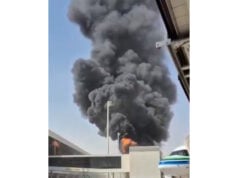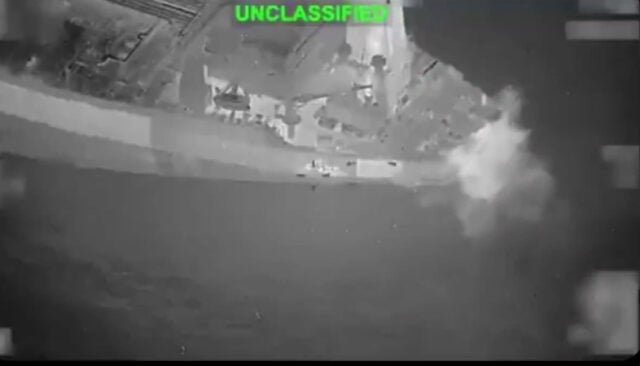
The fragile diplomatic ceasefire between the United States and Iran has suffered its most severe blow to date. A dramatic exchange of heavy military fire erupted across the Persian Gulf following an American operation to intercept and disable a commercial tanker attempting to breach the ongoing U.S. naval blockade. The naval interdiction quickly triggered a massive wave of retaliatory drone and ballistic missile strikes by Iran’s Islamic Revolutionary Guard Corps (IRGC) targeting regional allies, including Kuwait and the headquarters of the U.S. Navy’s Fifth Fleet in Bahrain.
pic.twitter.com/X3Gx7bPjnL https://t.co/ysAR4tv1is
— Pete Hegseth (@PeteHegseth) June 2, 2026
Video courtesy Al Jazeera
The intense back-and-forth marks a dangerous escalation in the 2026 Strait of Hormuz crisis, threatening to completely collapse back-channel peace negotiations that have been quietly unspooling over the past several weeks. While both Washington and Tehran maintain that an official ceasefire remains technically active on paper, the sheer scale of the live-fire engagement has exposed the volatility of the regional security architecture.

The Spark: A Hellfire Missile at Sea
The latest flare-up began in international waters as the Botswana-flagged commercial vessel M/T Lexie, an unladen oil tanker, altered its course and moved directly toward Iran’s strategic oil hub at Kharg Island. According to official statements released by U.S. Central Command (CENTCOM), the vessel’s crew repeatedly ignored maritime warnings and direct instructions from American naval patrols over a continuous 24-hour window.
As the M/T Lexie continued its run to breach the defensive perimeter, a U.S. military aircraft intercepted the vessel. Acting under the strict parameters of the naval blockade established on April 13, 2026, the American aircraft fired an AGM-114 Hellfire missile directly into the tanker’s engine room. The precision strike successfully disabled the ship’s propulsion system at sea without sinking the vessel or causing mass casualties, a tactical methodology the U.S. Navy has deployed multiple times since the blockade began to paralyze non-compliant shipping.
CENTCOM data indicates that the M/T Lexie is the sixth commercial vessel to be forcibly disabled by U.S. forces since the start of the blockade, while another 122 transport ships have been successfully turned around or redirected. However, unlike previous maritime enforcements which resulted in quiet standoffs, this specific strike provoked an immediate and highly coordinated military retaliation from Tehran.
Iran Striking Back: Ballistic Missiles and Air Raid Sirens
Within hours of the M/T Lexie being disabled, the IRGC issued a fierce public declaration via state media, warning that “disrupting the security of the Strait of Hormuz will carry a heavy price for the U.S. military.” What followed was a multi-directional bombardment of drones and ballistic missiles launched from the Iranian mainland, explicitly aimed at U.S. regional strongholds and neighboring Gulf states.
In Bahrain, the night sky was punctured by the wail of air raid sirens as residents were urgently instructed by the Ministry of Interior to seek immediate shelter. The IRGC claimed it successfully struck the sprawling complex of the U.S. Navy’s Fifth Fleet headquarters at Naval Support Activity (NSA) Bahrain. U.S. military officials immediately rejected the claim as psychological warfare, utilizing social media platforms to assert that American and Bahraini integrated air defense networks successfully intercepted all three incoming ballistic missiles before they could impact the naval installation.
Simultaneously, the attack wave expanded north toward Kuwait. The General Staff of the Kuwaiti Armed Forces issued an emergency alert as its localized air defense batteries engaged incoming targets. According to regional intelligence reports, two Iranian ballistic missiles fell short or broke apart mid-flight over the Gulf. However, a swarm of one-way attack drones managed to penetrate outer defense perimeters. While U.S. forces operating in Kuwait downed multiple drones, debris from intercepted craft rained down across urban sectors, causing significant material damage and fires in a parking facility in the Sabah Al Nasser district, alongside minor injuries to civilians on the ground.
U.S. Airstrikes on Qeshm Island
With projectiles flying across international airspace, the United States military launched immediate, kinetic “self-defense” counterstrikes. Navy aircraft and regional assets targeted an active Iranian military ground control station situated on Qeshm Island.
[Persian Gulf / Strait of Hormuz]
     │
     ├──► Qeshm Island (Iranian Drone/Missile Control Station) ◄── [U.S. Retaliatory Airstrike]
     │
     ├──► M/T Lexie (Disabled by U.S. Hellfire Missile)
     │
     ├──► NSA Bahrain / 5th Fleet HQ ◄── [3 Iranian Ballistic Missiles Intercepted]
     │
     └──► Sabah Al Nasser, Kuwait ◄── [Iranian Drone Swarm / Debris Damage]
Qeshm Island, strategically positioned directly within the narrow choke point of the Strait of Hormuz, serves as a primary logistical launch site for the IRGC’s coastal radar arrays, anti-ship missile batteries, and unmanned aerial vehicle (UAV) squadrons. The American airstrikes focused exclusively on neutralizing the communication towers and command infrastructure responsible for guiding the drone swarms targeting commercial shipping lanes and coalition forces. The U.S. military emphasized that the strike was tightly scoped to degrade Iran’s immediate offensive capabilities rather than signal the start of a broader campaign against mainland military installations.
Stalled Diplomacy and the “Dual Blockade”
This violent tit-for-tat exchange unfolds against a backdrop of deep political paralysis. The current crisis originally ignited on February 28, 2026, when combined American and Israeli airstrikes inside Iran significantly escalated regional tensions. By mid-April, following the collapse of diplomatic negotiations in Islamabad, the theater transformed into what geopolitical analysts describe as a punishing “dual blockade.” The United States Navy deployed massive carrier strike groups to blockade the entire Iranian coastline—choking off domestic oil exports and costing Tehran an estimated $500 million in daily lost revenue. In response, Iran has utilized its geographic proximity to systematically disrupt all commercial merchant traffic trying to exit the broader Persian Gulf.
Though a shaky, two-week temporary truce was negotiated in early April to allow vital energy transit, the implementation has been plagued by mutual distrust. Semiofficial Iranian news agencies reported earlier this week that diplomatic exchanges regarding an extension of the ceasefire had been completely paused by Tehran. Iranian diplomats have argued that any sustainable breakthrough requires tangible verification of sanctions relief rather than verbal promises, demanding an immediate end to American naval operations.
President Donald Trump disputed these reports of a diplomatic breakdown, asserting to members of the press that communication channels between Washington and Tehran remain open on a daily basis and labeling rumors of a total negotiation collapse as “fake news.” Nonetheless, military commanders on the ground recognize that the margin for error in the crowded waters of the Gulf has effectively shrunk to zero.
Geopolitical Repercussions for the Gulf States
The targeting of Kuwait and Bahrain highlights a dangerous evolution in Iran’s defensive doctrine. By deliberately expanding its strike zone to encompass sovereign Arab neighbors, Tehran is signaling that it will no longer allow nearby states to act as passive hosts for Western military infrastructure without facing direct consequences.
For countries like Kuwait and Bahrain, which rely heavily on Western security guarantees while maintaining delicate diplomatic ties with their massive neighbor across the Gulf, the escalation is a worst-case scenario. The activation of air defense shields over civilian populations changes the calculation for regional leaders, who now face internal pressure to de-escalate the broader American-led blockade before localized infrastructure sustains catastrophic damage.
As the smoke clears from the latest strikes on Qeshm Island and the wreckage of the drone incursions in Kuwait is cleared, the international community is left watching the Persian Gulf with profound anxiety. With shipping insurance rates skyrocketing and naval forces remaining locked at a state of maximum combat readiness, the line between an “enforced blockade under a ceasefire” and an all-out regional war has never been thinner.
Sources and Links:
- Air & Space Forces Magazine: Iran Fires Missiles, Drones After US Strikes Blockade-Busting Ship in Latest Flare-Up
- Gulf Today: US, Iran exchange renewed fire after reports of faltering peace talks
- The National News (Gulf Edition): Fresh Iran strikes on Bahrain and Kuwait test failing talks
- Arab News (Japan): Iran fires missiles on Kuwait, Bahrain and US strikes back after reports of faltering peace talks
- Hindustan Times: Did Iran’s IRGC strike US 5th Fleet headquarters in Bahrain with missiles, drones? US CENTCOM reveals ‘truth’
- Defense News / Military Times: US forces disable Iranian-flagged tankers trying to cross blockade
- Wikipedia: 2026 United States naval blockade of Iran & 2026 Strait of Hormuz crisis
Disclaimer
Artificial Intelligence Disclosure & Legal Disclaimer
AI Content Policy.
To provide our readers with timely and comprehensive coverage, South Florida Reporter uses artificial intelligence (AI) to assist in producing certain articles and visual content.
Articles: AI may be used to assist in research, structural drafting, or data analysis. All AI-assisted text is reviewed and edited by our team to ensure accuracy and adherence to our editorial standards.
Images: Any imagery generated or significantly altered by AI is clearly marked with a disclaimer or watermark to distinguish it from traditional photography or editorial illustrations.
General Disclaimer
The information contained in South Florida Reporter is for general information purposes only.
South Florida Reporter assumes no responsibility for errors or omissions in the contents of the Service. In no event shall South Florida Reporter be liable for any special, direct, indirect, consequential, or incidental damages or any damages whatsoever, whether in an action of contract, negligence or other tort, arising out of or in connection with the use of the Service or the contents of the Service.
The Company reserves the right to make additions, deletions, or modifications to the contents of the Service at any time without prior notice. The Company does not warrant that the Service is free of viruses or other harmful components.