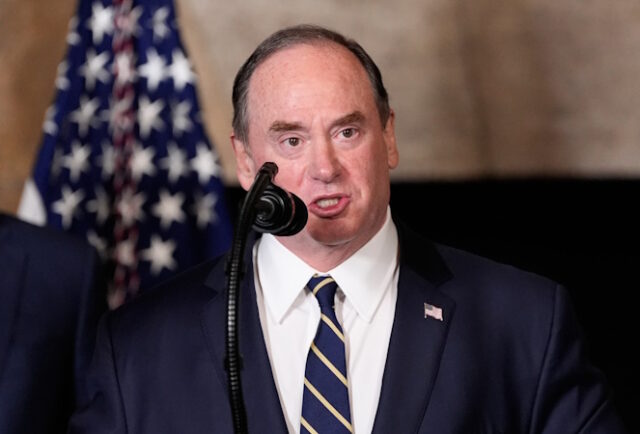
The “Department of War” Leadership Shaken Again
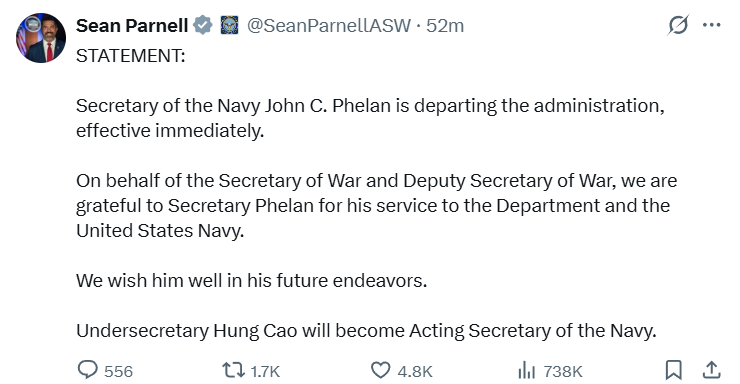
In a move that has sent shockwaves through the Pentagon—newly rebranded under the Trump administration as the Department of War—Secretary of the Navy John C. Phelan has resigned his position, effective immediately. The announcement, delivered via social media by Pentagon spokesperson Sean Parnell on Wednesday, April 22, 2026, marks the latest in a series of high-level departures that have come to define the tenure of Defense Secretary Pete Hegseth.
Phelan, a private equity mogul and founder of Rugger Management LLC, had served in the role since being nominated by President Donald Trump in late 2024. Despite his status as a major donor to the Trump campaign and his advisory role with the non-profit Spirit of America, Phelan’s departure appears to be the culmination of a months-long ideological struggle within the Navy’s civilian leadership.
The Pentagon confirmed that Undersecretary Hung Cao, a retired Navy captain and former Virginia Senate candidate known for his staunch loyalty to the MAGA movement, will assume the role of Acting Secretary of the Navy.

The Catalyst: Internal Friction and the “Cao Factor”
The “why” behind Phelan’s sudden exit is rooted in a bitter internal rivalry that has been simmering since late 2025. While Phelan was a political appointee, he reportedly attempted to maintain a degree of traditional administrative autonomy, often clashing with his subordinate, Hung Cao.
The tension reached a boiling point following the firing of Phelan’s former Chief of Staff, Jon Harrison, in October 2025. Harrison had reportedly attempted to limit Cao’s influence within the Navy, viewing the Undersecretary as a political operative rather than a traditional deputy. Cao, leveraging his direct line to both Secretary Hegseth and President Trump, successfully argued that Harrison—and by extension, Phelan—were “undercutting” the administration’s mission to streamline the military and excise “woke” legacy policies.
Insiders suggest that Phelan’s departure became inevitable once it was clear that Hegseth favored Cao’s aggressive, top-down leadership style. The transition to Cao is seen as a victory for the “loyalist” faction of the Pentagon, ensuring that the Navy’s leadership is fully aligned with the administration’s “Make America Strong Again” directives.
The Hegseth Connection: Purging the “Legacy Culture”
To understand Phelan’s resignation, one must look at the broader strategy employed by Defense Secretary Pete Hegseth. Since taking the helm, Hegseth has been unapologetic about his desire to “rid the U.S. military of diversity, equity, and inclusion (DEI) efforts” and remove any senior officers or officials who helped “create or benefit from” the previous administration’s culture.
Just weeks ago, Hegseth fired the Army’s top officer, Gen. Randy George, along with two other high-ranking generals. These moves followed the earlier removals of the Chairman of the Joint Chiefs of Staff, Gen. CQ Brown, and the Chief of Naval Operations, Adm. Lisa Franchetti.
Hegseth articulated his philosophy during a keynote speech to military commanders in Quantico in late September 2025, stating:
“It’s nearly impossible to change a culture with the same people who helped create or even benefited from that culture, even if that culture was created by a previous president and previous secretary.”
Phelan, though a Trump donor, was ultimately viewed as a “legacy” thinker who prioritized private-sector efficiency over the radical ideological overhaul Hegseth demands. His departure removes the final major civilian hurdle for Hegseth to reshape the Navy in his image—a process that will now be spearheaded by Hung Cao.
The Trump Connection: Loyalty Over Legacy
President Trump’s influence on this resignation cannot be overstated. The administration’s rebranding of the Pentagon to the “Department of War” in September 2025 was more than a cosmetic change; it signaled a shift toward a more aggressive, combat-focused military posture.
While Phelan initially had the President’s favor due to his financial support and business acumen, the Trump administration has increasingly prioritized absolute ideological alignment over traditional “donor” appointments. Trump’s stern warning to military leaders—“If you don’t like what I’m saying, you can leave the room. Of course, there goes your rank, there goes your future”—has become the guiding principle of his second term.
Phelan’s background in private equity, while valued for “cutting waste,” did not grant him immunity from the loyalty tests that have claimed the careers of dozens of career officers and political appointees alike. By replacing Phelan with Hung Cao, Trump is placing a trusted surrogate at the helm of the Navy during a period of active international conflict.
War in Iran: A Navy in Transition
The timing of Phelan’s resignation is particularly sensitive given the ongoing U.S. war against Iran. As the Navy maintains a blockade of Iranian ports and continues to engage in what Hegseth has called the “most intense” days of strikes yet, the sudden change in civilian leadership raises questions about operational continuity.
Undersecretary-turned-Acting Secretary Hung Cao has already signaled a “passive approach” to non-combat administrative traditions—such as Juneteenth celebrations and DEI training—while simultaneously ordering a more aggressive procurement of advanced weaponry. Critics argue that the “culture of fear” within the Department of War is stifling dissent and honest military advice, while supporters claim the purge is necessary to ensure the Navy is “unburdened by bureaucracy” during wartime.
Conclusion: The Future of Naval Leadership
John Phelan’s “effective immediately” exit is a clear signal that the era of the “moderate” political appointee is over within the Department of War. With Hung Cao now in control and Pete Hegseth continuing his sweep of the senior ranks, the U.S. Navy is entering an era of unprecedented ideological uniformity.
As the administration continues to challenge constitutional norms—including the federalized deployment of the National Guard and the use of the military in domestic policy—the loss of civilian leaders like Phelan, who might have provided a check on such moves, is likely to further consolidate power within the White House.
Sources and Links:
- Los Angeles Times: Pentagon says Navy Secretary John Phelan is leaving, in latest departure of a top defense leader
- Midland Daily News / Associated Press: Pentagon says Navy Secretary John Phelan is leaving, in latest departure of a top defense leader
- The Guardian: Top US army officer steps down after Hegseth reportedly demanded removal
- The Guardian: Marine colonel quits after 24 years citing concern for future of US under Trump
- Boston Political Review: Pete Hegseth Fires Navy Chief of Staff in String of Firings and Resignations
- The Independent: Navy Secretary to resign ‘immediately’ as US wages war in Iran
- Anadolu Agency: US Navy Secretary John C. Phelan departing administration: Pentagon
- Wikipedia: John C. Phelan
Disclaimer
Artificial Intelligence Disclosure & Legal Disclaimer
AI Content Policy.
To provide our readers with timely and comprehensive coverage, South Florida Reporter uses artificial intelligence (AI) to assist in producing certain articles and visual content.
Articles: AI may be used to assist in research, structural drafting, or data analysis. All AI-assisted text is reviewed and edited by our team to ensure accuracy and adherence to our editorial standards.
Images: Any imagery generated or significantly altered by AI is clearly marked with a disclaimer or watermark to distinguish it from traditional photography or editorial illustrations.
General Disclaimer
The information contained in South Florida Reporter is for general information purposes only.
South Florida Reporter assumes no responsibility for errors or omissions in the contents of the Service. In no event shall South Florida Reporter be liable for any special, direct, indirect, consequential, or incidental damages or any damages whatsoever, whether in an action of contract, negligence or other tort, arising out of or in connection with the use of the Service or the contents of the Service.
The Company reserves the right to make additions, deletions, or modifications to the contents of the Service at any time without prior notice. The Company does not warrant that the Service is free of viruses or other harmful components.