The waters of the Persian Gulf and the Indian Ocean have transformed into a volatile chessboard where the United States and Iran are locked in a maritime “waiting game” that threatens to ignite a full-scale regional conflict. As of April 23, 2026, the global community stands on edge following the expiration of a two-week ceasefire, with both nations escalating their naval interdictions to levels not seen since the “Tanker War” of the 1980s.
The New Phase: From Sanctions to Blockade
The current crisis reached a fever pitch on April 13, 2026, when the United States transition from a policy of “maximum pressure” via sanctions to an active naval blockade of Iranian ports. This directive, issued by the Trump administration, authorized the U.S. Navy to interdict any vessel suspected of carrying “contraband,” a definition that has expanded to include not just weapons and military dual-use items, but also Iranian crude and refined oil products.
Under the “belligerent right to visit and search,” the U.S. 5th Fleet, supported by assets from the Indo-Pacific Command, has effectively choked off Tehran’s maritime lifelines. According to recent reports from the U.S. Department of War, over 28 vessels were ordered to turn around or return to port within the first ten days of the blockade. This maneuver aims to force Iran back to the negotiating table by completely paralyzing its ability to export its primary resource.

Two vessels reportedly seized by the IRGC are both operated by MSC
While initial reports suggested they were part of a six-vessel MSC convoy, track analysis conducted by #MarineTraffic analysts indicates it is unlikely they were transiting together with the other four vessels,… pic.twitter.com/1Otru64ual
— MarineTraffic (@MarineTraffic) April 22, 2026
The physical manifestation of this conflict is best seen through the specific vessels currently held in “maritime purgatory.”
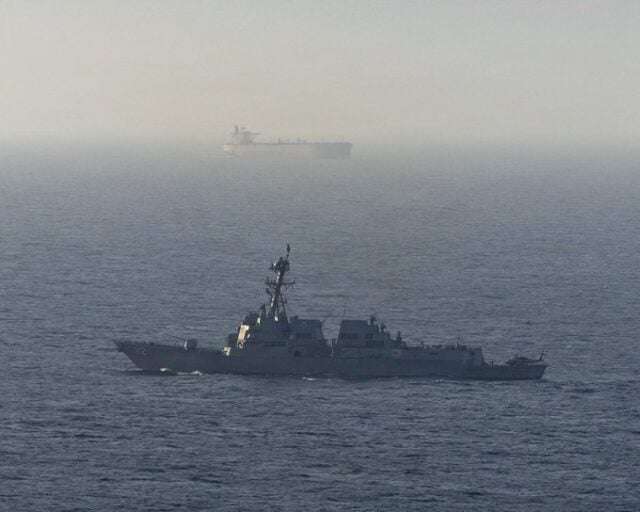
1. The M/V Touska and M/T Tifani (US-Stopped) On April 18, 2026, the U.S. Navy guided-missile destroyer USS Spruance intercepted the M/V Touska, an Iranian-flagged cargo vessel, as it attempted to transit the Gulf of Oman. The Touska was suspected of carrying dual-use electronics from China destined for Iran’s ballistic missile program. Days later, in the Indian Ocean, U.S. forces boarded the M/T Tifani, a “dark fleet” tanker that has been evading sanctions since 2025. These seizures signify Washington’s intent to pursue Iranian interests far beyond the Strait of Hormuz, extending interdiction efforts into the Indo-Pacific.
2. The Epaminondas and MSC Francesca (Iran-Seized) Iran’s Revolutionary Guard Corps (IRGC) has not remained passive. In a direct retaliation to the U.S. blockade, the IRGC Navy seized two international vessels on April 21, 2026. The Epaminondas, a Greek-owned tanker, and the MSC Francesca, a Panama-flagged container ship, were diverted to Iranian shores under the guise of “maritime violations.” Tehran claims these ships were “tampering with navigation systems” and operating without permits, though the White House has characterized these acts as “pure piracy” designed to hold the global economy hostage.
Footage of the Islamic Revolutionary Guard Corps (IRGC) Navy seizing a pair of civilian container ships in the Strait of Hormuz this morning. pic.twitter.com/Y8kBCcCIzo
— IRGC (@IRGC_Press) April 22, 2026
The phrase “waiting game” has become the defining term for the current stalemate. Neither side has yet committed to a full-scale kinetic invasion, but both are testing the limits of the other’s resolve.
For the United States, the game is one of economic exhaustion. By seizing ships and enforcing a blockade, Washington hopes to dry up the IRGC’s funding without having to launch a land-based campaign. President Trump has framed the blockade as a “tremendous success,” asserting that the U.S. now “totally controls the strait.”
For Iran, the waiting game is a test of international tolerance. By seizing neutral vessels like the MSC Francesca, Iran is betting that the resulting surge in oil prices and insurance premiums will eventually force U.S. allies—particularly in Europe and Asia—to pressure Washington into lifting the blockade. The IRGC has also utilized asymmetric tactics, including drone attacks on U.S. ships in the Gulf of Oman and the deployment of naval mines, which Tehran claims it “cannot detect,” complicating any efforts to reopen the Strait of Hormuz.
The Diplomatic Deadlock in Islamabad
While the navies maneuver at sea, diplomats are engaged in a frantic “waiting game” of their own in Pakistan. Acting as a mediator, Islamabad has hosted representatives from both nations this week. The core of the negotiation is the “Open for Open” deal: the U.S. would lift the naval blockade if Iran fully reopens the Strait of Hormuz and hands over its stockpile of highly enriched uranium.
However, the talks are currently stalled. Iran’s Foreign Ministry spokesperson, Esmail Baghaei, has denied reports that Tehran is considering handing over its uranium, while the U.S. has set a hard deadline. President Trump warned on Fox News that this week’s talks are the “last chance” for Iran, threatening that if no agreement is reached, Iranian civilian infrastructure could be targeted.
Global Economic and Humanitarian Fallout
The “waiting game” has already inflicted severe damage on the global economy. Brent Crude oil prices have surged past $120 per barrel, leading the International Energy Agency to declare this the “greatest global energy security challenge in history.”
The impact is most acute in the Gulf Cooperation Council (GCC) states. These nations rely on the Strait of Hormuz for over 80% of their caloric intake. The blockade and subsequent Iranian threats have triggered a “grocery supply emergency,” with food prices rising by 40% to 120% in some regions as shipping companies refuse to transit the volatile waterway.
Conclusion: The 8:00 PM Deadline
As of this morning, April 23, 2026, the world is watching the clock. The ceasefire that kept large-scale missile exchanges at bay for the last fortnight has officially expired. With the U.S. continuing its interdictions in the Indian Ocean and Iran holding international tankers at its docks, the “waiting game” is rapidly approaching a conclusion. Whether that conclusion is a diplomatic breakthrough in Islamabad or the start of a broader maritime war remains the most pressing question of the decade.
Sources Used and Links
- OMMCOM NEWS: US Seizure At Sea Signal New Phase In Iran War: Report
- Indo-Pacific Defense FORUM: U.S. continues to disrupt illicit networks supporting Iran
- Militarnyi: Iranian Boat Fires on Container Ship off Coast of Oman
- The Economic Times: Iran’s seizure of two cargo ships in Strait of Hormuz does not violate ceasefire?
- The Economic Times: Iran seizes ships, fires in Strait of Hormuz as tensions rise
- Council on Foreign Relations (CFR): Iran and the U.S. Exchange Retaliation Threats
- Institute for the Study of War (ISW): Iran Update Special Report, April 15, 2026
- Wikipedia: Economic impact of the 2026 Iran war
- Discovery Alert: Iran War Drives Global Oil Price Surge Amid Supply Crisis
- Newswire.lk: Iran seizes two cargo ships amid tensions in Strait of Hormuz
- International Crisis Group: Strait of Hormuz – Flashpoints and Blockade Logs
- Al Jazeera: Iran War Updates: Ships Taken in Hormuz and Ceasefire Extensions
- Financial Times: US Navy Seizes Iranian Vessel M/V Touska After Blockade Breach
- The Guardian: US Military Interdiction of Iran-Flagged Ship Near Hormuz
- CNBC Africa: Iran Seizes Two Container Ships in Strait of Hormuz Standoff
- Washington Post: Iranian Forces Move MSC Francesca and Epaminondas to Coastline
- The Times of Israel: IRGC Gunboats Target and Capture Container Ships off Oman
- Indo-Pacific Defense FORUM: US Disrupts Sanctioned Networks Supporting Iran in INDOPACOM
Disclaimer
Artificial Intelligence Disclosure & Legal Disclaimer
AI Content Policy.
To provide our readers with timely and comprehensive coverage, South Florida Reporter uses artificial intelligence (AI) to assist in producing certain articles and visual content.
Articles: AI may be used to assist in research, structural drafting, or data analysis. All AI-assisted text is reviewed and edited by our team to ensure accuracy and adherence to our editorial standards.
Images: Any imagery generated or significantly altered by AI is clearly marked with a disclaimer or watermark to distinguish it from traditional photography or editorial illustrations.
General Disclaimer
The information contained in South Florida Reporter is for general information purposes only.
South Florida Reporter assumes no responsibility for errors or omissions in the contents of the Service. In no event shall South Florida Reporter be liable for any special, direct, indirect, consequential, or incidental damages or any damages whatsoever, whether in an action of contract, negligence or other tort, arising out of or in connection with the use of the Service or the contents of the Service.
The Company reserves the right to make additions, deletions, or modifications to the contents of the Service at any time without prior notice. The Company does not warrant that the Service is free of viruses or other harmful components.