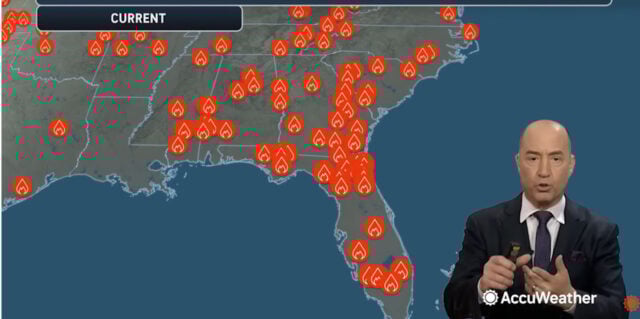
If you’ve stepped outside across much of the Southeastern United States lately, you’ve likely noticed a certain “crispness” in the air that usually doesn’t belong in the humid, lush South. Instead of the typical morning dew and damp soil, residents from Florida to Virginia are finding brittle grass, dusty trails, and a hazy sky that smells faintly of woodsmoke. This isn’t just a dry spell; it’s the beginning of what experts are calling an “explosive” wildfire season, fueled by a perfect storm of meteorological factors that have turned the region into a literal tinderbox.
As of late April 2026, the situation is moving from a concern to a full-blown emergency. Wildfires are no longer just a “Western” problem. While we often associate massive blazes with the canyons of California or the forests of the Pacific Northwest, the Southeast is currently battling a relentless surge in fire activity that has already displaced families, shut down major transit lines, and degraded air quality for millions of people.
The Epicenter: Florida’s Historic Drought
Florida is often thought of as the “Sunshine State,” but it’s also usually the “Rainy State.” However, the start of 2026 has told a different story. By mid-February, a staggering 99% of the state was already categorized as being in a drought. By late March, that situation escalated, with over 70% of Florida classified under “extreme drought” or worse. When the ground is that dry, the ecology changes. The lush wetlands and palm hammocks that usually act as natural firebreaks become fuel.

In Gainesville, the reality of this drought hit home recently with startling speed. Two separate wildfires erupted on a single Sunday, catching local neighborhoods off guard. Communities like Eryn’s Garden and Pine Forest—places where families usually spend their weekends gardening or walking dogs—suddenly found themselves under mandatory evacuation orders. One of these fires, located along North Main Street, exploded to over 100 acres in less than 24 hours. Firefighters struggled to gain even 25% containment as the wind whipped through the dry brush.
The impact wasn’t just on residential streets. The University of Florida campus was blanketed in a thick, acrid smoke that made it difficult for students to focus as they headed into the final stretch of the semester. The air quality became so poor that university officials had to urge professors to be flexible with students suffering from respiratory issues. It’s a surreal sight to see a bustling college town obscured by the kind of “smoke fog” usually reserved for mountain towns in the West.
Further south, the scale of the fires is even more daunting. In the Big Cypress National Preserve, a massive 35,000-acre blaze has been churning through the landscape, while an 8,600-acre fire has crossed county lines between Okeechobee and Glades. These aren’t just small brush fires; they are landscape-altering events. Even the infrastructure of the state is taking a hit, with Amtrak forced to halt train routes and shut down tracks near DeLand because the flames were simply too close to the rails for safe passage.
Georgia’s Record-Breaking Fire Activity
If you think Florida is an isolated case, a quick look north to Georgia will change your mind. The Georgia Forestry Commission has been working overtime, battling an average of 40 wildfires every single day. Let that sink in for a moment. That is nearly two fires every hour, 24 hours a day, across the state.
Statistically, 2026 has been a nightmare for Georgia’s fire crews. The state has seen more than 20,500 acres burned so far this year, which is a 112% increase over the five-year average. This isn’t a gradual rise; it is a statistical explosion. In Brantley County, a fire that ignited recently grew to 5,000 acres overnight. It wasn’t just trees that were lost; dozens of homes were destroyed as the fire behaved with “extreme” aggression, spotting embers far ahead of the main line and making “runs” driven by the wind.
The smoke from these Georgia fires is drifting across state lines, creating “unhealthy” and “very unhealthy” air quality readings as far away as the Florida Panhandle and coastal South Carolina. For residents in cities like Brunswick, the simple act of taking a walk has become a health risk.
The Science of a “Thirsty” Atmosphere
Why is this happening now? Meteorologists point to a few key culprits, but one of the most interesting is the concept of the “thirsty atmosphere.” As global temperatures rise, the air effectively becomes more efficient at pulling moisture out of everything it touches. It sucks the water out of the soil, the leaves on the trees, and even the local streams. This creates a feedback loop: the drier the ground gets, the hotter it gets, and the hotter it gets, the more the atmosphere “demands” moisture.
Combined with this atmospheric thirst is a significant drop in relative humidity. In parts of Alabama and the Florida Panhandle, humidity levels have recently plunged into the 15% to 20% range. For context, the Southeast usually thrives in humidity levels of 60% to 90%. When the air is that dry, any spark—whether from a lightning strike, a discarded cigarette, or a spark from a passing lawnmower—has an immediate and receptive fuel source.
High-pressure systems have also been parking themselves over the region, blocking the moisture-rich air from the Gulf of Mexico that usually provides the Southeast with its afternoon thunderstorms. Without that “predictable” rain, the drought only deepens, leaving firefighters to pray for a tropical moisture surge that hasn’t yet arrived.
The Front Lines: Firefighters and Resources
The men and women on the front lines are using every tool in the shed to combat these blazes. In the Florida fires near Putnam County, crews deployed 15 firefighting tractor-plow units. These massive machines are essential for creating “firebreaks”—strips of cleared land where there is no fuel for the fire to burn. But even with these breaks, the wind can carry embers (a process called “spotting”) over the lines, starting new fires behind the firefighters.
In the air, tankers and helicopters have become a constant presence, dropping thousands of gallons of water and bright red fire retardant to slow the advance of the flames. However, air support is only as good as the weather allows; if the winds are too high or the smoke is too thick, these pilots can’t fly safely, leaving the ground crews to handle the brunt of the work.
The National Interagency Fire Center (NIFC) has taken notice, issuing a “Fuels and Fire Behavior Advisory” for the entire Southeast. This is a significant move, as it signals that vegetation from the southern Appalachians all the way to the Atlantic coast has reached historically dry levels. They aren’t just worried about today; they are looking at the next two months.
Living with the Risk: Safety and Prevention
For those living in the path of these fires, the message from local officials is clear: “Don’t wait.” Wildfires in the South move differently than those in the West. Because the vegetation is often dense and includes volatile plants like palmettos and pine trees (which contain flammable oils), these fires can move through a neighborhood with terrifying speed.
Residents are being urged to practice “defensible space” principles. This means clearing dry leaves from gutters, moving firewood away from the house, and trimming low-hanging branches that could allow a ground fire to climb into the tree canopy. It also means having a “Go Bag” ready. When an evacuation order is issued in conditions like this, you may only have five to ten minutes to leave your driveway.
Furthermore, officials are pleading with the public to observe burn bans. In several counties across Georgia and Florida, any outdoor burning—even a small backyard fire pit or burning garden debris—is strictly prohibited. In this climate, a single ember floating away from a backyard grill could be the catalyst for a thousand-acre disaster.
Looking Ahead: Will the Rain Return?
The big question on everyone’s mind is, “When will it end?” Unfortunately, the short-term forecast isn’t offering much relief. While there are occasional cold fronts moving through the Central U.S. bringing severe thunderstorms there, the Southeast remains largely bypassed by meaningful precipitation.
AccuWeather meteorologists expect the fire risk to remain elevated through at least the end of May. The 2026 wildfire forecast for the entire U.S. suggests that over 5.5 million acres could burn this season, and the Southeast is currently shouldering a massive portion of that burden.
Until a consistent weather pattern shifts and brings the return of the humid, rainy afternoons the South is known for, the region will remain on high alert. It is a stark reminder that as our climate changes, the “wildfire season” is no longer a Western phenomenon—it’s a national one.
For now, residents of the Southeast are watching the skies, not just for rain, but for the tell-tale plumes of white and gray smoke that signal another fight is beginning. Stay safe, stay informed, and keep an eye on your local air quality and fire alerts. In a season this explosive, being prepared is the best defense we have.
Sources:
- AccuWeather: Wildfires rage across the Southeast as drought fuels explosive fire season
- Florida Forest Service
- Georgia Forestry Commission
- U.S. Drought Monitor
- National Interagency Fire Center (NIFC)
Disclaimer
Artificial Intelligence Disclosure & Legal Disclaimer
AI Content Policy.
To provide our readers with timely and comprehensive coverage, South Florida Reporter uses artificial intelligence (AI) to assist in producing certain articles and visual content.
Articles: AI may be used to assist in research, structural drafting, or data analysis. All AI-assisted text is reviewed and edited by our team to ensure accuracy and adherence to our editorial standards.
Images: Any imagery generated or significantly altered by AI is clearly marked with a disclaimer or watermark to distinguish it from traditional photography or editorial illustrations.
General Disclaimer
The information contained in South Florida Reporter is for general information purposes only.
South Florida Reporter assumes no responsibility for errors or omissions in the contents of the Service. In no event shall South Florida Reporter be liable for any special, direct, indirect, consequential, or incidental damages or any damages whatsoever, whether in an action of contract, negligence or other tort, arising out of or in connection with the use of the Service or the contents of the Service.
The Company reserves the right to make additions, deletions, or modifications to the contents of the Service at any time without prior notice. The Company does not warrant that the Service is free of viruses or other harmful components.