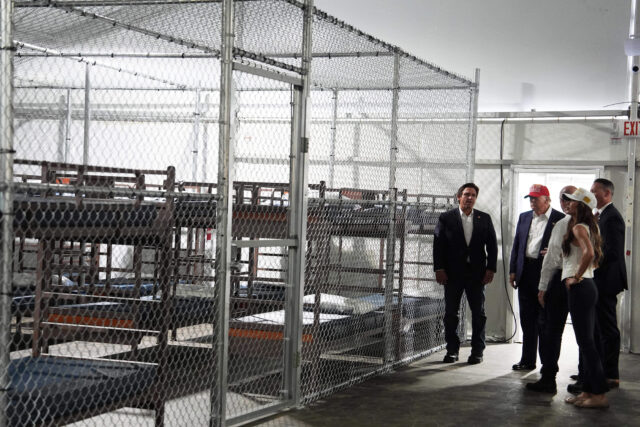
Internal documents recently obtained under a judge’s order have pulled back the curtain on the staggering costs of Florida’s “Alligator Alcatraz,” a makeshift immigration detention facility located in the heart of the Everglades. According to a report by the Florida Trib, the state’s “daily burn” rate for the facility exceeded $1.2 million, with early operations costing as much as $3 million per day.
The documents, consisting of thousands of pages of emails, budget spreadsheets, and contracts, were released following a lawsuit by the advocacy group Friends of the Everglades. They reveal that the Florida Division of Emergency Management (FDEM) formally requested a $1.49 billion grant from the federal government to cover the costs of the site, which was constructed using tents and trailers at the Dade-Collier Training and Transition Airport.
Millions for Portable Toilets and “Boonie Hats”
The financial details paint a picture of rapid, high-stakes spending with minimal legislative oversight. One of the most significant expenditures identified was a $92 million payout to a single vendor, Doodie Calls, for portable restrooms and the disposal of approximately 45,000 gallons of wastewater generated daily.
The Florida Trib reported, “Individual expenses across dozens of spreadsheets include $39,000 spent on pillows for the staff ‘village’ at the facility… The state doled out $169,900 for ‘boonie hats,’ a kind of military-style cotton hat.”

Staffing costs have also drawn scrutiny. The facility’s warden reportedly earns $1,000 a day, totaling $365,000 annually, with an additional $273,000 expected in overtime. Furthermore, corrections officers at the site were projected to earn base salaries of over $120,000—nearly three times the starting pay of officers in Florida’s standard prison system, which has long struggled with understaffing and low wages.
The Federal Funding Mirage
The primary controversy surrounding “Alligator Alcatraz” is not just the cost, but who will ultimately pay for it. Governor Ron DeSantis and his administration initially assured the public that the federal government would reimburse the state for these expenses. In October 2025, DeSantis even claimed victory on social media after the Department of Homeland Security (DHS) announced a $608 million award.
However, months later, that money has failed to materialize. Recent court filings show a shift in tone from state officials. Attorneys for the state now acknowledge that Florida “took the risk” that federal funding might never arrive. This admission is central to ongoing legal battles, as environmental groups argue the state bypassed mandatory environmental reviews required for federally funded projects. By claiming the facility is purely state-funded to avoid these reviews, the administration has inadvertently weakened its own case for federal reimbursement.
Lack of Oversight and Political Ties
The records also highlight the speed at which multimillion-dollar deals were inked with private vendors. Several of the companies receiving state funds are owned by major Republican donors who have contributed to political committees for DeSantis and President Donald Trump.
This spending was made possible by the Emergency Preparedness & Response Fund, a multi-billion-dollar pool created in 2022 that allows the governor’s office to bypass the traditional legislative appropriation process during perceived emergencies. As state lawmakers meet this week to consider reauthorizing this fund, the “Alligator Alcatraz” records are serving as a flashpoint for critics who argue the executive branch has been given a “blank check” with no accountability.
Environmental and Legal Roadblocks
Beyond the financial fallout, the facility faces existential threats from the judicial system. A federal district judge previously ordered the facility to wind down operations due to the lack of environmental reviews, though that order was temporarily stayed by an appeals court.
The site’s location in the sensitive Everglades ecosystem has long been a point of contention. Critics argue that processing hundreds of detainees and housing hundreds of staff members in a flood-prone, ecologically vital area is both a human rights concern and an environmental disaster waiting to happen.
As the “daily burn” continues to drain state coffers, the DeSantis administration remains locked in a standoff with federal agencies over the $608 million grant. While FEMA initially signaled that funds were available, the agency later froze the money, citing the need for a finalized Environmental and Historic Preservation (EHP) review—the very thing the state has attempted to avoid.
For now, Florida taxpayers remain on the hook for a project that costs millions of dollars every week, with no clear end date and no guaranteed federal relief in sight. As the Florida Trib investigation concludes, the records underscore a “staggering scale of spending… largely out of public view.”
Source: Florida Trib
Disclaimer
Artificial Intelligence Disclosure & Legal Disclaimer
AI Content Policy.
To provide our readers with timely and comprehensive coverage, South Florida Reporter uses artificial intelligence (AI) to assist in producing certain articles and visual content.
Articles: AI may be used to assist in research, structural drafting, or data analysis. All AI-assisted text is reviewed and edited by our team to ensure accuracy and adherence to our editorial standards.
Images: Any imagery generated or significantly altered by AI is clearly marked with a disclaimer or watermark to distinguish it from traditional photography or editorial illustrations.
General Disclaimer
The information contained in South Florida Reporter is for general information purposes only.
South Florida Reporter assumes no responsibility for errors or omissions in the contents of the Service. In no event shall South Florida Reporter be liable for any special, direct, indirect, consequential, or incidental damages or any damages whatsoever, whether in an action of contract, negligence or other tort, arising out of or in connection with the use of the Service or the contents of the Service.
The Company reserves the right to make additions, deletions, or modifications to the contents of the Service at any time without prior notice. The Company does not warrant that the Service is free of viruses or other harmful components.