By Zachary Handlos, Georgia Institute of Technology
Large parts of the southeastern U.S. are in the midst of an exceptional drought, and it is fueling dozens of wildfires in Florida and Georgia.
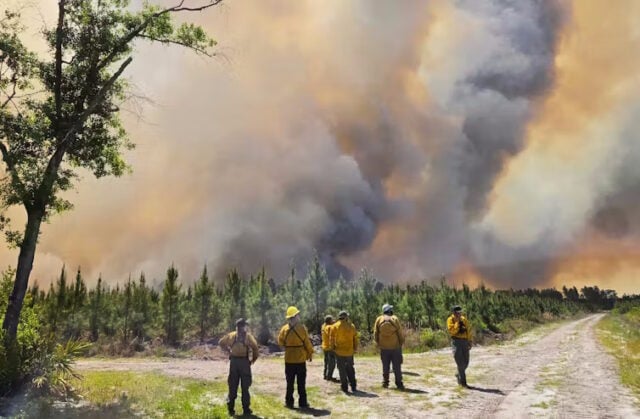
One of those wildfires, in southeastern Georgia’s Brantley County, had damaged about 90 homes by April 24, 2026, and officials said about 800 other homes were at risk. Another fire near the Georgia-Florida border had burned more than 30,000 acres and about 35 structures, and more than 180 homes at considered risk. The smoke from the blazes triggered air quality alerts in Atlanta, in the north-central part of the state.
Why is a region of the U.S. more often known for thunderstorms and humidity in spring seeing so many wildfires?


Georgia Department of Natural Resources via AP
I teach meteorology at the Georgia Institute of Technology, including how weather patterns can lead to conditions conducive to wildfires. Here’s what’s happening to drive these conditions.
Key ingredients for a wildfire
Wildfires need a few key ingredients to spread: low relative humidity, dry fuels and strong winds.
Much of the Southeast has been in a drought since July 2025. From mid-March to mid-April 2026, the region saw less than a quarter of its normal precipitation for that time of year.
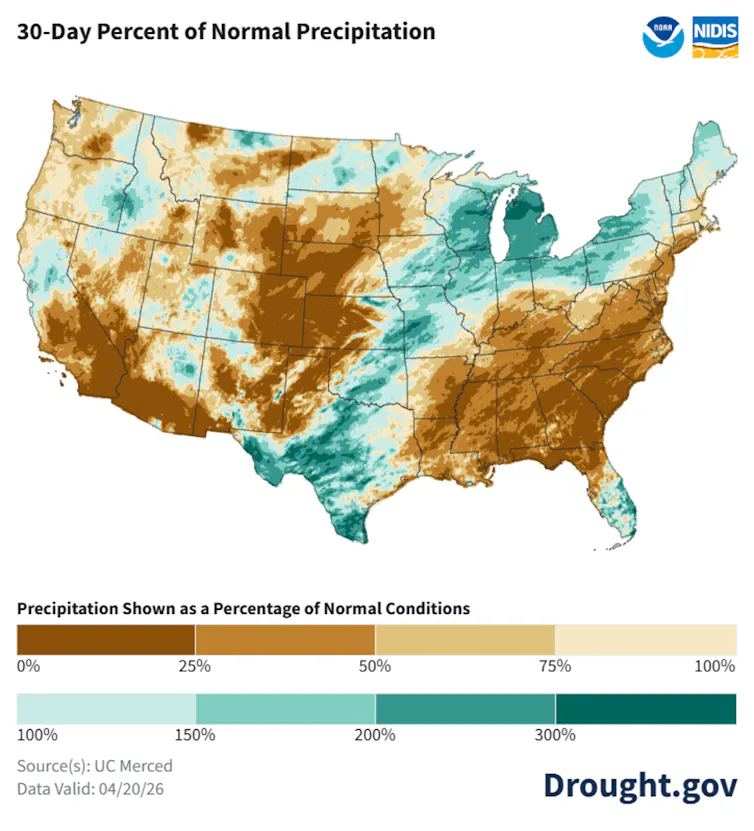
Drought.gov
As a result, the U.S. Drought Monitor classified most of this region in “extreme” or “exceptional” drought by mid-April.
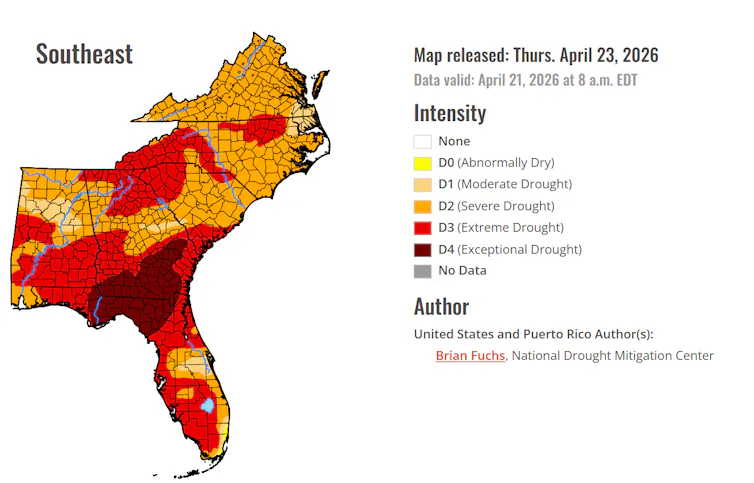
Brian Fuchs, National Drought Mitigation Center/U.S. Drought Monitor
Part of the reason for the lack of rainfall has been a persistent high-pressure system over the Southeast.
High-pressure systems are areas where air aloft sinks toward the surface, preventing clouds and precipitation from forming. The Southeast high-pressure system resulted from the presence of a “ridge” in the jet stream, a northward bend in this fast current of air several miles above Earth’s surface.
Another consequence of this high pressure has been the presence of generally southeast winds, which have transported warm and fairly dry air into the area.
The relative humidity – a measure of the amount of moisture in the air relative to the maximum amount the air can contain at its actual air temperature – has also been very low due to warmer-than-usual temperatures and lower-than-usual moisture.

Pivotal Weather
As a result of these conditions, trees, grass and leaves dry out and can quickly become fuel for wildfires. That kind of dry fuel is widespread throughout rural areas of Georgia and north Florida.
Once a fire starts, whether from lightning, power lines or other human sources, strong winds can spread it rapidly in these conditions. Georgia fire officials said the largest fire in mid-April, near the Florida state line, started with a spark from welding equipment that ignited surrounding vegetation. They believe a mylar balloon hitting a power line sparked the fire that burned dozens of homes in Brantley County.
What’s ahead for the region?
As global temperatures rise, the frequency of drought conditions in the Southeast will increase. This, in combination with less soil moisture content in the summer, could be conducive for increased wildfire activity.
Wildfires do eventually burn out. It takes a combination of help from the atmosphere, with moisture to douse them, and firefighters clearing away dry fuel to stop their spread.
Georgia and Florida may get a reprieve soon from the weather, as multiple low-pressure systems are forecast for the region in late April and early May that could bring rainfall. In the meantime, more than half of Georgia’s counties are under a state of emergency, as several agencies battle the flames to protect homes with helicopters in the air and scores of firefighters on the ground.
This article, originally published April 23, 2026, has been updated with more homes damaged and the suspected causes.
Zachary Handlos, Atmospheric Science Educator, Georgia Institute of Technology
This article is republished from The Conversation under a Creative Commons license. Read the original article.
Disclaimer
Artificial Intelligence Disclosure & Legal Disclaimer
AI Content Policy.
To provide our readers with timely and comprehensive coverage, South Florida Reporter uses artificial intelligence (AI) to assist in producing certain articles and visual content.
Articles: AI may be used to assist in research, structural drafting, or data analysis. All AI-assisted text is reviewed and edited by our team to ensure accuracy and adherence to our editorial standards.
Images: Any imagery generated or significantly altered by AI is clearly marked with a disclaimer or watermark to distinguish it from traditional photography or editorial illustrations.
General Disclaimer
The information contained in South Florida Reporter is for general information purposes only.
South Florida Reporter assumes no responsibility for errors or omissions in the contents of the Service. In no event shall South Florida Reporter be liable for any special, direct, indirect, consequential, or incidental damages or any damages whatsoever, whether in an action of contract, negligence or other tort, arising out of or in connection with the use of the Service or the contents of the Service.
The Company reserves the right to make additions, deletions, or modifications to the contents of the Service at any time without prior notice. The Company does not warrant that the Service is free of viruses or other harmful components.