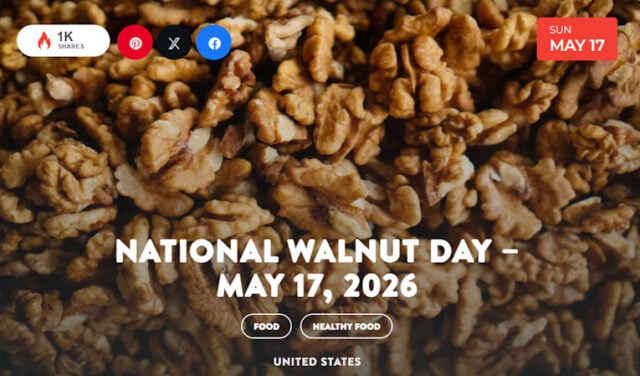
Each year May 17th recognizes the holiday squirrels go a little nutty over, National Walnut Day.
- 7000 BC – Walnuts are one of the oldest tree food known to man, dating back to 7000 B.C
- 2000 BC – The first historical account of walnut cultivation dates back to Babylon
- 1754 BC – The cultivation of the walnut is mentioned in The Code of Hammurabi, the oldest code of laws in the world.
- 17th Century – English settlers are responsible for bringing walnut plants to the New World.
- 1800s – European walnuts are shipped from England to North America where it becomes a popular tree.
- 1900s – The climate in Chile does well for growing walnuts and the country eventually becomes the world’s third largest walnut exporte
- 1949 – The Walnut Marketing Board creates National Walnut Day to celebrate and promote walnuts
- 1958 – A Senate Resolution proposed by William F. Knowland leads to an official declaration from President Dwight D. Eisenhower, declaring National Walnut Day on May 17, 1958.
- 2016 – The most walnuts cracked against the head in one minute is 181 and was achieved by Muhammed Rashid (Pakistan), in Udine, Italy, on 17 April 2016.
- 2017 – The most walnuts crushed by the hand in one minute is 212, achieved by Prabhakar Reddy P, (India), in Andhra Pradesh, India, on 13 August 2017. Prabhakar beat the previous record by just one verified crushed walnut.
- Rounded, single-seeded stone fruits of the walnut tree, walnuts are a high-density source of nutrients, particularly proteins and essential fatty acids.
- Like other tree nuts, walnuts must be processed and stored properly.
- Grown for their seeds, the Persian or English Walnut and the Black Walnut are the two most common major species of walnuts.
- Even since ancient times, walnuts have been used for various health benefits and have even been considered to be medicinal for treating issues such as bad breath, wound healing and reduction of inflammation.
- English Walnut, originated in Persia. commercially produced
- Black Walnut, native to eastern North America, has high flavor, a hard shell, and poor hulling characteristics, which prevent its commercial growth for nut production.
- The husk of the walnut is peeled away from the shell at harvest. It contains juice that readily stains anything it comes into contact with. The husk juice has been used as a cloth dye.
- The United States exports more walnuts than any other country. Ninety-nine percent of the nation’s commercial English walnuts are produced in the Sacramento and San Joaquin valleys of California.
- China is the world’s largest walnut producer, accounting for nearly half of global walnut production.
- Walnuts were traded along the Silk Road route between Asia and the Middle East. Caravans carried walnuts to far-off lands and eventually, through sea trade, spreading the popularity of the walnut around the world.
- English merchant marines transported the product for trade to ports around the world and they became known as “English Walnuts.” England, in fact, never grew walnuts commercially.
- Walnuts are among the most nutritious of all nuts. There are 654 calories in 100 grams (3.5 ounces) of walnuts.
- Some of the health benefits of walnuts include reducing bad cholesterol, improving metabolism, and helping control diabetes.
- They also good for anti-inflammatory properties, aid in weight management, and help as a mood booster.
- They are also believed to slow down the spread of cancer.
- The word “walnut” derives from Old English wealhhnutu, literally “foreign nut,” with wealh meaning “foreign.” The walnut was so called because it was introduced from Gaul and Italy. The previous Latin name for the walnut was nux Gallica, “Gallic nut.”
- Walnuts have always been considered as “Brain Food”, perhaps because the surface structure of the walnut has a crinkly appearance like that of the brain. Due to this reason, they have been considered as a symbol of intelligence, leading to the belief that they actually increase one’s intellect. While this is not exactly true, recent studies have proven that the consumption of these seeds does help in promoting brain function.
- Nocino is an Italian liqueur made from unripe walnuts. It’s nutty, sweet, strong, and a bit spicy—in other words, it will warm you right up. The Italians drink it on its own as a digestif, but it also pairs very well with brown spirits. We think it’d be a great addition to a Manhattan.
Sources:

Just Fun Facts
Disclaimer
Artificial Intelligence Disclosure & Legal Disclaimer
AI Content Policy.
To provide our readers with timely and comprehensive coverage, South Florida Reporter uses artificial intelligence (AI) to assist in producing certain articles and visual content.
Articles: AI may be used to assist in research, structural drafting, or data analysis. All AI-assisted text is reviewed and edited by our team to ensure accuracy and adherence to our editorial standards.
Images: Any imagery generated or significantly altered by AI is clearly marked with a disclaimer or watermark to distinguish it from traditional photography or editorial illustrations.
General Disclaimer
The information contained in South Florida Reporter is for general information purposes only.
South Florida Reporter assumes no responsibility for errors or omissions in the contents of the Service. In no event shall South Florida Reporter be liable for any special, direct, indirect, consequential, or incidental damages or any damages whatsoever, whether in an action of contract, negligence or other tort, arising out of or in connection with the use of the Service or the contents of the Service.
The Company reserves the right to make additions, deletions, or modifications to the contents of the Service at any time without prior notice. The Company does not warrant that the Service is free of viruses or other harmful components.