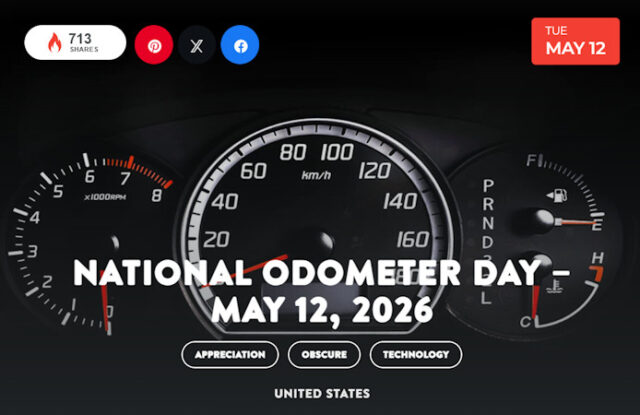
National Odometer Day on May 12th each year provides an opportunity to learn a little bit about the odometer.
An odometer is an instrument that indicates the distance traveled by a vehicle. It may be electronic, mechanical or a combination of both.
- 700 – 460 BC: Before the odometer, distance in ancient Greece was measured by ‘bematists,’ or people specially trained to measure distances by counting steps.
- 206 BC – 220 AD: Han Dynasty Invents The First Odometer
- Invented in the Han dynasty, in the form of a road carriage with a drum. As the story goes, each time the measurement of distance was met, a wooden figure would hit the drum. Experts consider this to be a highly advanced version of the odometer (given the time) and cite it as an influence on the present odometer.
- 70 AD – Early descriptions of odometers are given by Hero of Alexandria and many more prominent figures.
- 16 BC – The Roman architect and engineer Vitruvius is credited with inventing the earliest odometer in 15 BCE. The concept consisted of a chariot wheel that turned 400 times to show one Roman mile.
- 1600s – Odometers were first developed in the 1600s for wagons and other horse-drawn vehicles to measure distances traveled.
- 1775 – Benjamin Franklin designed a simple odometer in 1775 while serving as Postmaster General, analyzing postal delivery routes.
- 1847 – William Clayton, a Mormon pioneer, invented his “roadmometer” and attached it to his wagon while heading to Utah.
- 1903 – Arthur P. and Charles H. Warner of Beloit, Wisconsin, developed the first automobile odometer, which appeared in 1903 and was patented as the Auto-Meter.
- The word odometer comes from the Greek words hodos, meaning path or gateway, and metron, meaning measure.
- In some countries, an odometer is called a mileometer, kilometer, or tripometer.
- Each year, 450,000 automobiles are sold with fake odometer readings, according to the National Highway Traffic Safety Administration (NHTSA). One of the reasons it’s critical to buy a car from a reputable dealer and understand how to spot a faulty odometer is because of this.
- Modern automobiles have one, but luxury automobiles have two. A pair of trip meters can be seen in many high-end automobiles.
- In different countries, odometers are called by various names like mileometer, milometer, or tripmeter
- The odometer is a device attached to the wheel of the vehicle that is used to measure the distance traveled by a vehicle, while the mileage shows the total distance the vehicle has traveled and/or the fuel expenses of this
- There are two types of odometers: mechanical and digital. They serve the same purpose, counting mileage, but their mechanisms are different.
- A mechanical odometer, also known as an analog odometer, has a train of gears and rotating dials. When the vehicle’s wheel rotates, it turns the cable connected to the transmission. The number of gear rotations determines how many miles your vehicle has covered.
- Digital odometer—this is an electronic car mileage odometer that serves the same function as a mile tracker, but its working principle is different. It has sensors that can measure how fast the wheels are spinning. The car’s computer multiplies the data by the time the vehicle has traveled. For example, if you are going 40 km/h for 1 hour, you’ve covered 40 km (24.85 miles). The data is displayed digitally on the instrument.
Sources:

Disclaimer
Artificial Intelligence Disclosure & Legal Disclaimer
AI Content Policy.
To provide our readers with timely and comprehensive coverage, South Florida Reporter uses artificial intelligence (AI) to assist in producing certain articles and visual content.
Articles: AI may be used to assist in research, structural drafting, or data analysis. All AI-assisted text is reviewed and edited by our team to ensure accuracy and adherence to our editorial standards.
Images: Any imagery generated or significantly altered by AI is clearly marked with a disclaimer or watermark to distinguish it from traditional photography or editorial illustrations.
General Disclaimer
The information contained in South Florida Reporter is for general information purposes only.
South Florida Reporter assumes no responsibility for errors or omissions in the contents of the Service. In no event shall South Florida Reporter be liable for any special, direct, indirect, consequential, or incidental damages or any damages whatsoever, whether in an action of contract, negligence or other tort, arising out of or in connection with the use of the Service or the contents of the Service.
The Company reserves the right to make additions, deletions, or modifications to the contents of the Service at any time without prior notice. The Company does not warrant that the Service is free of viruses or other harmful components.