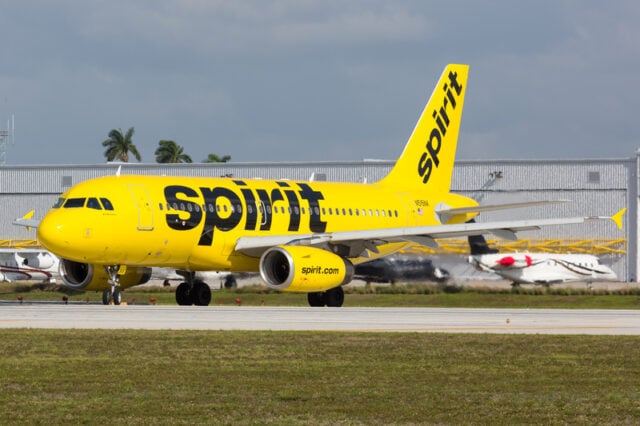
As of April 24, 2026, the American aviation industry stands at a historic crossroads. Spirit Airlines, once the pioneer of ultra-low-cost travel in the United States, is currently teetering on the edge of a total operational shutdown. Following a series of cascading financial failures, two separate bankruptcy filings in as many years, and a global energy crisis that has seen jet fuel prices more than double since January, the federal government is now weighing an intervention that would have been unthinkable just a few years ago: a taxpayer-funded takeover.
Sources close to the White House have confirmed that the Trump administration is actively exploring the use of the Defense Production Act (DPA) to either seize control of the airline or provide a massive liquidity injection to it. The move, described by some officials as a “strategic nationalization,” is intended to prevent the immediate liquidation of the carrier, which would leave thousands of passengers stranded and permanently alter the competitive landscape of the U.S. skies.
The $500 Million Rescue Package
The proposed rescue plan, currently being debated in the West Wing and the Treasury Department, involves a $500 million emergency loan. Unlike the CARES Act bailouts of the COVID-19 era, this deal comes with aggressive strings attached. In exchange for the capital, the U.S. government would receive warrants that would allow it to take a “significant ownership stake” in Spirit Aviation Holdings, Inc.
This “equity-for-cash” model has sparked intense debate among economists and lawmakers. Supporters argue that Spirit provides essential “bridge” services to low-income travelers and that its collapse would allow “Big Four” carriers to hike prices unchecked. Critics, however, label the move “airline socialism,” questioning why taxpayer money should be used to prop up a company that has failed to reorganize successfully despite multiple trips through Chapter 11.

The Genesis of a “Chapter 22”
Spirit’s current predicament is the culmination of what industry analysts are calling a “Chapter 22”—a slang term for a company that emerges from Chapter 11 bankruptcy only to refile a short time later.
The timeline of Spirit’s decline is a cautionary tale of regulatory intervention and operational misfortune:
- The 2024 Merger Block: The downward spiral accelerated in early 2024 when a federal judge blocked JetBlue Airways’ $3.8 billion acquisition of Spirit on antitrust grounds. The ruling, intended to protect competition, ironically left Spirit without the capital or the scale needed to survive in a high-cost environment.
- The First Bankruptcy (November 2024): Facing a wall of debt, Spirit filed for its first Chapter 11 in late 2024. It emerged quickly in March 2025, after a “light” restructuring that swapped bond debt for equity but failed to address fundamental operational flaws.
- The Second Filing (Summer 2025): By mid-2025, it became clear the first restructuring was insufficient. Operations were hammered by a maintenance crisis involving Pratt & Whitney GTF engines, forcing the grounding of dozens of aircraft. A second, more comprehensive Chapter 11 filing followed.
The Fuel Crisis of 2026
While Spirit’s debt was a known quantity, the “black swan” event of early 2026 has been the skyrocketing cost of fuel. Following the escalation of military conflicts in the Middle East, specifically involving Israel and Iran, the Strait of Hormuz—a vital artery for 20% of the world’s oil—has seen significant disruptions.
For an airline like Spirit, which operates on razor-thin margins, the impact has been catastrophic. In February 2026, Spirit’s restructuring plan was built on an assumed fuel price of approximately $2.24 per gallon. By April, prices had surged past $5.00. This “$360 million fuel gap” has rendered the airline’s latest reorganization plan unfeasible, prompting creditors to threaten to repossess engines and spare parts used as collateral.
The Battle for Newark Slots
The desperation within Spirit’s executive suite became public earlier this month when it was revealed that Spirit and United Airlines executives had approached White House officials with a “liquidation lite” plan. Under this proposal, Spirit would have sold its highly coveted takeoff and landing “slots” at Newark Liberty International Airport (EWR) to United.
The Trump administration reportedly rejected the deal. Officials argued that the federal government actually “owns” these slots and that allowing United to acquire them would only further consolidate power in the hands of a legacy carrier. Instead, the administration has signaled that it would rather see Spirit preserved as a “leaner, stronger competitor” under federal oversight or a DPA-managed restructuring.
Rightsizing the Fleet
In a March 2026 SEC filing, Spirit CEO Dave Davis outlined a plan to “rightsize” the airline to a fleet of just 76 to 80 planes—down from over 200 at its peak. The strategy focuses on maximizing utilization of Airbus A320 and A321ceo aircraft on peak days while abandoning secondary markets.
“Spirit will emerge as a strong, value-driven carrier,” Davis said in a statement. “Our plan reduces debt and lease obligations from $7.4 billion to approximately $2 billion. We are focused on our strongest markets, including Fort Lauderdale, Orlando, and Detroit.”
However, with ticket sales currently paused for flights beyond the current month, the “emergence by early summer” promised in the March restructuring support agreement (RSA) looks increasingly doubtful without a federal “hail Mary.”
Impact on the American Traveler
For the millions of “budget-conscious” travelers who rely on Spirit’s $40 fares, the uncertainty is palpable. The airline has already shuttered several crew bases and suspended dozens of routes. Travelers are being warned that buying a Spirit ticket today is a “calculated risk.”
“Spirit’s survival is no longer something travelers can assume,” says an industry analyst at Holland & Knight. “If you are flying for a wedding or a time-sensitive event, the savings may not be worth the risk of a sudden operational shutdown.”
The disappearance of Spirit would likely trigger a “fare floor” across the industry. Historically, when Spirit enters a market, legacy carriers are forced to lower prices to compete—a phenomenon known as the “Spirit Effect.” Without that downward pressure, the “Big Four” (Delta, United, American, and Southwest) could see record profits while the average American is priced out of the sky.
The Nationalization Debate
The prospect of a “Trump-led takeover” of an airline has created strange political bedfellows. Some populist conservatives argue that the airline is a piece of critical infrastructure that must be protected from “predatory” creditors and foreign fuel shocks. Meanwhile, some progressives are cautious about using public funds to bail out a corporation that has arguably been mismanaged for years.
The use of the Defense Production Act is particularly controversial. Typically reserved for wartime production or national emergencies (like the COVID-19 pandemic), using it to save a commercial airline would set a massive precedent. Proponents argue that the stability of the national transportation network is a matter of national security, especially during a global energy crisis.
The Path Forward
As of this evening, Spirit Airlines remains in intensive negotiations with both its secured noteholders and the Department of the Treasury. The airline’s goal is to finalize the $500 million rescue package before the end of the month. If the deal fails, Chapter 7 liquidation—the final “going out of business” sale—becomes the only remaining option.
For now, the planes are still flying, but the “Yellow Bird” of the American skies is flying on borrowed time and taxpayer potential.
Sources Used and Links:
- CBS News: White House mulls using Defense Production Act in Spirit Airlines takeover
- CBS News: Trump confirms he’s weighing a taxpayer takeover of Spirit Airlines “for the right price”
- Aerospace Global News: US government moves to bail out Spirit Airlines with $500 million rescue package
- Holland & Knight: 2025 Aviation Bankruptcy Update | Insights
- Spirit Airlines Investor Relations: Spirit Airlines Announces Restructuring Support Agreement and Plan of Reorganization
- Spirit Airlines Investor Relations: Spirit Airlines Reaches Agreement in Principle on Key Terms of Restructuring Support Agreement with Its Secured Creditors
- Travel Tourister: Trump Signals Spirit Airlines Bailout as “Shutdown Risk” Hits Critical Level
Disclaimer
Artificial Intelligence Disclosure & Legal Disclaimer
AI Content Policy.
To provide our readers with timely and comprehensive coverage, South Florida Reporter uses artificial intelligence (AI) to assist in producing certain articles and visual content.
Articles: AI may be used to assist in research, structural drafting, or data analysis. All AI-assisted text is reviewed and edited by our team to ensure accuracy and adherence to our editorial standards.
Images: Any imagery generated or significantly altered by AI is clearly marked with a disclaimer or watermark to distinguish it from traditional photography or editorial illustrations.
General Disclaimer
The information contained in South Florida Reporter is for general information purposes only.
South Florida Reporter assumes no responsibility for errors or omissions in the contents of the Service. In no event shall South Florida Reporter be liable for any special, direct, indirect, consequential, or incidental damages or any damages whatsoever, whether in an action of contract, negligence or other tort, arising out of or in connection with the use of the Service or the contents of the Service.
The Company reserves the right to make additions, deletions, or modifications to the contents of the Service at any time without prior notice. The Company does not warrant that the Service is free of viruses or other harmful components.