WASHINGTON — In the most sweeping and disruptive change to the American legal immigration system in over half a century, the Trump administration announced a strict new policy requiring foreign nationals currently residing in the United States to return to their home countries if they wish to apply for permanent residency.
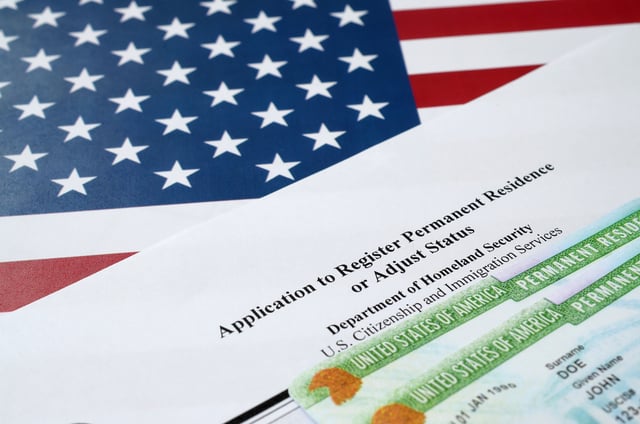
The policy memorandum, issued by U.S. Citizenship and Immigration Services (USCIS), declares that the decades-old practice of “Adjustment of Status”—which allowed people legally inside the country to obtain a green card without leaving—will now be treated as an “extraordinary form of relief” granted only under exceptional, case-by-case circumstances. Under this framework, hundreds of thousands of high-skilled tech workers, international students, spouses of U.S. citizens, and humanitarian visa holders will be forced to choose between abandoning their lives in America to navigate a backlogged consular system abroad, or staying in the U.S. with no clear path to permanent status.
The announcement sent immediate shockwaves through corporate boardrooms, immigrant communities, and legal advocacy circles, altering the landscape for an estimated 1.2 million people currently trapped in the green card backlog.
Shifting From In-Country Approval to “Self-Deportation”
For more than sixty years, Section 245 of the Immigration and Nationality Act has allowed foreign nationals who entered the U.S. legally to transition to permanent residency while remaining on American soil. This mechanism ensured that critical employees didn’t have to interrupt their work, and families were not forced into prolonged, multi-year separations while the government processed paperwork.

The new USCIS directive effectively dismantles this mechanism. According to the agency’s memorandum, titled “Adjustment of Status is a Matter of Discretion and Administrative Grace, and an Extraordinary Relief that Permits Applicants to Dispense with the Ordinary Consular Visa Process,” the administration interprets federal law to mean that permanent residency applications should naturally occur outside American borders.
“We are returning to the original intent of the law to ensure aliens navigate our nation’s immigration system properly,” said USCIS Spokesman Zach Kahler in an official statement. “From now on, an alien who is in the U.S. temporarily and wants a green card must return to their home country to apply, except in extraordinary circumstances. This policy allows our immigration system to function as the law intended instead of incentivizing loopholes.”
The Department of Homeland Security (DHS), which oversees USCIS, echoed the hardline stance in a blunt social media post confirming the shift: “The era of abusing our nation’s immigration system is over.”
Immigration policy analysts have characterized the move as a disguised mechanism for mass self-deportation. Rather than actively removing individuals through law enforcement, the policy forces legal residents to leave the country voluntarily to secure their future status.
The Catch-22: Travel Bans and Reentry Bars
Immigration lawyers and humanitarian organizations quickly pointed out that the directive places hundreds of thousands of families and workers into an inescapable legal trap, often referred to as a “Catch-22.”
Under existing statutory laws, individuals who have overstayed temporary visas but are otherwise qualified for a green card—such as those married to American citizens—trigger automatic three-year or ten-year bars from reentering the United States the exact moment they step onto an airplane to leave. Previously, an Adjustment of Status inside the country bypassed this penalty. By forcing these applicants abroad, the administration ensures they will be legally barred from returning to their families for up to a decade.
Furthermore, the policy intersects with the administration’s broader geopolitical travel restrictions. Currently, citizens of 39 countries face outright travel bans on national security grounds, while a separate administration policy has paused immigrant visa processing for citizens of 75 countries.
If an applicant belongs to one of these overlapping categories, they are caught in a devastating loop: the U.S. government orders them to return home to process an immigrant visa at a local American consulate, yet the very same government has barred those consulates from issuing visas.
“If families are told that the non-citizen family member must return to his or her country of origin to process their immigrant visa, but immigrant visas are not being processed there, it’s a Catch-22,” wrote World Relief, a prominent humanitarian and refugee resettlement organization, in a public statement. “These policies will effectively create an indefinite separation of families.”
Corporate and Economic Fallout
The policy’s economic ramifications are projected to disrupt major American industries, particularly the technology, healthcare, and academic sectors, which rely heavily on non-immigrant visas like the H-1B (specialty occupations) and L-1 (intracompany transfers).
Historically, corporate employers sponsor high-skilled foreign workers who enter as temporary non-immigrants, eventually moving them to permanent residency via an employer-sponsored green card. Because business immigration law explicitly recognizes “dual intent”—allowing an individual to legally work on a temporary visa while actively pursuing a permanent life in the U.S.—this pipeline has been the backbone of Silicon Valley and major medical research centers for decades.
While the USCIS policy memorandum notes that the new restrictions may be “less applicable” to dual-intent visa categories like H-1B and L-1 holders, it adds a chilling caveat: maintaining a valid H-1B or L-1 visa is “not sufficient, on its own, to warrant a favorable exercise of discretion.”
This means that high-salaried professionals, researchers, and engineers will face unpredictable case-by-case evaluations by individual USCIS officers. If an officer decides that an executive or data scientist does not meet an un-defined threshold of “extraordinary circumstances,” that employee will be ordered to exit the country, leaving American employers facing sudden vacancies.
Michael Valverde, a senior official at USCIS under both Republican and Democratic administrations who departed the agency last year, warned of severe market disruptions. The announcement, Valverde stated, would “disrupt the plans of hundreds of thousands of families and employers annually,” driving global talent to competing markets like Canada or the European Union.
The “Extraordinary” Discretionary Standard
What alarms legal experts most is the absolute lack of clear definitions regarding what actually constitutes an “extraordinary circumstance” allowing an immigrant to stay and adjust status.
Instead of publishing a clear list of exemptions, the USCIS directive instructs its adjudicating officers to weigh the “totality of the circumstances” using broad discretionary powers. Adjudicators are directed to heavily weigh negative factors, which include:
- Any minor immigration law violations or brief lapses in lawful status.
- A “failure to depart as expected” when a temporary tourist or student visa expires.
- Whether the applicant’s original admission or parole somehow violated the shifting spirit of administrative regulations.
The policy memo notes that positive factors like deep family ties in the United States, property ownership, or a clean record of moral character will be weighed, but they are no longer an entitlement to an in-country approval.
By removing predictable standards, the administration has introduced massive systemic volatility. According to analysis by the Cato Institute, USCIS had already slashed green card approvals by roughly half over the preceding year simply by leaving files unprocessed—a phenomenon analysts labeled “quiet quitting” on legal immigration. The new memorandum shifts this strategy from passive delay to active, formalized mass denials.
The Cato Institute notes that the policy effectively walks away from 1.2 million green card applicants, forfeiting hundreds of millions of dollars in non-refundable application fees paid by families and businesses, while shielding consular denials from any judicial review under the legal doctrine of “consular nonreviewability.”
Vulnerable Populations Face Immediate Peril
While corporate entities scramble to assess the damage to their workforces, humanitarian aid organizations are warning of an immediate crisis for highly vulnerable populations, including refugees, political asylum seekers, and abused children.
Though the text of the memo primarily targets non-immigrants—such as tourists, students, and temporary workers—civil rights groups point out that its implementation will have a chilling, sweeping effect across all entry categories. For instance, individuals who fled domestic violence, human trafficking, or cartel warfare and were granted temporary humanitarian protections face immense danger if forced to return to their home nations to wait out administrative queues.
According to reporting from Reuters, HIAS, an international refugee protection organization, strongly condemned the directive. The group stated that the USCIS policy effectively forces survivors of human trafficking, as well as abused, abandoned, or neglected children who qualify for special legal statuses, to return directly to the highly volatile and dangerous environments they initially fled just to process paperwork.
Looking Ahead: Legal Challenges and Escalation
The administration defends the rule as an essential administrative housekeeping measure. USCIS Spokesman Zach Kahler argued that shifting the workload to the Department of State’s overseas consulates will free up scarce domestic agency resources, allowing USCIS to focus on backlogs in naturalization applications and visas for victims of violent crimes.
However, immigration attorneys are already preparing a wave of federal lawsuits, arguing that the policy bypasses mandatory notice-and-comment rulemaking periods required by the Administrative Procedure Act (APA), and fundamentally rewrites statutes enacted by Congress.
Until federal courts intervene, the reality for over a million legal residents remains precarious. Families face the prospect of sudden fracture, employers face the loss of key personnel, and an immigration system defined for sixty years by orderly internal adjustment has been thrown into unprecedented structural chaos.
Sources and Links:
- The Associated Press (AP): Foreigners in U.S. must apply for green cards abroad, new Trump administration rule says
- PBS NewsHour: Foreigners in U.S. must apply for green cards abroad, new Trump administration rule says
- CBS News: Trump administration to require most immigrants seeking green cards to leave the U.S. first
- Cato Institute (Cato at Liberty): DHS Quits Granting Green Cards—Almost Entirely
- The Guardian: US green card applicants will now have to return to home countries to apply, DHS says
- The Times of India: US government to Green Card applicants: Go to your Home country first; here’s the American immigration authority’s complete memo
- The Indian Express: US says foreign nationals must return home to apply for Green Card
- Quarles & Brady LLP: Top 5 Things to Know about the New USCIS Adjustment of Status Policy
- Erickson Immigration Group: USCIS Issues Policy Memo Requiring Adjustment of Status Requests to be Completed Outside of the US
- T&S Immigration Law: USCIS Issues Policy Memorandum Describing Adjustment of Status as a Discretionary and Extraordinary Measure: Q&As
Disclaimer
Artificial Intelligence Disclosure & Legal Disclaimer
AI Content Policy.
To provide our readers with timely and comprehensive coverage, South Florida Reporter uses artificial intelligence (AI) to assist in producing certain articles and visual content.
Articles: AI may be used to assist in research, structural drafting, or data analysis. All AI-assisted text is reviewed and edited by our team to ensure accuracy and adherence to our editorial standards.
Images: Any imagery generated or significantly altered by AI is clearly marked with a disclaimer or watermark to distinguish it from traditional photography or editorial illustrations.
General Disclaimer
The information contained in South Florida Reporter is for general information purposes only.
South Florida Reporter assumes no responsibility for errors or omissions in the contents of the Service. In no event shall South Florida Reporter be liable for any special, direct, indirect, consequential, or incidental damages or any damages whatsoever, whether in an action of contract, negligence or other tort, arising out of or in connection with the use of the Service or the contents of the Service.
The Company reserves the right to make additions, deletions, or modifications to the contents of the Service at any time without prior notice. The Company does not warrant that the Service is free of viruses or other harmful components.