The Dramatic Announcement from Washington
In a sweeping diplomatic development reshaping Middle Eastern politics, President Donald Trump announced on Sunday, June 14, 2026, that the United States and Iran have reached a comprehensive framework agreement. The accord aims to immediately halt a destructive four-month kinetic war that has throttled global trade, spiked energy prices, and pushed the international community toward systemic collapse. Taking to Truth Social, Trump declared that the intensely negotiated deal is “now complete,” pausing months of high-intensity naval bombardments, airstrikes, and proxy skirmishes.
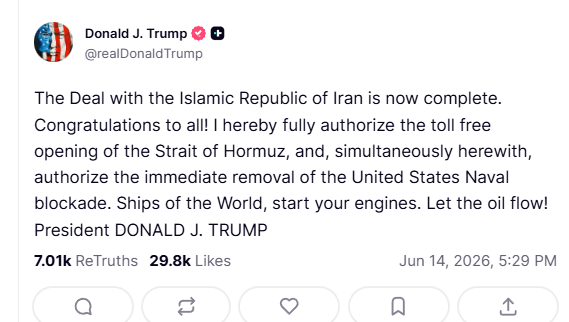
The centerpiece of the executive action is the total lifting of the maritime blockade the United States military placed on Iranian ports and shipping lanes. “Congratulations to all! I hereby fully authorize the toll free opening of the Strait of Hormuz, and, simultaneously herewith, authorize the immediate removal of the United States Naval blockade,” Trump posted, adding, “Ships of the World, start your engines. Let the oil flow!”
Pakistani Prime Minister Shehbaz Sharif, whose government served as the central mediator for the backchannel talks, corroborated the announcement. Sharif confirmed that the nations agreed to terms mandating “the immediate and permanent termination of military operations on all fronts.” While approved by decision-makers in Washington and Tehran, the formal signing ceremony is scheduled for Friday, June 19, 2026, in Switzerland.

Decoding the Terms of the Breakthrough Accord
While the full text remains classified, diplomats have shared the foundational components of the agreement. The core architecture rests on reciprocal concessions addressing the primary security grievances of both nations. For the United States, the main objectives were restoring safe maritime navigation and containing Iran’s advancing nuclear initiatives.
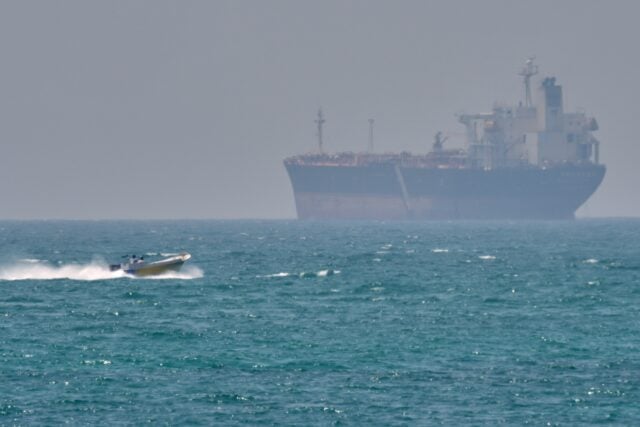
The agreement guarantees the vital Strait of Hormuz will be an open, toll-free international corridor. Iranian forces committed to halting all hostile interceptions, naval mining, and drone attacks against commercial vessels transiting the Persian Gulf. In exchange, the United States will stand down its naval strike groups and dismantle the crushing embargo that starved the Iranian economy over the last quarter.
The nuclear dimension has generated intense scrutiny. President Trump asserted that the Iranian regime formally signaled they “no longer want a Nuclear Weapon, nor will they have one.” According to leaked draft frameworks, Iran agreed to freeze high-level uranium enrichment, capping operations at standard civilian power generation levels, and will reinstate robust International Atomic Energy Agency (IAEA) monitoring protocols.
In return, Iran will receive significant economic concessions. The framework outlines a pathway for the United States to issue extensive waivers on economic sanctions. Most critically, the agreement authorizes the phased unfreezing of tens of billions of dollars in sovereign Iranian financial assets locked in foreign banks. Iranian Foreign Minister Abbas Araghchi noted that the framework includes a legally binding pledge from Washington promising a total cessation of future military aggression against Iran.
From Maximum Pressure to Open Warfare: How We Got Here
To understand the magnitude of the announcement, observers must review the violent trajectory of U.S.-Iran relations over the past sixteen months. Upon reassuming the presidency in early 2025, the second Trump administration reinstated a hyper-aggressive “maximum pressure” campaign to force Tehran into a completely renegotiated security pact. In March 2025, Trump sent a personal letter to Iranian Supreme Leader Ali Khamenei, drawing a rigid 60-day deadline for Iran to negotiate or face catastrophic economic isolation.
Initial efforts to avoid kinetic conflict showed progress during secret, Omani-mediated talks held in Muscat in April 2025. Led by U.S. Special Envoy Steve Witkoff and Iranian Foreign Minister Abbas Araghchi, mediators relayed a three-step de-escalation plan proposed by Iran. The Iranian framework offered a permanent freeze on high-level enrichment in exchange for sanctions relief.
However, the diplomatic track disintegrated rapidly due to deep-seated mistrust. Believing that Iran was utilizing talks as a stalling tactic to push its uranium enrichment past critical thresholds, the United States and Israel launched preventative measures. By early 2026, tensions boiled over into open war. The United States initiated a naval blockade, and Tehran responded with ballistic missiles and suicide drone swarms targeting American military facilities and commercial supertankers, closing the Strait of Hormuz and triggering a global energy crisis.
A Weekend of High-Stakes Shuttle Diplomacy and Last-Minute Hurdles
The path to Sunday’s announcement was defined by intense, chaotic signals over a frantic 48-hour window. The diplomatic endgame began on Saturday, June 13, when President Trump caught international allies off guard by proclaiming on social media that a monumental peace deal had been “largely negotiated” and was scheduled to be signed the following day. This rapid timeline initially provoked deep skepticism and confusion within Iran.
Iranian Foreign Ministry spokesperson Esmaeil Baqaei quickly issued a public statement attempting to cool the media frenzy, clarifying that while an agreement was close, the precise date for an official signing had not been finalized. Hardline factions within Iran’s Islamic Revolutionary Guard Corps (IRGC) criticized what they termed Trump’s “unusual insistence” on forcing a sudden Sunday timeline, suggesting the president was rushing the process to score a public relations victory coinciding with his 80th birthday celebrations.
Fearing that the opportunity might slip away, a flurry of urgent interventions took place Sunday morning. Qatari diplomatic negotiators boarded emergency flights to Tehran for closed-door consultations with Iranian security officials. Simultaneously, Pakistani Prime Minister Shehbaz Sharif engaged in continuous telephone diplomacy, serving as the structural channel between the White House and the Iranian Supreme National Security Council. This intense shuttle diplomacy ultimately succeeded in bridging the semantic gaps, paving the way for the historic afternoon announcement.
Regional Complications and the Shadow of the Lebanon Conflict
Despite the triumphant rhetoric, the framework’s viability remains threatened by volatile realities on the ground. The most immediate complication stems from the complex network of proxy conflicts tied to the U.S.-Iran dynamic, particularly the ongoing war in Lebanon involving Hezbollah and Israel. While Prime Minister Sharif emphasized that the framework requires the cessation of military operations across “all fronts,” it remains uncertain whether all regional actors will comply.
This reality was laid bare hours before President Trump’s announcement. Israeli defense forces conducted devastating airstrikes against a suspected Hezbollah command installation within a densely populated neighborhood of Beirut. The intense bombardment, occurring precisely as negotiators were finalizing the peace text, drew sharp condemnation from international observers who feared the localized flare-up could instantly collapse the fragile deal.
The provocative timing of the Beirut strikes prompted an emergency public intervention from United Nations Secretary-General Antonio Guterres. Issuing a stern rebuke, Guterres criticized the military escalation, noting that the strikes took place at a “crucial moment” when global powers were on the precipice of a resolution. “I urge all parties to show maximum restraint,” Guterres stated. In response, Trump released a statement urging that “all sides should stand down,” declaring that the strikes on Beirut should not have occurred under the current diplomatic climate.
Domestic Calculations and Political Stakes
Pentagon Readiness Metrics: Military intelligence indicates high ammunition expenditure rates during global operations, creating intense domestic pressure to prioritize strategic reserves over extended blockades.
Mounting domestic pressures and a severe military logistics crisis heavily drove President Trump’s sudden diplomatic pivot. Senator Mark Kelly recently warned of a critical “munitions issue” as the protracted conflict strained American stockpiles, while soaring energy costs damaged the economy. Faced with an unsustainable war, the administration seized this exit ramp as a foreign policy triumph. While experts remain divided over the framework’s long-term viability, the upcoming Switzerland summit represents a historic reordering of Middle Eastern geopolitics.
Sources and Links:
- CBS News: Trump says U.S. deal with Iran “is now complete,” authorizes removal of Navy blockade of Strait of Hormuz
- The Guardian: Trump news at a glance: president claims Iran ‘no longer want a nuclear weapon’ amid peace deal hopes
- The Washington Post: U.S. and Iran to close deal within a day, Trump says, but Tehran yet to confirm
- The Times of Israel: Despite Trump pronouncement, Iran signals no final decision made on deal
- PBS NewsHour: Trump says deal with Iran, including opening Strait of Hormuz, is ‘largely negotiated’
- CBS News (Live Updates): Live Updates: Trump says “all sides should stand down” after Israel strikes Lebanon as U.S.-Iran peace talks continue
Disclaimer
Artificial Intelligence Disclosure & Legal Disclaimer
AI Content Policy.
To provide our readers with timely and comprehensive coverage, South Florida Reporter uses artificial intelligence (AI) to assist in producing certain articles and visual content.
Articles: AI may be used to assist in research, structural drafting, or data analysis. All AI-assisted text is reviewed and edited by our team to ensure accuracy and adherence to our editorial standards.
Images: Any imagery generated or significantly altered by AI is clearly marked with a disclaimer or watermark to distinguish it from traditional photography or editorial illustrations.
General Disclaimer
The information contained in South Florida Reporter is for general information purposes only.
South Florida Reporter assumes no responsibility for errors or omissions in the contents of the Service. In no event shall South Florida Reporter be liable for any special, direct, indirect, consequential, or incidental damages or any damages whatsoever, whether in an action of contract, negligence or other tort, arising out of or in connection with the use of the Service or the contents of the Service.
The Company reserves the right to make additions, deletions, or modifications to the contents of the Service at any time without prior notice. The Company does not warrant that the Service is free of viruses or other harmful components.