Vice President JD Vance departed for Switzerland on Saturday night to attend emergency high-level talks on Sunday aimed at rescuing a fragile U.S.-Iran peace agreement that has unraveled just days after its signing. The high-stakes diplomatic summit comes at a moment of extreme peril: the Iranian military has officially declared the strategic Strait of Hormuz closed once again, explicitly accusing the United States and Israel of violating the central tenets of the newly minted peace accord through continued military operations in southern Lebanon.
The sudden escalation underscores the deep volatility of the interim deal, known as the Islamabad Memorandum of Understanding (MoU). Signed on Wednesday, June 15, 2026, by U.S. President Donald Trump and Iranian President Masoud Pezeshkian, the 14-point framework was designed to halt direct hostilities, secure a 60-day ceasefire across all regional fronts, and gradually reopen vital maritime corridors to relieve a biting global energy crisis. Instead, a swift resurgence of violence between Israel and Hezbollah has plunged the diplomatic breakthrough into immediate jeopardy.

A Diplomatic Mission Under Fire
Vice President JD Vance is wheels up from Washington, D.C., en route to Switzerland 🇺🇸 pic.twitter.com/uEeFTnx5Dn
— Luke Schroeder (@VPPressSec) June 20, 2026
Speaking to reporters at Joint Base Andrews in Maryland before boarding his flight, Vice President Vance sought to maintain an optimistic public posture despite the deteriorating security situation.
[You can watch an Al Jazeera report on Sunday’s meeting HERE]
“Our understanding is that the Iranians just landed,” Vance stated, confirming that Iranian negotiators had arrived in Bürgenstock, a resort town overlooking Lake Lucerne. “We’ll have a couple of days of talks to try to get this thing kicked off in the right way. There’s a lot to discuss, but we’re going to go through it all.”
When questioned about the renewed cross-border bombardments in the Levant, Vance offered a contrasting assessment to the chaotic headlines. “Despite the headlines, things are actually getting better there,” Vance insisted, arguing that the diplomatic focus remains locked on preventing a total regional escalation and preserving the broader agreement.
Vance is stepping into a complex, multi-nation mediating matrix in Switzerland. He joins White House envoy Steve Witkoff and the president’s son-in-law, Jared Kushner, who have been conducting preparatory discussions. A high-level Pakistani delegation, led by Prime Minister Shehbaz Sharif and Army Chief General Asim Munir, along with Qatari representatives, are also on the ground to act as primary mediators between Washington and Tehran.
The Iranian delegation, which delayed its initial Friday departure out of protest over the strikes, is reportedly led by Parliament Speaker and top negotiator Mohammad Bagher Ghalibaf. It includes Foreign Minister Abbas Araghchi, alongside the deputy oil minister and the central bank governor—an indication that structural economic relief and oil transit remain central to Tehran’s agenda.
The Strait of Hormuz Closes Again
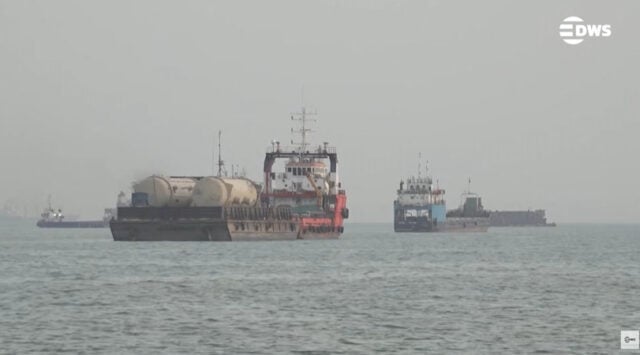
The immediate catalyst for the emergency summit was a severe directive issued on Saturday by Iran’s Khatam al-Anbiya Central Headquarters, the unified command of the Iranian armed forces. In an official statement, the central command declared the Strait of Hormuz completely closed to all maritime commercial traffic, effectively choking off a waterway through which roughly one-fifth of the world’s petroleum products and liquefied natural gas flows.
Iranian military officials explicitly defended the closure as a retaliatory measure against Western bad faith, citing a “clear breach of commitments” regarding the first clause of the Islamabad MoU.
The first clause of the signed agreement states:
“The U.S. and Iran and their allies in the current war declare the immediate and permanent termination of military operations on all fronts, including in Lebanon, and undertake from now on not to initiate any war or any military operation against each other, and to refrain from the threat or use of force against each other, and ensuring the territorial integrity and sovereignty of Lebanon.”
Tehran contends that Washington has failed in its implicit obligation to restrain its closest regional ally, Israel. Despite a separate, U.S.-and-Qatar-brokered ceasefire that technically went into effect between Israel and Hezbollah on Friday afternoon, heavy fighting has continued unabated.
Iranian Foreign Ministry spokesperson Esmaeil Baghaei warned that Israel’s relentless actions have placed the entire post-war agreement in jeopardy. The Iranian central military command echoed this sentiment, framing the closure of the shipping lane as merely “the first step of response to the enemy’s breach of trust,” adding that further military measures would be deployed if Israeli forces failed to halt operations and withdraw from seized territories in southern Lebanon.
While U.S. Central Command initially claimed that commercial shipping lanes remained open, noting that dozens of vessels had safely transited the region earlier in the day, shipping insurance premiums began surging rapidly following Tehran’s formal military decree.
Flashpoint Lebanon: The Ceasefire that Wasn’t
The core friction undermining the Trump administration’s diplomatic objective is the stark divide between the text of the U.S.-Iran MoU and the active military strategy of the Israeli government. Israeli Prime Minister Benjamin Netanyahu stated firmly on Friday that Israel intends to maintain its troops within a self-declared security zone in southern Lebanon for as long as necessary to protect communities along its northern border, directly contradicting Iran’s demands for an immediate withdrawal.
According to Israeli military officials, Hezbollah launched more than 50 projectiles at Israeli forces occupying positions inside Lebanon overnight from Friday into Saturday. The Israel Defense Forces (IDF) responded with a massive wave of retaliatory airstrikes targeting dozens of Hezbollah assets across southern Lebanon.
The human toll of the breakdown has been staggering. Lebanese health authorities reported that recent Israeli airstrikes killed dozens of people across multiple villages, including a single strike in Barish that decimated an entire family of four. The total death toll since the escalation of the conflict in Lebanon officially surpassed 4,000 on Saturday, according to Lebanon’s health ministry.
By Saturday night, the IDF stated it had received updated instructions from the Israeli government to operate purely in a “defensive manner,” halting proactive strikes. However, the fragile calm remains highly unstable as both sides occupy overlapping, heavily contested territory.
President Trump’s “No Tolls” Stance
The breakdown comes at a critical juncture for President Donald Trump, who has tethered much of his domestic political agenda to solving the global energy crisis sparked by the multi-front conflict. Under the original terms of the Wednesday MoU, a 60-day window was established during which Tehran would systematically reopen the Strait of Hormuz in exchange for the United States easing its tight naval blockade on Iranian ports.
Faced with the reality of a reclosed strait, President Trump took to social media on Saturday to issue a firm warning about the waterway’s economic implications. Trump asserted that there would be absolutely “NO TOLLS” imposed on international shipping in the Strait of Hormuz during the 60-day ceasefire period, nor would any be tolerated afterward.
In characteristic fashion, Trump added a warning that any future maritime fees would only be levied by and for the United States, should the comprehensive peace deal fail to materialize, citing America’s extensive naval deployments as “the Guardian Angel to the countries of the Western World.” The statement highlights the administration’s intent to maintain absolute freedom of navigation, even if it requires direct naval interventions to bypass Iranian blockades.
Domestic Fallout: Public Scepticism High in Latest Polls
The intense volatility abroad is mirroring a sharp decline in domestic political support for the administration’s handling of the conflict. For months, the American public has expressed growing fatigue over military expenditures, escalating inflation, and volatile energy costs tied directly to the standoff in the Persian Gulf.
Recent empirical data indicates that the administration is facing an uphill battle in convincing the electorate of its foreign policy efficacy. According to a Reuters/Ipsos polling series, public approval of President Trump’s broader performance has hovered at a near-record low of 35%.
The data highlights several key metrics regarding the public’s view on Iran:
- Handling of Iran: Only 29% of Americans approve of the administration’s direct management of the Iran crisis, while a substantial 52% state that the decision to engage in military actions against Iran has not been worth the overall costs to the nation.
- Economic Connection: The domestic economic impact of the conflict remains a primary vulnerability. An overwhelming 86% of Americans state that the conflict with Iran bears a heavy responsibility for recent spikes in domestic gasoline prices, which have severely strained household finances. Furthermore, 54% of respondents noted that the conflict has had a “mostly negative” impact on their personal financial situation.
- Desire for an Exit: Public desire for a swift diplomatic conclusion is pronounced. Approximately 66% of Americans believe the United States should prioritize an expedited end to its involvement in the Middle East conflict, even if it means failing to achieve all of Washington’s strategic geopolitical goals in the region.
Parallel data from an Economist/YouGov tracking poll echoes this widespread public skepticism. Their findings indicate that roughly two-thirds of Americans view the administration’s negotiation strategies with Tehran as ineffective. Additionally, a record 63% of respondents expressed deep disapproval of the overall handling of the broader economy, which remains closely tied to the security status of global oil chokepoints like the Strait of Hormuz.
As Vice President Vance sits down at the negotiating table in Bürgenstock this Sunday, the stakes could not be higher. He is not merely fighting to rescue a signature international accord from a cycle of regional violence; he is attempting to reverse a cascading domestic economic and political crisis before the window for diplomacy closes permanently.
Sources and Links:
- Fox News Live Updates: Vance travels to Switzerland for talks as Iran negotiators arrive
- The Hindu International: Iran says Strait of Hormuz ‘closed’ as Israeli strikes on Lebanon continue
- Financial Times: Iran says it closed Strait of Hormuz after Israel and Hizbollah exchange fire
- Ipsos Public Opinion: The Iran Conflict | Ipsos Trends and Polls
- YouGov Poll Analysis: Economist/YouGov Poll: New low for Trump approval on the economy, expectations of a drawn-out Iran war
- Ummid News Chronicle: Iran closes Strait of Hormuz after Israel bombs Lebanon
- Common Dreams Report: Israel’s ‘Sabotage’ of Peace Agreement Working Again as Iran Closes Strait of Hormuz
- World News Group (WNG): U.S.-Iran talks in Switzerland delayed
Disclaimer
Artificial Intelligence Disclosure & Legal Disclaimer
AI Content Policy.
To provide our readers with timely and comprehensive coverage, South Florida Reporter uses artificial intelligence (AI) to assist in producing certain articles and visual content.
Articles: AI may be used to assist in research, structural drafting, or data analysis. All AI-assisted text is reviewed and edited by our team to ensure accuracy and adherence to our editorial standards.
Images: Any imagery generated or significantly altered by AI is clearly marked with a disclaimer or watermark to distinguish it from traditional photography or editorial illustrations.
General Disclaimer
The information contained in South Florida Reporter is for general information purposes only.
South Florida Reporter assumes no responsibility for errors or omissions in the contents of the Service. In no event shall South Florida Reporter be liable for any special, direct, indirect, consequential, or incidental damages or any damages whatsoever, whether in an action of contract, negligence or other tort, arising out of or in connection with the use of the Service or the contents of the Service.
The Company reserves the right to make additions, deletions, or modifications to the contents of the Service at any time without prior notice. The Company does not warrant that the Service is free of viruses or other harmful components.