By Rebecca Bromelkamp
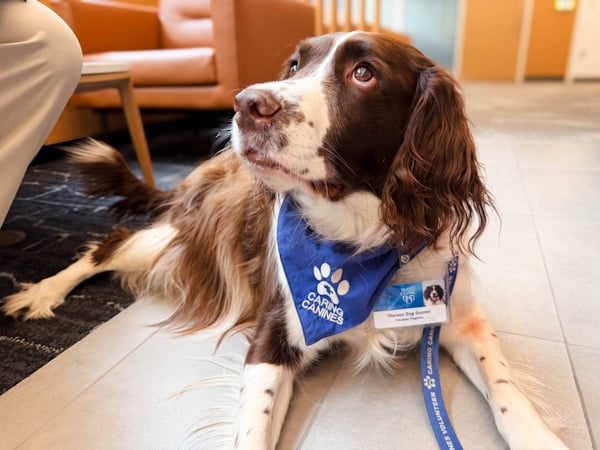
ROCHESTER, Minn. — A visit from a therapy animal may do more than lift spirits. A new study in Mayo Clinic Proceedings highlights how animal-assisted treatment can support inpatient stroke rehabilitation. Patients who interacted with therapy animals showed greater engagement in their treatment, increased physical activity and longer mobility compared with those who did not.
The findings suggest a promising approach to addressing common barriers patients face with stroke recovery, including limited motivation, reduced energy, lack of companionship and decreased interest in therapy activities. By incorporating trained therapy dog-handler teams into rehabilitation care, patients can do a variety of activities including walking, playing fetch, and petting or brushing the dog.
“The presence of a therapy dog can change the entire dynamic of a rehabilitation session,” says Whitney Romine, manager of animal-assisted services at Mayo Clinic. “Patients often share that they feel more grounded, safe and empowered to engage in therapy activities, which can make a meaningful difference in their recovery experience.”

The paper, “The Impact of Animal-Assisted Treatment on Inpatient Stroke Rehabilitation,” shows how patient care could be improved using a clinical care delivery model that includes qualified animal handler teams. The study also explores how these changes could be applied across a variety of medical specialties and patient populations.
“Stroke recovery can be challenging, particularly when patients face barriers such as low motivation or limited energy,” says Brent Bauer, M.D., a physician in internal medicine at Mayo Clinic. “This research demonstrates that animal-assisted treatment may offer a practical and effective way to enhance engagement and support better rehabilitation outcomes.”
This research was conducted in collaboration with Nestlé Purina PetCare. For a complete list of authors, disclosures and funding, review the study.
Disclaimer
Artificial Intelligence Disclosure & Legal Disclaimer
AI Content Policy.
To provide our readers with timely and comprehensive coverage, South Florida Reporter uses artificial intelligence (AI) to assist in producing certain articles and visual content.
Articles: AI may be used to assist in research, structural drafting, or data analysis. All AI-assisted text is reviewed and edited by our team to ensure accuracy and adherence to our editorial standards.
Images: Any imagery generated or significantly altered by AI is clearly marked with a disclaimer or watermark to distinguish it from traditional photography or editorial illustrations.
General Disclaimer
The information contained in South Florida Reporter is for general information purposes only.
South Florida Reporter assumes no responsibility for errors or omissions in the contents of the Service. In no event shall South Florida Reporter be liable for any special, direct, indirect, consequential, or incidental damages or any damages whatsoever, whether in an action of contract, negligence or other tort, arising out of or in connection with the use of the Service or the contents of the Service.
The Company reserves the right to make additions, deletions, or modifications to the contents of the Service at any time without prior notice. The Company does not warrant that the Service is free of viruses or other harmful components.