The landscape of the nation’s capital is poised for a dramatic and highly contested transformation. In a decisive move that has ignited fierce debate across the political and architectural landscape, the U.S. Commission of Fine Arts (CFA) has officially approved the design plan for a massive triumphal arch championed by President Donald Trump.
The federal panel, composed entirely of commissioners appointed by the president, voted to move the project forward despite an extraordinary wave of public opposition. The decision marks a pivotal advancement for one of the administration’s most ambitious and polarizing efforts to leave a lasting physical imprint on Washington, D.C., ahead of the United States’ 250th anniversary celebrations.
A Monumental Vision for the Gateway to Washington
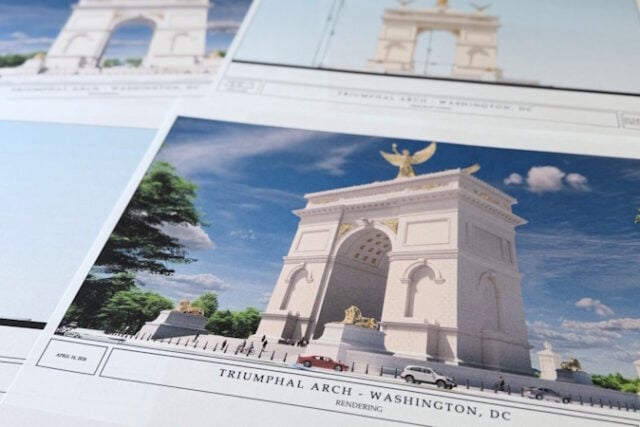
The proposed triumphal arch is slated for construction at Memorial Circle on Columbia Island—a historic public park nestled between the District of Columbia and Arlington National Cemetery. Serving as a prominent gateway into the capital, the monument is designed to stand a staggering 250 feet (76 meters) tall from its base. At this scale, the structure will comfortably eclipse France’s famous Arc de Triomphe by nearly 100 feet and tower at more than twice the height of the nearby Lincoln Memorial.
According to the concept plans presented to the federal agency by lead architect Nicolas Charbonneau, the arch features a bold neoclassical aesthetic designed to capture national prestige. The apex of the structure will feature a torch held aloft by a classical figure reminiscent of Lady Liberty, flanked by two sprawling American eagles.

The monument’s exterior will be constructed of high-durability granite, a material chosen over the administration’s initial preference for marble for its superior strength and resilience to the elements. Gilded lettering will decorate the upper facades, boldly inscribing the historic phrases “One Nation Under God” and “Liberty and Justice for All.” Furthermore, the plan incorporates a public observation deck at the very top of the arch, designed to provide visitors with sweeping 360-degree views of the capital skyline and the surrounding Potomac River landscape.
The arch is part of a broader, rapid-fire effort by the administration to beautify and alter the historic core of the city in time for the July 4 national milestone. Other concurrent projects include the construction of a new White House ballroom and a highly publicized initiative to apply a distinctive blue coating to the interior of the nearby Lincoln Memorial Reflecting Pool.
Overriding Direct Public Opposition
The swift approval of the project has drawn sharp criticism from preservationists, local residents, and political opponents, particularly due to the absolute lack of public support documented during the evaluation process.
According to Thomas Luebke, the longtime secretary of the Commission of Fine Arts, the federal agency received roughly 1,000 formal online public submissions during the open comment windows. Astonishingly, Luebke confirmed that 100% of those submitted comments were registered in direct opposition to the arch.
Members of the public who testified in person at the commission’s hearings expressed deep concern over the sheer scale and thematic tone of the structure. Many labeled the project a “vanity arch” and a severe misuse of federal funds. Outside the National Building Museum, where the CFA convenes, protestors routinely gathered with signs reading “Stop Arch Insanity” and “No Vanity Arch.”
Local civic groups have focused heavily on the project’s spatial impact. Critics argue that placing a 250-foot granite arch directly inside Memorial Circle fundamentally disrupts the carefully planned visual corridor connecting the Lincoln Memorial to the Arlington House across the Arlington Memorial Bridge. Zachary Burt, the community outreach manager for the D.C. Preservation League, vocally opposed the project during public testimony, cautioning that the monument “threatens the solemn vista” of the area and “risks overshadowing the revered landmarks that Americans hold in the highest regard.”
Emotional testimonies from lifelong Washington-area residents highlighted the deep personal attachment many have to the existing, unobstructed historic corridor. Despite these impassioned pleas, the panel moved forward, driven by a unified voting bloc of presidential loyalists.
The Internal Mechanics of a Handpicked Panel
The unanimity of the panel’s support is inextricably linked to its sweeping structural overhaul. President Trump systematically replaced the Commission of Fine Arts’ previous membership, populating the advisory body with individuals aligned with his traditional, classical architectural philosophies.
Because the current panel is made up entirely of the president’s handpicked choices, the review process progressed at what internal sources described as “unprecedented speed.” Rather than acting as a traditional bureaucratic roadblock, the commission functioned largely as an advisory collaborator, working alongside the administration’s architects to refine the design to ensure it could withstand logistical challenges.
During the hearings, commission chair Rodney Mims Cook Jr. explicitly defended the panel’s supportive posture, noting the deep personal investment driving the project from the highest levels of government. Cook, who has historically expressed an architectural desire to see a traditional arch integrated into the capital’s classical fabric, praised Charbonneau’s team for their presentation. Cook even publicly suggested that the administration should consider constructing three separate arches across the city’s quadrants to maximize the aesthetic impact.
Similarly, Interior Secretary Doug Burgum attended the hearings to offer formal executive backing. Burgum argued that leaving Memorial Circle empty actually “directly contradicts the original vision” of the city’s early landscape designers, who envisioned Columbia Island as a home for a major, beautiful civic structure. He framed the arch as the realization of long-delayed historical intent.
When confronted with public pushback over the disruption to the D.C. skyline, Commissioner Chamberlain Harris countered that the current design successfully honors the classical heritage of the city’s original master planners.
Design Revisions and Component Compromises
While the panel ultimately granted its blessing to the concept, the approval was not without minor aesthetic negotiations and structural compromises. Over a multi-month review process, the commission pushed the design team to make key concessions to better blend the arch into its sensitive surroundings.
Key Architectural Modifications
- Height Reduction from the Base: Although the core arch itself maintains its vertical height of 250 feet, an earlier iteration featured an additional eight-foot-tall foundational base. The commission insisted on removing this base, effectively lowering the maximum elevation of the overall structure to prevent it from excessively dominating the horizon.
- Removal of the Gilded Lions: The original blueprint featured four massive, gilded lion statues guarding the base of the arch. Vice Chairman James McCrery II—a prominent classical architect who previously designed the administration’s White House ballroom—led a push to eliminate them. McCrery and other panel members pointed out that lions are “not native to the United States” and lacked appropriate cultural placement on an American monument.
- Widened Depth and Structural Integrity: To compensate for the elimination of the lower ornamental features and to ensure maximum stability, the revised plan widened the overall depth of the arch. This adjustment provides a sturdier stance while expanding internal corridors.
- Elimination of the Subterranean Pathway: Early plans detailed a 250-foot underground pedestrian tunnel designed to guide tourists safely beneath traffic into the center of the arch. McCrery strongly criticized this feature as an unnecessary and unfortunate engineering complication, prompting the design team to scrap the subterranean route in favor of surface-level access.
Commission member Mary Anne Carter publicly lauded these structural deletions and modifications, noting that scaling back the heavy, exotic embellishments helps the arch forge a more respectful, somber aesthetic bridge with the nearby markers of Arlington National Cemetery.
Legal and Legislative Hurdles Ahead
While securing the approval of the Commission of Fine Arts is a massive victory for the administration, the path to breaking ground remains heavily obstructed by looming legal battles and constitutional questions.
Because the designated site at Memorial Circle rests on federal land directly controlled by the National Park Service, congressional Democrats have mounted a fierce legislative counter-offensive. Lawmakers argue that the executive branch cannot unilaterally authorize the construction of an entirely new national monument without explicit statutory approval and funding allocations from Congress.
Simultaneously, a coalition consisting of military veterans, historic preservation groups, and a prominent government watchdog organization has filed a federal lawsuit to block both the arch and the Lincoln Memorial Reflecting Pool modifications. The plaintiffs allege that the administration bypassed mandatory environmental and historical impact evaluations in an unconstitutional rush to begin construction before the July 4 anniversary.
Despite the impending litigation, the White House remains unyielding. White House Press Secretary Karoline Leavitt reaffirmed the administration’s aggressive timeline, stating to reporters that beginning construction on the architectural arc this year represents a profoundly fitting tribute to celebrate two and a half centuries of American independence. With both sides dug into their positions, the battle over Washington’s skyline is shifting from the designer’s drafting table directly into the federal courts.
Sources Used
- PBS NewsHour: Design plan for Trump’s proposed Washington arch is approved by Trump-appointed commission
- The Los Angeles Times: Design plan for Trump’s proposed Washington arch is approved by key federal agency
- CBS 58 / CNN: Trump arch moves ahead — but monument loses eight feet and four lions
- NOTUS (News of the United States): Trump’s Handpicked Arts Commission Unanimously Approves Early D.C. Arch Design
- MyCentralOregon.com / ABC News: Fine arts panel gives initial approval to Trump’s ‘triumphal arch’ but asks for design revisions
Disclaimer
Artificial Intelligence Disclosure & Legal Disclaimer
AI Content Policy.
To provide our readers with timely and comprehensive coverage, South Florida Reporter uses artificial intelligence (AI) to assist in producing certain articles and visual content.
Articles: AI may be used to assist in research, structural drafting, or data analysis. All AI-assisted text is reviewed and edited by our team to ensure accuracy and adherence to our editorial standards.
Images: Any imagery generated or significantly altered by AI is clearly marked with a disclaimer or watermark to distinguish it from traditional photography or editorial illustrations.
General Disclaimer
The information contained in South Florida Reporter is for general information purposes only.
South Florida Reporter assumes no responsibility for errors or omissions in the contents of the Service. In no event shall South Florida Reporter be liable for any special, direct, indirect, consequential, or incidental damages or any damages whatsoever, whether in an action of contract, negligence or other tort, arising out of or in connection with the use of the Service or the contents of the Service.
The Company reserves the right to make additions, deletions, or modifications to the contents of the Service at any time without prior notice. The Company does not warrant that the Service is free of viruses or other harmful components.