Refusing to retreat in the face of escalating criticism from religious leaders and political allies alike, President Donald Trump took to Truth Social on Wednesday morning to share a provocative new AI-generated image. The post, which depicts the President in a warm, fraternal embrace with Jesus Christ, arrives just forty-eight hours after a similar “messianic” post was deleted following a firestorm of “blasphemy” accusations from the nation’s most prominent evangelical voices.
The latest image, which began circulating on Wednesday, April 15, 2026, appears to be a deliberate “doubling down” on a strategy that blends high-stakes populist politics with divine iconography—a move that has left even some of his most loyal South Florida supporters questioning where political branding ends and religious sacrilege begins.
The “Irish for Trump” Connection
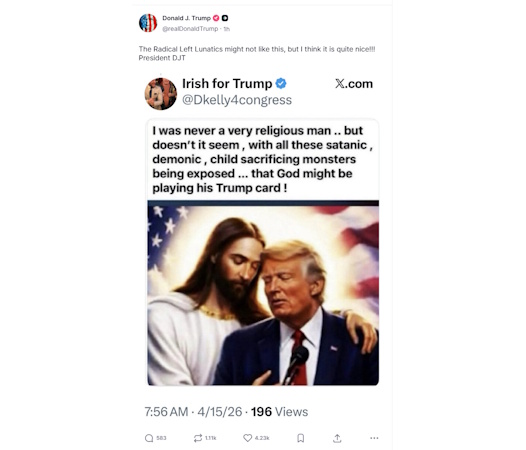
The image shared on Wednesday was not an original creation of the Trump campaign but was instead a screenshot of a post from an X (formerly Twitter) account titled “Irish for Trump.” The original caption for the image read:
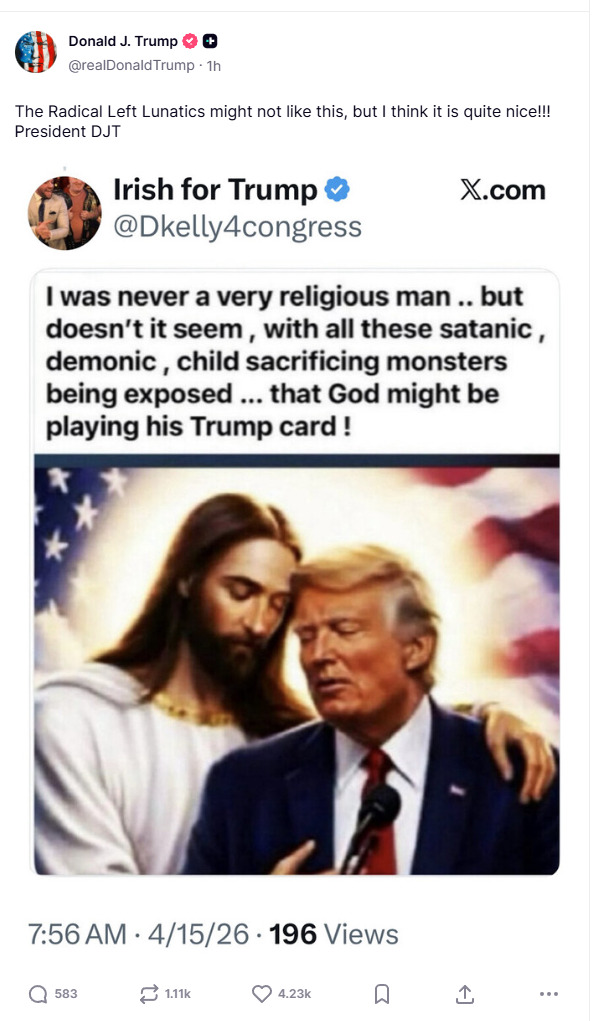
President Trump shared the screenshot with his own characteristic commentary, writing: “The Radical Left Lunatics might not like this, but I think it is quite nice!!! President DJT.”

Unlike the hyper-stylized “healer” image from earlier in the week, which featured complex military and patriotic backgrounds, today’s picture is more intimate. It portrays a serene Jesus Christ, with long hair and a traditional robe, wrapping his arm around a smiling President Trump. The lighting is soft and ethereal, designed to evoke a sense of divine endorsement and personal friendship.
Observers note that while the previous image sought to portray Trump as a source of power (the healer), this new image portrays him as a recipient of divine comfort—a tactical shift that may be designed to soften the “God complex” criticisms that plagued his earlier posts this week.
A Week of Divine Discord
To understand the weight of today’s post, one must look back at the chaotic sequence of events that began on Easter Sunday. That evening, the President shared an AI-generated scene that was immediately dubbed the “Trump as Healer” image.
In that depiction, Trump was shown wearing a white chiton and a red himation (garments traditionally associated with Christ or ancient biblical figures). He was shown placing a glowing palm on the forehead of a sick man in a hospital bed—a scene strikingly similar to the biblical accounts of Jesus healing the infirm. The background was a chaotic mélange of American symbols: a nurse, a soldier, a “veteran” in a baseball cap, the Statue of Liberty, fighter jets, and soaring eagles. Most controversially, some internet sleuths pointed out that a shadowed figure in the background appeared to resemble a horned demon, while others suggested the “sick man” bore a resemblance to the late Jeffrey Epstein.
The backlash was swift and bipartisan. By Monday morning, the post had been scrubbed from Truth Social. However, when asked about it by reporters at the White House later that day, the President offered a defense that many found as surreal as the image itself.
“I did post it, and I thought it was me as a doctor,” Trump insisted. “It had to do with the Red Cross, as a Red Cross worker there, which we support. Only the fake news could come up with that one. I make people better. A lot better.”
Critics, including late-night host Jon Stewart, were quick to dismantle this explanation. Stewart mocked the “doctor” defense on Tuesday night, pointing out that Red Cross workers generally do not wear flowing biblical robes or have light radiating from their palms. “Do you even care about lying to us anymore?” Stewart asked during his monologue. “Your lies used to have a real spark… now the best you’ve got is: ‘Oh, it wasn’t Jesus. I’m a doctor.’”
The Great Schism: Conservative Backlash
For the first time in his political career, the “messianic” branding that has been a staple of Trump’s movement is causing visible cracks in his evangelical base. Figures who have stood by the President through legal challenges and policy shifts are now publicly rebuking his use of religious imagery.
Megan Basham, a prominent columnist for the Daily Wire, described the posts as “OUTRAGEOUS blasphemy.” On social media, she demanded that the President “take this down immediately and ask for forgiveness from the American people and then from God.”
Similarly, Riley Gaines, the Fox News host and frequent Trump rally speaker, expressed deep unease. “Faith is not a prop,” Gaines wrote. “Does he actually think this? Either way, two things are true: 1) a little humility would serve him well, 2) God shall not be mocked.”
The sentiment was echoed by Isabel Brown, who called the imagery “disgusting and unacceptable,” arguing that it reflected a “profound misreading” of an American public currently experiencing a revival of genuine Christian faith. Even within the halls of Congress, House Speaker Mike Johnson reportedly intervened personally, asking the President to remove the initial “healer” image.
The Global Stakes: Pope Leo XIV and the Iran Conflict
The timing of these religious posts is not accidental. They coincide with a massive escalation in the President’s public feud with Pope Leo XIV, the first American-born pontiff. The Pope has become an outspoken critic of the Trump administration’s military strategy in Iran and the ongoing naval blockade of the Strait of Hormuz—an operation the White House has dubbed “Operation Epic Fury.”
In a recent address from Algiers, Pope Leo condemned “neocolonial” powers and warned that the Gospel should not be “abused” for political ends. President Trump responded with a series of scorched-earth Truth Social posts, labeling the Pope “weak on crime” and “terrible for foreign policy.”
“I don’t think he’s doing a very good job,” Trump told reporters at Joint Base Andrews. “He likes crime, I guess. I am not a fan of Pope Leo.”
Political analysts suggest that the “Jesus” images are a direct attempt to bypass the Pope’s authority. By showing himself in direct communion with Christ, Trump is signaling to his Catholic and evangelical followers that he does not need the approval of the Vatican or any earthly religious hierarchy.
The South Florida Impact
For readers in South Florida, the controversy is hitting close to home. The region’s dense population of Hispanic Catholics and white Evangelicals makes it a primary battleground for this “theological warfare.”
In Miami’s Little Havana and the suburban enclaves of Doral, many Catholic voters are torn between their support for Trump’s economic policies and their loyalty to the Holy See. The President’s claim that he preferred the Pope’s brother, Louis (whom he called “all MAGA”), over the Pope himself has caused particular consternation in the South Florida archdiocese.
“We are used to the President’s rhetoric, but this is different,” said one local community leader in Broward County. “To attack the Pope while simultaneously portraying himself as the Savior—it’s a very dangerous line to walk in a community that takes its faith seriously.”
Furthermore, as the naval blockade in the Middle East continues to impact global oil prices and shipping, the “messianic” distraction may be an attempt to keep the base focused on identity politics rather than the complex realities of a looming global conflict.
The Era of “AI Slop”
Technologically, these images represent the forefront of what digital culture experts call “AI slop”—hyper-saturated, emotionally manipulative imagery generated with a few prompts. The images are designed to be “vibe-checked” rather than scrutinized for logic.
In the April 15 “embrace” image, the AI’s limitations are still visible. Some observers pointed out that the President’s hands appeared “unnaturally smooth,” a common hallmark of AI generation. Others noted that the background was strangely sparse compared to his usual aesthetic, likely a response to the “demon/Epstein” hidden imagery scandals that plagued the previous post.
As the 2026 political cycle intensifies, the use of AI to create “divine endorsements” is likely to become a permanent fixture of the landscape. For Donald Trump, the goal appears to be simple: to remain the center of the national conversation, even if it requires stepping onto the most sacred ground imaginable.
Sources Used and Links:
- Forbes: Trump Posts AI Photo With Jesus—Days After He Was Slammed For ‘Blasphemy’
- Al Jazeera: Trump deletes image of himself as Jesus-like saviour after backlash
- The Guardian: Jon Stewart on Trump’s Jesus photo denial: ‘Do you even care about lying to us any more?’
- India Today: Trump posts AI image of himself as Jesus Christ, internet spots Epstein
- RBC-Ukraine: Trump faces backlash over Jesus-style image
- Times of India: ‘I do make people better’: Donald Trump explains why he deleted post depicting him as Jesus
- ANI News: Trump deletes AI-generated image depicting himself as Jesus amid backlash
- The Bangor Daily News: AI generated picture of Trump appearing to depict himself as Jesus taken off social media
- Ada Derana: Donald Trump deletes controversial Truth Social post where he appears Jesus-like
Disclaimer
Artificial Intelligence Disclosure & Legal Disclaimer
AI Content Policy.
To provide our readers with timely and comprehensive coverage, South Florida Reporter uses artificial intelligence (AI) to assist in producing certain articles and visual content.
Articles: AI may be used to assist in research, structural drafting, or data analysis. All AI-assisted text is reviewed and edited by our team to ensure accuracy and adherence to our editorial standards.
Images: Any imagery generated or significantly altered by AI is clearly marked with a disclaimer or watermark to distinguish it from traditional photography or editorial illustrations.
General Disclaimer
The information contained in South Florida Reporter is for general information purposes only.
South Florida Reporter assumes no responsibility for errors or omissions in the contents of the Service. In no event shall South Florida Reporter be liable for any special, direct, indirect, consequential, or incidental damages or any damages whatsoever, whether in an action of contract, negligence or other tort, arising out of or in connection with the use of the Service or the contents of the Service.
The Company reserves the right to make additions, deletions, or modifications to the contents of the Service at any time without prior notice. The Company does not warrant that the Service is free of viruses or other harmful components.