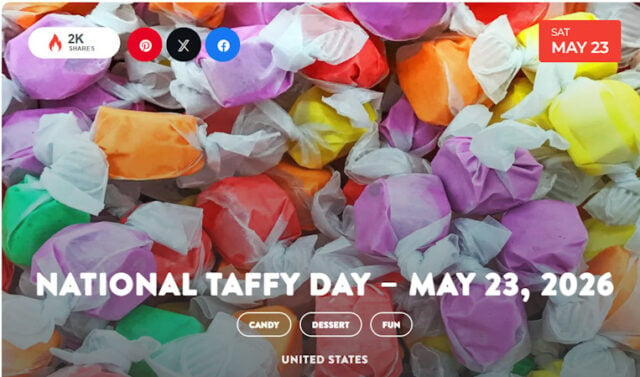
On May 23, we celebrate our favorite sweet and chewy treat on National Taffy Day. Taffy has a long history as one of America’s native sweets. Common lore has it that in the 1880s, a Jersey Shore candy shop got flooded, soaking the shop’s taffy stock with Atlantic salt water. On a lark, the owner sold the candy as “saltwater taffy” and an American delicacy was born!
- 1817 – Taffy is mentioned in print for the first time in the Oxford English Dictionary.
- Mid-1800s – Soft, chewy taffy is very popular.
- 1870s -In the late 19th century, homemade taffy “pulls” spread across the United States as cold‑weather parties, with newspapers and etiquette writers describing groups gathering to cook, pull, and share the candy.
- 1880s – Candy makers Joseph Fralinger and Enoch James refine recipes and packaging in Atlantic City, boxing salt water taffy as a portable souvenir and helping to spread the confection far beyond the boardwalk.
- 1883 – Salt water taffy was invented in Atlantic City, New Jersey.
- 1900 – By the turn of the 20th century, patented mechanical taffy pullers replaced much hand‑pulling in candy factories, continuously stretching and aerating the candy to create a lighter texture at a commercial scale.
- 1920s – Consider it “public domain”: The “original” saltwater taffy was trademarked by John R. Edmiston, who immediately asked the larger taffy companies to share in the profits generated by the trademark. He was, of course, sued. In 1923 the Supreme Court ruled that the taffy had been around too long and used by too many people to provide royalties.
- 1939 – Did you know that two of the best-known saltwater taffy makers in Atlantic City, New Jersey, set aside their rivalry and teamed up to ship taffy overseas to the armed forces during World War II? The leading candy companies on the boardwalk at the time were Fralinger’s and James, and they made it their mission to do what they could to help the troops get through the war
- 1951 – When Topps baseball cards were first introduced, taffy was included in the pack. Unfortunately, the cards’ varnish tainted the taffy, so Topps later switched to gum.
- 1958 – The U.S. Food Additives Amendment of 1958 establishes stricter oversight of ingredients, coloring, and preservatives in candies like taffy, pushing makers toward standardized labeling and safer mass production.
- 1971 – The Willy Wonka Candy Company, founded in 1971, later introduced Laffy Taffy as a branded, joke‑filled chewy candy bar, bringing taffy’s texture into supermarkets and convenience stores nationwide.
- 1978 – Frank Sinatra holds the record for the largest single mail order: more than 500 boxes of James’s taffy went to his friends and relatives the morning after his first performance at Resorts International in 1978.
- 1979 – Both Resorts and Caesars casinos offered bused-in gamblers a choice of a souvenir box of saltwater taffy or $5 in quarters. Nearly all the gamblers took the money.
- 1993 – Arthur Gager III, a Fralinger descendant, wanted to celebrate the 100th anniversary of saltwater taffy on the Boardwalk with the world’s longest outdoor taffy pull. But unfortunately, hot sun and muggy humidity reduced the taffy to a gooey mess.
- 2005 – A new Laffy Taffy, in the shape of a long cord, arrives on the market.
- Today is also Lucky Penny Day; it was also one of the penny candies that could once be bought for a cent.
- Many manufacturers claim that David Bradley was one of the first sellers of the candy. A huge storm hit Atlantic City and flooded the boardwalk. Bradley’s store was flooded, and the ocean water soaked his entire stock of taffy. In one account, a young girl asked if the store still had taffy for sale. Bradley jokingly told the girl to grab some “salt water taffy.”
- Here’s another explanation: it’s probably due to the water’s proximity to the boardwalk. That fact was used as an early marketing tactic: Joseph Fralinger, known for popularizing taffy, sold “salt water taffy” to sunbathers and tourists as a souvenir (early correspondence from Fralinger refers to the taffy as “Ocean Wave,” “Sea Foam” and eventually “Salt Water Taffy”).
- Modern technology allows confectioners to produce 1,000 pieces of taffy a minute.
- In one hour, enough pieces of taffy are made to cover one-third of the length of Atlantic City (about 1.3 miles).
- The three most popular taffy flavors sold by Sweet Candy Company are peppermint, cinnamon, and chocolate.
- Many of the most famous taffy makers still use the same pulling process that dates back over 100 years!
- Turkish taffy was a candy bar similar to taffy, available in a variety of flavors. It was made at a factory in Coney Island and sold at an amusement park there. The family that manufactured the taffy, made of egg whites and corn syrup, emigrated from Turkey.
Sources:

Warrell Corp
Disclaimer
Artificial Intelligence Disclosure & Legal Disclaimer
AI Content Policy.
To provide our readers with timely and comprehensive coverage, South Florida Reporter uses artificial intelligence (AI) to assist in producing certain articles and visual content.
Articles: AI may be used to assist in research, structural drafting, or data analysis. All AI-assisted text is reviewed and edited by our team to ensure accuracy and adherence to our editorial standards.
Images: Any imagery generated or significantly altered by AI is clearly marked with a disclaimer or watermark to distinguish it from traditional photography or editorial illustrations.
General Disclaimer
The information contained in South Florida Reporter is for general information purposes only.
South Florida Reporter assumes no responsibility for errors or omissions in the contents of the Service. In no event shall South Florida Reporter be liable for any special, direct, indirect, consequential, or incidental damages or any damages whatsoever, whether in an action of contract, negligence or other tort, arising out of or in connection with the use of the Service or the contents of the Service.
The Company reserves the right to make additions, deletions, or modifications to the contents of the Service at any time without prior notice. The Company does not warrant that the Service is free of viruses or other harmful components.