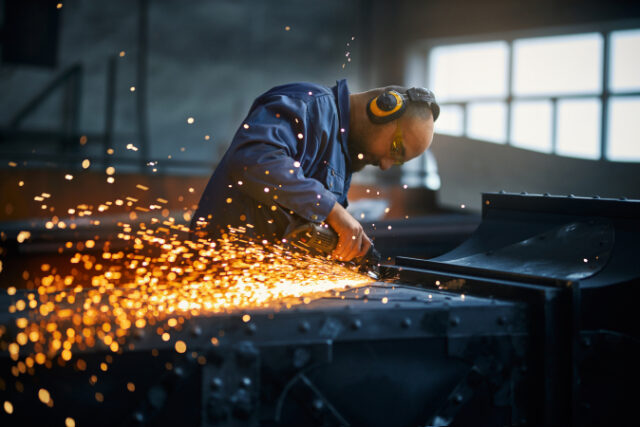
From the medical industry, aerospace, automotive, construction, energy and the agricultural sector, metal fabrication is necessary and prevalent in today’s economy. Ever-evolving technology constantly creates the need to upgrade innovations and sharpen levels of skills. So, to predict the future potential of metal fabrication, you’d better focus on its trends.
About Metal Fabrication
Fabricators build structures and machines from raw metal materials by various processes, i.e., cutting, welding, machining, forming, assembling, to mention a few. Metal fabrication involves big projects such as big machinery, hand railings, and heavy-duty equipment. Other creations include structural and architectural metals, screws, nuts, and bolts.
Companies that provide metal fabrication or sheet metal services usually use standard raw materials and techniques such as castings, fittings, welding wire and plate metals to create many consumer products. Metal fabrication companies employ different professionals, including boilermakers, ironworkers, blacksmiths, and welders, to convert sheet metal into final products.
Ideally, the metal fabrication industry has come a long way as companies strive to hone their skills to make the most of the available resources. Besides optimizing manufacturing processes, many shops are gearing their efforts towards a customer base paired with close attention to specific aspects.

Customer Support Systems
A well-established metal fabrication industry in the future should not be a shocker when customer service is great. It has always been a significant factor in growing the customer base. The difference, now and in the future, is that client experiences, reputations, and information about metal fabrication services will be instantly accessible on the internet. Every activity will be online, including the disappointing customer experiences that companies tend to hide. The same applies to positive experiences to enable several business segments to understand and manage their social media platforms.
Technology
Automated programs for metal fabrication rely on technology to facilitate routine processes for cutting, welding, and shaping sheet metal into final products. For instance, machines will improve the efficiency of complicated welding using proper techniques. Quality is guaranteed in the process, not to mention the speed of fabricating multiple components.
Young Innovative Minds
Like in other industries, metal fabrication companies do well when they recruit young people to redefine their business segments from “boring” and “too much work.” The reality is that young people integrate well with technology and seem to fit perfectly into creative teams. As technology becomes a greater aspect of metal fabrication, it attracts millennials to train them in fabrication and what each process entails.
Being Proactive
Fabrication companies might tend to look at what their competitors are doing and mirror their strategies to thrive. Well, the future of metal fabrication doesn’t necessarily rely on making such adjustments. Manufacturing companies will become more proactive in anticipating customers’ needs and preferences instead of doing things the same way. Their primary focus will be on upgrading systems and technology to make employees productive so they can stay competitive.
Trends and technologies Shaping the Metal Fabrication Industry
The metal fabrication sector is a solid investment that has developed on the basis of consumer demand. Ideally, companies with lucrative targets tend to attract many customers who want to invest their capital in sectors that yield significant profits. Fabricators have learned to streamline their production practices to reliably increase output to meet various customer needs. Essentially, several trends and technologies come into play to help them diversify their customer base to serve multiple requests. Some include:
Digitalizing Metal Fabrication
Business entrepreneurs need to appreciate digitization in metal fabrication to significantly utilize the resources available to them. Essentially, they need to understand that the revolution doesn’t eliminate the human factor, but is another step in productivity and efficiency. As much as the metal fabrication industry has been slow in digitizing manufacturing processes, the future calls for more involvement to increase the need for cyber security.
The manufacturing industry is one of the most hacked sectors in the world, it puts customers’ and companies’ information at risk. As such, cyber security is one of the trends that would benefit from digitization as long as it’s at the forefront of fabricators’ minds.
Integrating Collaborative Robots
Robots are not a shocker to metal fabrication companies. The machines come in handy in cases where human workforces can’t handle dangerous and complicated tasks. Previously, the robots were heavy and massive, so they required their own floor space to work. Today’s technology has made robots functional and collaborative alongside humans to complete tasks as a team. Collaborative robots (cobots) carry out tedious tasks to offset the fabrication industry’s labor shortage.
The COVID-19 pandemic particularly exacerbated the evolution of cobots since many people were out of work. While they might still be in the early development stages, cobots will most likely fill necessary fabrication niches in the future.
Appreciating Automation in CNC Machining
Until recently, CNC machines required human programming and intervention to effectively operate. Automation can now be integrated into CNC metal fabrication stages to prevent employees from suffering from repetitive stress.
In the long run, increased productivity and efficiency become a plus in a company. Automating CNC machines will become more popular in the future as metal fabrication companies embrace new strategies to thrive.
A Look Into the Future Beyond 2022
Although future predictions can be challenging in an industry that depends on the economic fortune of its clients, one fact is indisputable: business owners who can keep up with the ever-changing demands to maintain high output will always maximize their profits.
Disclaimer
Artificial Intelligence Disclosure & Legal Disclaimer
AI Content Policy.
To provide our readers with timely and comprehensive coverage, South Florida Reporter uses artificial intelligence (AI) to assist in producing certain articles and visual content.
Articles: AI may be used to assist in research, structural drafting, or data analysis. All AI-assisted text is reviewed and edited by our team to ensure accuracy and adherence to our editorial standards.
Images: Any imagery generated or significantly altered by AI is clearly marked with a disclaimer or watermark to distinguish it from traditional photography or editorial illustrations.
General Disclaimer
The information contained in South Florida Reporter is for general information purposes only.
South Florida Reporter assumes no responsibility for errors or omissions in the contents of the Service. In no event shall South Florida Reporter be liable for any special, direct, indirect, consequential, or incidental damages or any damages whatsoever, whether in an action of contract, negligence or other tort, arising out of or in connection with the use of the Service or the contents of the Service.
The Company reserves the right to make additions, deletions, or modifications to the contents of the Service at any time without prior notice. The Company does not warrant that the Service is free of viruses or other harmful components.