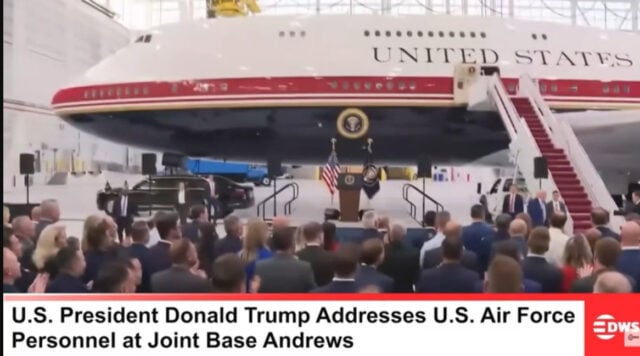
The tarmac at Joint Base Andrews just got a whole lot more crowded—and a lot more colorful. Under the bright lights of a specially constructed military hangar in Maryland, the iconic, light-blue silhouette that has defined American presidential travel since the Kennedy administration was officially replaced. Standing in its place was a massive, newly retrofitted Boeing 747-8, gleaming in a bold new red, white, and dark blue color scheme.
Video courtesy C=SPAN
This is the new “VC-25B Bridge” aircraft, a unique addition to the presidential fleet that serves as a literal and symbolic bridge for executive travel. The unveiling ceremony was pure theater. Stepping off the jumbo jet to the sounds of his signature campaign anthem, “God Bless the USA,” the commander-in-chief wasted no time pitching the new aircraft to an assembled crowd of a few hundred Air Force personnel. He called it a unique masterpiece, declaring it the world’s most luxurious plane and claiming its level of workmanship would probably never be seen again.
For aviation buffs and political observers alike, the rollout represents the culmination of a years-long obsession with changing the look of the world’s most famous airplane. But behind the theatrical reveal lies a fascinating tale of international diplomacy, massive defense contracting delays, and a fierce aesthetic debate that has divided Washington for nearly a decade.

A Gift from the Gulf
The story of how this specific aircraft became Air Force One is anything but traditional. Typically, presidential aircraft are ordered directly from American manufacturers under rigid, multi-billion-dollar defense procurement contracts. However, this particular Boeing 747-8 Intercontinental originally belonged to the Qatar Amiri Flight, serving the wealthy House of Thani as a royal VVIP transport.
After being withdrawn from Qatari royal service, the luxury jet was offered to the United States as an “unconditional donation.” The gift was formalized through a memorandum of understanding, presenting the administration with a unique opportunity to solve a massive logistical headache.
The primary, purpose-built Air Force One replacement program—a $3.9 billion fixed-price contract awarded to Boeing—has been plagued by severe schedule delays and substantial cost overruns. Originally slated for delivery by late 2024, those official replacements aren’t expected to hit the tarmac until mid-2028. Facing a rapidly aging VC-25A fleet that has flown presidents for over thirty years, the government accepted the Qatari jet to fill the widening gap.
Responding to critics who questioned the ethics and potential security risks of flying a foreign government’s gift, the defense was swift. Supporters asked why taxpayers should be forced to shell out hundreds of millions of dollars when the country could secure an advanced airframe for free from an ally. To finalize its new status, it was promised that the aircraft would eventually be donated to a future presidential library rather than kept for private use.
Trading “Jackie Kennedy Blue” for Stars and Stripes
The most immediately striking aspect of the new aircraft is its exterior. For over sixty years, Air Force One has been instantly recognizable by its “luminous ultramarine blue” and polished aluminum belly—a design crafted in 1962 by legendary industrial designer Raymond Loewy and First Lady Jacqueline Kennedy.
The newly unveiled design throws out that historic playbook. The new livery features a crisp white upper fuselage, a sharp red accent stripe running along the center, and a commanding dark navy blue underbelly with gold accents. A massive, waving American flag is painted proudly across both sides of the tail structure, and the words “UNITED STATES OF AMERICA” span the upper cabin in a bold font. The presidential seal rests prominently near the front boarding doors.
This look closely mirrors the patriotic palette proposed during a previous term, intentionally replacing what had been dismissively termed “Jackie Kennedy blue” with a bolder, heavier aesthetic. The visual transformation isn’t just limited to this single aircraft, either. The Air Force plans to roll out this updated color scheme across other elements of the executive airlift fleet, including the modified Boeing 757s that operate as Air Force Two.
Military Muscle Beneath the Royal Luxury
While the plane was frequently described as a “palace in the sky” during its time in the Middle East, converting a commercial VIP liner into a secure mobile command center requires an extraordinary amount of invisible work. Over the past year, defense contractor L3Harris took charge of the aircraft at service facilities in Waco and Greenville, Texas, executing a complex $400 million military overhaul.
The Air Force explicitly noted that during this retrofitting process, engineers prioritized operational readiness over dramatic interior redesigns, leaving the existing luxury layout minimally changed. This means the high-end wood paneling, premium leather seating, and spacious staterooms likely remain intact, saving taxpayers the expense of gutting a perfectly good luxury cabin.
However, the real money was spent upgrading what lies beneath the glossy finishes. The aircraft underwent extensive structural modifications to install highly classified defense systems, anti-missile countermeasures, and advanced cyber protections. The onboard electronics were completely hardened to safeguard the aircraft against the destructive electromagnetic pulse (EMP) generated by a nuclear detonation.
Furthermore, the finished aircraft boasts state-of-the-art secure communication arrays, allowing the president to run the country seamlessly from 40,000 feet in the air during a national crisis. Like its predecessors, the sprawling three-level, 4,000-square-foot interior includes an expansive presidential suite, a dedicated conference room, a medical suite that can serve as an emergency operating room, and massive galleys capable of feeding up to 100 people at a time.
Ready for the Big Stage
The aging VC-25A fleet is finally getting a break. Just days before the unveiling, the old presidential plane completed its final international journey, bringing the executive team back to Washington from a trip to Europe amid nostalgic farewell tributes from White House staff on social media.
The new Boeing 747-8 isn’t quite ready to take over official transport duties tomorrow morning, however. The Air Force confirmed that the plane is now entering a critical phase of “commissioning flights”—essentially a rigorous final exam to certify all military systems, communications, and flight safety protocols under active conditions.
The training mission has been underway for months. Military pilots, technicians, and maintenance crews have been familiarizing themselves with the upgraded 747-8 platform using a dedicated three-dimensional interior mock-up and training flights on a leased model.
The timing of the public rollout is entirely intentional. The Air Force and the White House are fast-tracking the final operational approvals with a very specific deadline in mind. The new, red-white-and-blue flagship is scheduled to lead a massive, historic military flyover of Washington, D.C. on July 4th, celebrating the United States’ landmark 250th birthday. It promises to be a dramatic, highly visual debut for a plane born from a mix of royal luxury, foreign diplomacy, and American military engineering.
Sources and Links:
- CBS News: Trump unveils new Air Force One, a $400 million plane gifted by Qatar
- KHOU 11 (AP): President Trump unveils the new Air Force One, a converted Qatari jet
- MiGFlug: New Air Force One Gets Stars and Stripes Livery — VC-25B Bridge
- Simple Flying: Air Force One’s New Look: Ex-Qatari Boeing 747 Rolls Out In Trump’s New Livery
- GV Wire: Trump Unveils Qatari 747 Ahead of Joining Air Force One Fleet
- The White House: Air Force One
Disclaimer
Artificial Intelligence Disclosure & Legal Disclaimer
AI Content Policy.
To provide our readers with timely and comprehensive coverage, South Florida Reporter uses artificial intelligence (AI) to assist in producing certain articles and visual content.
Articles: AI may be used to assist in research, structural drafting, or data analysis. All AI-assisted text is reviewed and edited by our team to ensure accuracy and adherence to our editorial standards.
Images: Any imagery generated or significantly altered by AI is clearly marked with a disclaimer or watermark to distinguish it from traditional photography or editorial illustrations.
General Disclaimer
The information contained in South Florida Reporter is for general information purposes only.
South Florida Reporter assumes no responsibility for errors or omissions in the contents of the Service. In no event shall South Florida Reporter be liable for any special, direct, indirect, consequential, or incidental damages or any damages whatsoever, whether in an action of contract, negligence or other tort, arising out of or in connection with the use of the Service or the contents of the Service.
The Company reserves the right to make additions, deletions, or modifications to the contents of the Service at any time without prior notice. The Company does not warrant that the Service is free of viruses or other harmful components.