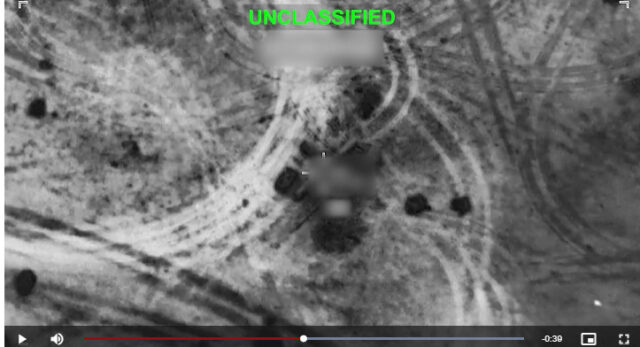
The geopolitical landscape of the Middle East shifted dramatically today as U.S. President Donald Trump announced the formal reinstatement of a total naval blockade on Iran. The decision marks the explosive collapse of recent diplomatic efforts and sets the stage for an intense showdown over the Strait of Hormuz—a critical maritime chokepoint through which approximately one-fifth of the world’s oil and gas supply transits.
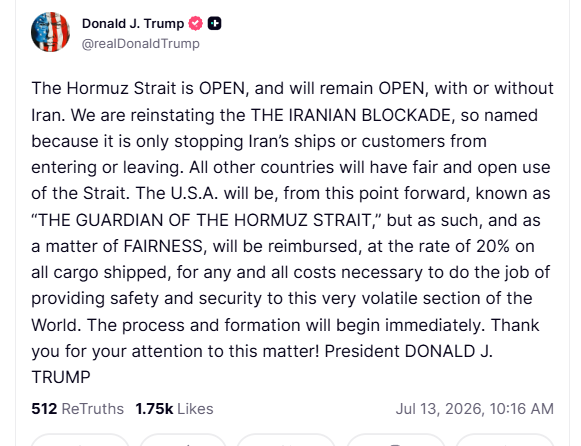
In a bold assertion of unilateral power, Trump announced that the United States would formally assume the role of “The Guardian of the Hormuz Strait.” Under this new framework, the U.S. military intends to take full control of the waterway, while demanding a 20% reimbursement fee on all commercial cargo transiting the area to offset the operational costs of providing safety and security. The swift policy shift follows a catastrophic weekend of escalating military engagements, with both sides launching widespread missile strikes and naval assaults that have shattered the region’s fragile peace.
The Collapse of the Sunday “Done Deal”
The sudden return to a strict naval blockade stems from the complete breakdown of highly sensitive, eleventh-hour diplomatic talks. Speaking directly to the media on Monday morning, President Trump revealed that American and Iranian negotiators had engaged in an intense, 11-hour meeting on Sunday aimed at hammering out a permanent end to the war and resolving disputes over Iran’s nuclear program.

According to Trump, a comprehensive agreement had been fully finalized during the session.
“We had a deal. What nobody knows, we had a deal. It was a done deal,” Trump stated. “And then they broke it. They always break it.”
The diplomatic breakthrough evaporated hours later when Iranian officials called back to demand extensive modifications to the agreed text. Citing a long history of volatile negotiations, Trump declared that the United States would no longer tolerate shifting terms, choosing instead to enforce total maritime dominance. The U.S. Central Command (CENTCOM) was promptly ordered to re-establish the blockade boundaries, effectively sealing off Iranian ports to all incoming and outgoing merchant traffic.
A Weekend of Unprecedented Escalation

The diplomatic breakdown was mirrored by a massive surge in violence over the weekend of July 11–12, 2026, as both nations exchanged some of the heaviest blows since the conflict began. The escalation began in earnest on Saturday, when the U.S. military launched a massive, coordinated air campaign targeting Iranian coastal infrastructure. U.S. forces struck 140 separate targets concentrated along the Iranian coastline, systematically degrading radar installations, missile depots, and fast-attack naval vessels. Among the areas hit was the strategic southern port of Jask, where semi-official Iranian news agencies confirmed the death of Lieutenant Hamidreza Dehghani of the Islamic Republic’s navy. CENTCOM officials underscored that the extensive weekend strikes were explicitly directed by the Commander-in-Chief to hold Iranian forces accountable for repeated provocations against international mariners. The American offensive continued well into Sunday, further pounding military facilities along the Persian Gulf.
Iran responded to the heavy U.S. bombardment with immediate, widespread retaliation over the weekend, expanding the geographic scope of the conflict by targeting American installations located within neighboring Gulf states. Throughout Saturday and Sunday, the Islamic Revolutionary Guard Corps (IRGC) unleashed extensive missile and drone barrages aimed at U.S. military bases in Jordan, Kuwait, Bahrain, Qatar, and Oman. In a public statement, the IRGC claimed a major tactical success, asserting that its forces had completely demolished the primary command and control center alongside the MQ-9 Reaper drone hangars at the Prince Hassan Air Base in Jordan.
While U.S. defense officials confirmed the incoming attacks, they quickly disputed Tehran’s narrative of destruction. According to a senior Pentagon official, the overwhelming majority of the Iranian drones and ballistic missiles were successfully intercepted by integrated air defense systems, resulting in no American casualties and zero major structural damage to regional installations. Simultaneously, Iranian naval forces maintained pressure within the waterway itself, launching a targeted strike on Sunday against a Cyprus-flagged commercial container ship attempting to transit the strait.
JUST IN: MarineTraffic’s verified shipping data over the last 24 hours directly contradicts CENTCOM’s latest statement that traffic is flowing and the Strait is open.
CENTCOM insists “Iran does not control the strait” and “traffic is flowing.” But shipping data tells a different… pic.twitter.com/oOg19KJAtc
— The Hormuz Report (@HormuzReport) July 13, 2026
The U.S. Claim: Enforcing Global Order as “The Guardian”
The United States has anchored its claim to maritime control in the defense of international law and global economic stability. By assuming the title of “The Guardian of the Hormuz Strait,” Washington positions its naval presence as a lawful intervention to maintain the freedom of navigation. The American administration argues that the Strait of Hormuz is an open international waterway that cannot legally be monopolized, closed, or taxed by a single regional power. The U.S. position is that the reinstated blockade is a targeted, defensive measure applying exclusively to vessels arriving at or departing from Iranian ports, designed to strip the regime of its economic leverage and prevent the import of dual-use military components.
To fund this massive security umbrella, the Trump administration’s proposed 20% tariff on transiting cargo introduces a new framework for maritime security, demanding that international beneficiaries of U.S. protection help offset the financial burden. Prominent American military figures, including retired General Frank McKenzie, have publicly defended this aggressive posture, stating that the only path to extracting meaningful diplomatic concessions from Tehran is to apply direct pressure that threatens the regime’s existential survival. For Washington, taking over the strait is a matter of protecting global energy markets from arbitrary disruption and re-establishing a rules-based maritime order.
The Iranian Claim: Sovereign Domination and Regional Protection
Tehran’s claim to control stands in direct opposition to the American mandate, rooted in an unyielding defense of national sovereignty and regional ownership. The Iranian Foreign Ministry issued a sharp rebuke following the resumption of the U.S. blockade, asserting that the Strait of Hormuz is an internal domain under the explicit security jurisdiction of the Islamic Republic. Iran contends that under the terms of the previous month’s interim peace frameworks, it possesses the legal authority to regulate all maritime traffic passing through its territorial waters, including the right to issue transiting permits and levy administrative fees.
Iranian officials have officially contradicted Washington’s assertions, declaring the Strait of Hormuz closed to international transit until “stability and calm are fully restored” to the region. Tehran blames the United States entirely for the current crisis, accusing Washington of introducing systemic insecurity into the Persian Gulf by openly interfering with legitimate Iranian traffic management protocols. From the Iranian perspective, the U.S. Navy operates as an illegal, hostile force whose primary goal is to enforce crippling economic warfare. Armed with an extensive arsenal of asymmetric weaponry—including anti-ship missiles, sea mines, and swarmed attack boats—Iran claims it holds the ultimate veto over the strait. The regime maintains that if Iran is legally or militarily blocked from exporting its own oil, no other nation will be permitted to safely export energy resources through the Gulf.
An Impasse with Global Ramifications
As the new week begins, the competing claims of the United States and Iran have brought commercial shipping in the Persian Gulf to a grinding halt. With the U.S. enforcing its “Guardian” mandate through overwhelming naval blockades and Iran threatening further asymmetric strikes from its coast, the international community faces the immediate prospect of a severe energy shock. United Nations officials have warned that the breakdown of Sunday’s 11-hour negotiations leaves both sides with few remaining diplomatic off-ramps. As both superpowers and regional actors brace for the fallout, the battle for control over the world’s most critical maritime chokepoint threatens to turn the ongoing conflict into a prolonged global crisis.
Sources and Links:
- CBS News: Trump orders new round of strikes to “hold Iranian forces accountable,” CENTCOM says as two sides exchange threats
- The Soufan Center: No End to the U.S.-Iran War in Sight
- Las Vegas Sun News: Trump says US will blockade Iran in the Strait of Hormuz and will charge ships for safe passage
- Ynet News: Trump: US to become ‘Guardian of Hormuz Strait,’ charge 20% on cargo
- Axios: Trump reimposes naval blockade on Iran amid escalating clashes in Hormuz
- Apa.az: Trump: US to become ‘Guardian of Hormuz Strait,’ charge 20% on cargo
- Moomoo News: Trump Declares US “Guardian of the Hormuz Strait,” Seeking 20% Reimbursement on All Cargo
- Wikipedia: 2026 United States naval blockade of Iran
Disclaimer
Artificial Intelligence Disclosure & Legal Disclaimer
AI Content Policy.
To provide our readers with timely and comprehensive coverage, South Florida Reporter uses artificial intelligence (AI) to assist in producing certain articles and visual content.
Articles: AI may be used to assist in research, structural drafting, or data analysis. All AI-assisted text is reviewed and edited by our team to ensure accuracy and adherence to our editorial standards.
Images: Any imagery generated or significantly altered by AI is clearly marked with a disclaimer or watermark to distinguish it from traditional photography or editorial illustrations.
General Disclaimer
The information contained in South Florida Reporter is for general information purposes only.
South Florida Reporter assumes no responsibility for errors or omissions in the contents of the Service. In no event shall South Florida Reporter be liable for any special, direct, indirect, consequential, or incidental damages or any damages whatsoever, whether in an action of contract, negligence or other tort, arising out of or in connection with the use of the Service or the contents of the Service.
The Company reserves the right to make additions, deletions, or modifications to the contents of the Service at any time without prior notice. The Company does not warrant that the Service is free of viruses or other harmful components.