Motorists across the Sunshine State woke up to a harsh reality at the fuel pump this Saturday morning. As the geopolitical landscape remains fraught with uncertainty, the economic aftershocks have manifested in a sharp, sudden spike in retail gasoline prices. According to the latest data from AAA and local market monitors, the average price for a gallon of regular unleaded gasoline in Florida has climbed to $4.34, a significant 6-cent increase from just 24 hours ago.
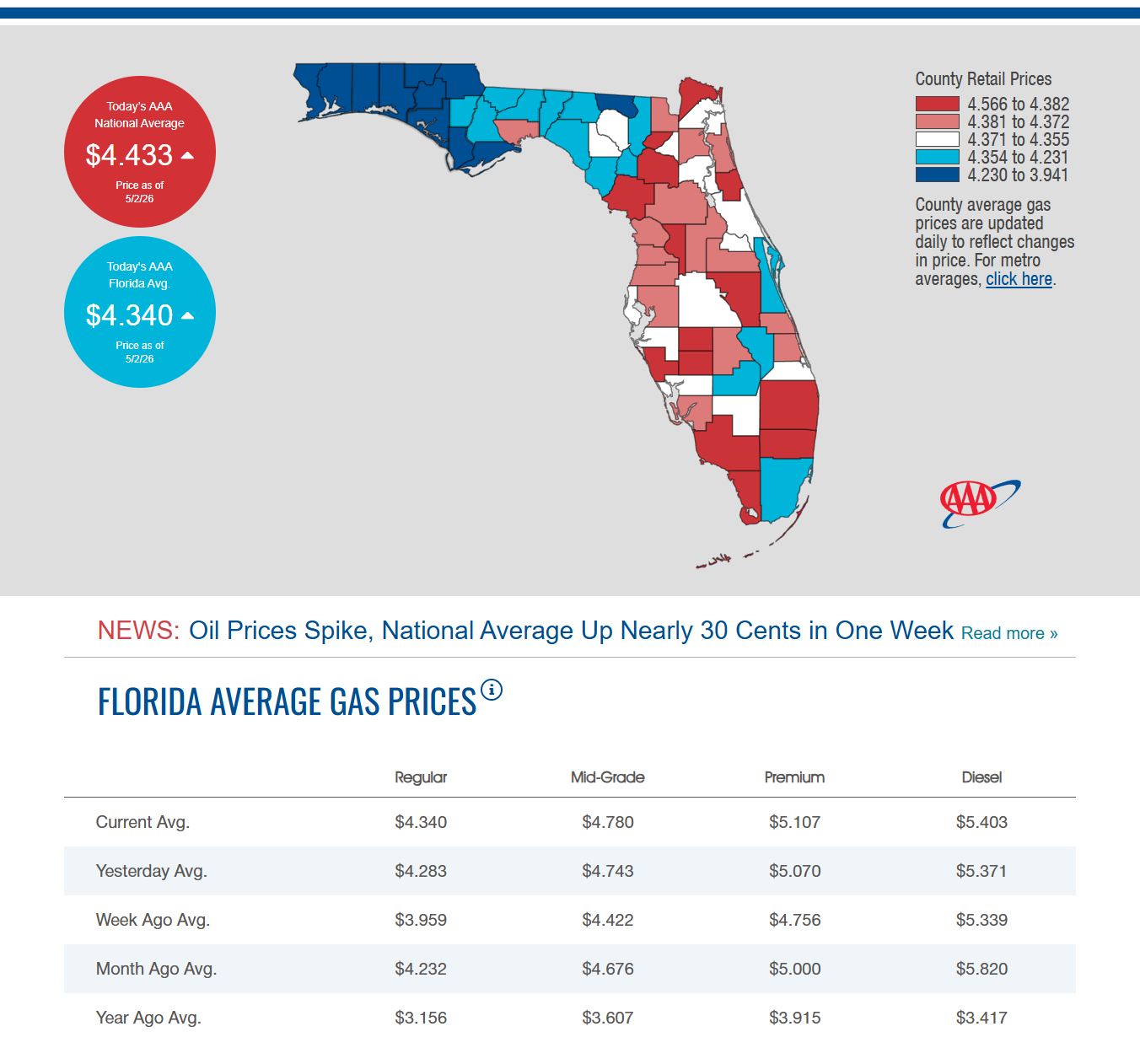
This local surge mirrors a broader national trend. The U.S. national average reached $4.433 today, up from yesterday’s average of $4.392. While a few cents might seem negligible in a single transaction, the cumulative effect on the Florida economy—heavily dependent on tourism and road-based logistics—is profound. For many residents in South Florida, the return to mid-2022 price levels is a painful reminder of how quickly global events can dictate local livelihoods.
The Immediate Catalyst: Today vs. Yesterday
The six-cent jump in Florida gas prices between May 1 and May 2, 2026, is one of the steepest single-day increases recorded in the state this year. Analysts point to a combination of factors, including the continued closure of the Strait of Hormuz and a “panic premium” being baked into wholesale futures. Yesterday, oil prices on the global market climbed above $100 per barrel, with Brent crude leading the charge. As retailers pass these costs onto consumers at an increasing pace, the “lag time” between crude spikes and pump prices has virtually vanished.

In Florida, where fuel is primarily delivered via waterborne tankers to ports like Port Everglades and Port Tampa Bay, any disruption in maritime insurance or shipping routes has an outsized impact. The six-cent hike today is not merely a reflection of current supply, but a defensive hedge by retailers facing an increasingly volatile replacement cost for their next delivery.
The Long View: Prices Since the War Began
To understand the gravity of today’s $4.34 average in Florida, one must look back to the beginning of the current conflict. Before the escalation of hostilities in the Middle East in early 2026—a conflict often referred to in policy circles as the “2026 Iran War”—the energy market was in a state of relative stability.
In February 2026, the national average for regular gasoline was hovering around $2.98 per gallon. The onset of the war, marked by the blockade of the Strait of Hormuz and attacks on critical energy infrastructure, triggered what the International Energy Agency (IEA) has called the “largest supply disruption in the history of the global oil market.”
Since the war’s inception just two months ago, U.S. gas prices have risen by approximately $1.45 per gallon. This 48% increase in such a short window has outpaced the inflationary trends of the previous three years combined. For a standard 15-gallon tank, a Florida driver is now paying nearly $22 more per fill-up than they were in late January.
A Historical Comparison: 2022 vs. 2026
This isn’t the first time Florida has seen prices flirt with the $5.00 mark. Historical data from the Energy Information Administration (EIA) provides a sobering comparison. Following the Russian invasion of Ukraine in February 2022, gas prices surged to a then-record national average of $5.032 in June 2022.
However, the 2026 crisis differs in its mechanics. While the 2022 surge was driven by a shift in European energy dependencies and sanctions on Russian crude, the current crisis is a direct physical supply shock. The Strait of Hormuz handles roughly 20-35% of the world’s seaborne crude oil trade. With traffic through this artery restricted, the world is essentially missing a vital limb of its energy anatomy.
In 2023 and 2024, prices stabilized in the mid-$3.00 range as American production reached record highs and global demand softened. By late 2025, Florida drivers were enjoying prices as low as $3.02. The sudden reversal in 2026 has been a shock to the system, particularly for the logistics and agricultural sectors that underpin the Florida economy.
Regional Impacts Across the Sunshine State
The pain at the pump is not distributed equally. In South Florida, particularly in Miami-Dade and Broward counties, prices often trend higher due to increased overhead and higher demand. Conversely, the Florida Panhandle sometimes sees slightly lower rates due to its proximity to Gulf Coast refineries. However, today’s six-cent jump has been remarkably uniform across the state’s major metropolitan areas.
For residents of retirement communities like The Villages, where many rely on fixed incomes, these increases represent a direct cut to discretionary spending. Every extra dollar spent on fuel is a dollar taken away from local restaurants, retail, and services. The South Florida Reporter has received numerous reports from local residents who are beginning to consolidate trips and cancel weekend travel plans to compensate for the rising costs.
Geopolitical Factors: The Strait of Hormuz and Force Majeure
The current crisis was exacerbated in late March and April 2026 when major energy players, including QatarEnergy, declared Force Majeure on their contracts. This legal declaration, which essentially means the company cannot fulfill its obligations due to “acts of God” or war, sent shockwaves through the market.
The physical damage to LNG (Liquefied Natural Gas) facilities in the Persian Gulf has also had a secondary effect on gasoline. As power plants shift from gas back to oil-based fuels to keep the lights on, the demand for crude oil intensifies, further squeezing the supply available for refinement into motor gasoline. The World Bank has warned that if the conflict continues, energy prices could surge by 24% this year, potentially pushing gas prices toward an unprecedented $6.00 per gallon in certain high-cost regions.
Economic Ripples: Inflation and the Consumer
Beyond the immediate cost to drivers, the fuel hike is a primary driver of broader inflation. Transportation costs for groceries and consumer goods are passed directly to consumers in Florida. With fertilizer prices also jumping by 31% this year due to the same energy supply chain issues, food prices are expected to follow the upward trajectory of the gas pump within the next 90 days.
Economists at the Bureau of Transportation Statistics have noted that for every $1 increase in gas prices, the average American household loses approximately $100 per month in purchasing power. In Florida, a state with no state income tax but a high reliance on sales tax, a reduction in consumer spending could eventually lead to tighter state and municipal budgets.
The Road Ahead: Forecasts and Expectations
What can Florida drivers expect for the remainder of May? The outlook remains cautious. While there have been sporadic reports of a potential ceasefire, ship traffic through the Strait of Hormuz remains far below pre-war levels. Analysts from AAA suggest that unless a significant de-escalation occurs, the psychological “ceiling” of $5.00 per gallon may be tested before the start of the summer travel season.
“We are in uncharted territory,” says one market analyst. “In 2022, we had reserves to tap into. In 2026, the global supply chain is much leaner, and the physical threats to infrastructure are more acute.”
For now, the advice to Florida motorists remains practical: keep tires properly inflated, avoid aggressive driving to maximize fuel efficiency, and utilize gas-tracking apps to find the most competitive rates in their neighborhoods. While six cents may seem like a small number, in the context of a world at war, it is a significant signal of the turbulent times ahead.
Data Summary: Gas Price Comparison Table
| Metric | National Average | Florida Average |
| Today (May 2, 2026) | $4.433 | $4.340 |
| Yesterday (May 1, 2026) | $4.392 | $4.280 |
| Change (24 Hours) | +$0.041 | +$0.060 |
| Pre-War (Feb 2026) | $2.980 | $3.020 |
| Total Increase Since War | +$1.453 | +$1.320 |
| 2022 Peak (June) | $5.032 | $4.890 |
Sources Used and Links:
- The Economic Times: “Gas Prices Today May 2: Check latest rates in California, Texas, Florida, New York and Pennsylvania” https://m.economictimes.com/us/news/gas-prices-today-may-2-latest-rates-california-texas-florida-new-york-pennsylvania/articleshow/130713763.cms
- AAA Fuel Prices: “State Gas Price Averages” https://gasprices.aaa.com/state-gas-price-averages/
- World Bank Group: “Middle East War to Spark Biggest Energy Price Surge in Four Years” https://www.worldbank.org/en/news/press-release/2026/04/28/commodity-markets-outlook-april-2026-press-release
- Wikipedia: “2026 Iran war fuel crisis” https://en.wikipedia.org/wiki/2026_Iran_war_fuel_crisis
- Energy Information Administration (EIA): “U.S. All Grades All Formulations Retail Gasoline Prices” https://www.eia.gov/dnav/pet/hist/LeafHandler.ashx?n=pet&s=emm_epm0_pte_nus_dpg&f=m
- Bureau of Transportation Statistics (BTS): “Motor Fuel Prices – February 2026” https://www.bts.gov/newsroom/motor-fuel-prices-february-2026-0
- Center for American Progress: “State-by-State Increases in Gas Prices Since War” https://www.americanprogress.org/article/state-by-state-increases-in-gas-prices-since-trumps-war-on-iran/
- FRED | St. Louis Fed: “US Regular All Formulations Gas Price (GASREGW)” https://fred.stlouisfed.org/series/GASREGW
Disclaimer
Artificial Intelligence Disclosure & Legal Disclaimer
AI Content Policy.
To provide our readers with timely and comprehensive coverage, South Florida Reporter uses artificial intelligence (AI) to assist in producing certain articles and visual content.
Articles: AI may be used to assist in research, structural drafting, or data analysis. All AI-assisted text is reviewed and edited by our team to ensure accuracy and adherence to our editorial standards.
Images: Any imagery generated or significantly altered by AI is clearly marked with a disclaimer or watermark to distinguish it from traditional photography or editorial illustrations.
General Disclaimer
The information contained in South Florida Reporter is for general information purposes only.
South Florida Reporter assumes no responsibility for errors or omissions in the contents of the Service. In no event shall South Florida Reporter be liable for any special, direct, indirect, consequential, or incidental damages or any damages whatsoever, whether in an action of contract, negligence or other tort, arising out of or in connection with the use of the Service or the contents of the Service.
The Company reserves the right to make additions, deletions, or modifications to the contents of the Service at any time without prior notice. The Company does not warrant that the Service is free of viruses or other harmful components.