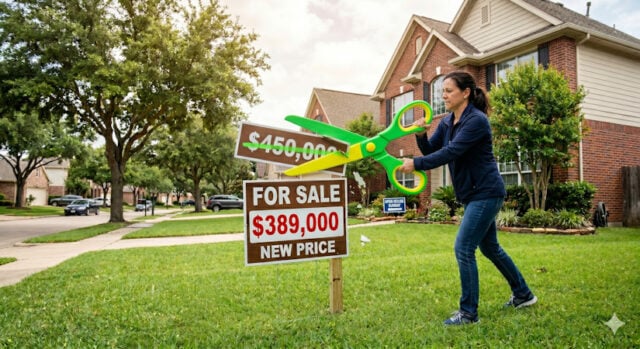
The national real estate market is undergoing a subtle yet profound shift this spring. For the past several years, homebuyers across the United States have played a stressful game of chicken with sellers, waiting out soaring valuations and high interest rates in hopes of catching a break. Now, fresh housing data indicates that the window for securing a massive discount may be narrowing. According to the Realtor.com April 2026 Monthly Housing Report, the share of active residential listings featuring a price reduction fell to 16.7% in April, a notable decline from the 17.9% recorded during the same period last year.
This nationwide drop in price cuts does not necessarily mean property values are skyrocketing out of reach once again. Instead, experts suggest it points to an evolving, more sophisticated strategy among homeowners. Rather than launching their properties with overly ambitious, “wishful thinking” price tags and waiting for the market to force a reduction, contemporary sellers are self-correcting before their homes ever hit the Multiple Listing Service (MLS).
“This year has seen both fewer price cuts and lower median list prices, suggesting sellers have internalized the generally more buyer-friendly market conditions and are adjusting price expectations before rather than after listing,” explains Jake Krimmel, a senior economist at Realtor.com. This behavioral shift represents a maturing marketplace where sellers are prioritizing realistic entry points to attract motivated buyers immediately, rather than testing the waters with inflated figures.
Despite this macro-level stabilization, real estate remains a fundamentally hyper-local endeavor. While national averages paint a picture of upfront moderation, a closer look at specific metropolitan areas reveals a starkly different reality. In several major hubs—most notably across the Sun Belt and parts of the West—inventory gluts, stubborn mortgage rates, and unique regional challenges are forcing sellers to slash prices at rates that far outpace the national average.

The Top Five Metros for Real Estate Discounts
To understand where the buyers hold the most leverage, look no further than the five metropolitan markets where price reductions remain highly prevalent. Leading the charge is the Southwest’s premier urban expanse, followed closely by major vacation destinations and mountain getaways.
According to data compiled by Realtor.com, these five markets saw the highest concentration of discounted listings in April 2026:
- Phoenix-Mesa-Chandler, AZ: 29.10% of active listings had price cuts (a year-over-year decrease of 2.2 percentage points), with a median list price of $499,000.
- Tampa-St. Petersburg-Clearwater, FL: 25.13% of active listings had price cuts (a year-over-year decrease of 4.2 percentage points), with a median list price of $406,500.
- San Antonio-New Braunfels, TX: 24.95% of active listings had price cuts (a year-over-year decrease of 0.7 percentage points), with a median list price of $324,700.
- Denver-Aurora-Centennial, CO: 24.35% of active listings had price cuts (a year-over-year decrease of 2.8 percentage points), with a median list price of $587,000.
- Portland-Vancouver-Hillsboro, OR-WA: 24.04% of active listings had price cuts (a year-over-year increase of 0.7 percentage points), with a median list price of $579,750.
“Put simply, homes are not moving in these markets,” says Krimmel. “That’s down in part due to ample supply but also anemic demand at current prices and interest rates.”
The presence of Phoenix and Tampa at the summit of this list continues a multi-year trend; both cities also topped the national charts for price reductions in April 2025. This persistent stagnation begs the question of why these specific metros continue to struggle with overpricing. As Krimmel notes, “It’s likely part unrealistic expectations and part wishful thinking, but price reductions do mean sellers are getting the message loud and clear.”
Inside the Phoenix Phenomenon: Heat, Oil, and Solar Panels
As the undisputed capital of real estate discounts, the Phoenix metro area provides a fascinating case study on how localized factors can stall a housing market. Local agent Paul Mosley of Epique Realty, who operates across Phoenix, Scottsdale, and Mesa, knows firsthand what it takes to get a deal across the finish line in this climate.
Mosley recently listed a sprawling, 4,200-square-foot, five-bedroom estate situated on a full acre of land. Complete with a three-car garage and a massive multi-RV garage, the property seemed to check every box for a luxury buyer. Yet, after just 16 days on the market, dozens of property showings, and three separate open houses, the listing failed to generate a single formal offer.
Recognizing that the property was beginning to stagnate, Mosley and his clients took decisive action, slashing the asking price by $50,000 down to $1.35 million. “We’re priced to sell,” Mosley told Realtor.com regarding the reduction. “I’m not reducing it again.”
While the home itself was slightly dated and required minor cosmetic updates like new paint and modernized bathrooms, Mosley stresses that systemic regional pressures are the true culprits behind the slowdown. Realtor.com data reinforces this, showing that the median number of days a home sits on the market in Phoenix has risen by five days compared to last year.
According to Mosley, a cocktail of macroeconomic and environmental elements is depressing local demand. For starters, mortgage interest rates have remained stubbornly fixed around 6.36%, compounding broader consumer anxieties regarding inflation.
Furthermore, geography and climate play an unexpected role. “March had several 100-degree-plus days,” Mosley notes, explaining that the unseasonable heat waves effectively paralyzed the spring shopping season. “That was not good for us.” Instead of spending their weekends driving around looking at open houses, prospective buyers stayed indoors to escape the grueling temperatures.
Compounding the climate issue is the car-dependent nature of the region. “Everyone in Phoenix drives,” Mosley says. “We’re not a public transportation city. We’re urban sprawl, way too spread out.” With gasoline and oil prices squeezing household budgets, the literal cost of commuting to look at homes has become a deterrent.
Mosley also points to an architectural and financial quirk unique to the Sun Belt: solar panels. While energy efficiency is generally viewed as a positive asset, the reality of solar panel lease agreements has become a major roadblock. Many buyers are deeply reluctant to take over existing solar contracts, which they frequently view as overpriced and financially restrictive.
Finally, the demographics of Arizona are shifting real estate dynamics. The state ranks second only to Florida in its concentration of 55+ active adult communities. Mosley observes that these age-restricted developments are feeling the brunt of the downturn. “Those places are getting hammered [in prices],” Mosley says, pointing out that older, retirement-age buyers tend to be inherently more conservative and hyper-aware of how inflation might erode their fixed incomes.
The highly seasonal nature of these retirement communities adds another layer of complexity. Senior “snowbirds” flock to the region during January, February, March, and April. “After that, they’re gone,” Mosley says. “We hit 100 degrees? They’re out of here.”
For sellers trapped in these sluggish conditions, Mosley’s advice is straightforward: leave your ego at the door. “You’ve got to price it to sell. Price it lower than you think. I’ve got a lot of people who want to test the higher end of the market, and they’re wrong.”
To illustrate his point, Mosley points to another turnkey, beautifully maintained four-year-old midcentury modern home in Scottsdale. Despite its premium custom pool, spa, and shaded gazebo, it sat idle until the price was cut from $3 million to $2.8 million. In today’s landscape, properties that move swiftly are usually backed by sellers facing mandatory life transitions. “The stuff that’s moving, it’s because [those sellers] have to sell—maybe for a job change or a divorce,” Mosley says.
Divergent Realities in Florida and Colorado
Moving east to the Gulf Coast of Florida, the Tampa metropolitan area occupies the number two spot on the list, with over a quarter of all listings undergoing price cuts. Like Phoenix, Tampa experienced an unprecedented housing boom during the pandemic era, leaving it vulnerable to a correction.
“This price drop is real,” asserts Martin Orefice, the founder of Orlando-based Rent-to-Own Labs, who frequently conducts business in the Tampa market. Speaking to Realtor.com, Orefice clarified that the pain of these price drops is not being felt equally across all price points. Instead, the luxury and upper-tier segments are bearing the brunt of the correction.
“Higher-end homes are falling by 30% or more in some areas, especially big suburban houses, while entry-level houses are basically holding steady because there simply aren’t as many of them around,” Orefice explains. “I see this as a reflection of tight budgets more than anything else.” As middle-class buyers find themselves priced out by prevailing interest rates, the pool of qualified buyers for upscale suburban estates has shrunk dramatically.
Meanwhile, in the mountain-bound metro of Denver, the narrative centers around a stark economic divide. Joe Risi of Home Waters Real Estate describes the Mile High City and its surrounding areas as a definitive “tale of two markets.” On one side of the spectrum are ultra-wealthy buyers looking for premier “blue-chip” assets. These buyers operate with immense capital, occasionally purchasing trophy properties for extraordinary, record-breaking figures.
Yet, even the most elite properties are not completely immune to price adjustments. For example, the historic, 229.5-acre Flying Dog legacy ranch located in Carbondale recently endured a massive $2 million price reduction, bringing its current asking price down to $19.8 million.
Risi’s colleague, Mike Shook, highlights a critical distinction dictating success in the luxury market: a buyer’s willingness to renovate. “High-end buyers today have zero appetite for ‘projects,'” Shook tells Realtor.com. “On one side, you have move-in-ready, ‘turnkey’ estates that continue to move quickly. On the other, you have large ranches and legacy properties that need significant infrastructure—new roads, updated water systems, or structural overhauls. These are the properties seeing price drops and longer days on market.”
Regional Variations and the Silver Lining
When looking at the United States by geographic region, a clear dichotomy emerges between the inventory-starved North and the high-supply South and West. Price discounts remain relatively rare in the Northeast (10.2% of listings) and the Midwest (13.4%). In these regions, a lack of new construction and a locked-in cohort of homeowners unwilling to give up their low mortgage rates have kept inventory tight, forcing buyers to compete aggressively for available homes.
In contrast, the South and West feature much higher rates of discounting, sitting at 18.8% and 17.9% respectively. Paradoxically, the South is also the region where the share of reductions lessened the most over the past year, dropping by 1.8 percentage points. The West followed closely behind with a 1.1 percentage point decline.
This drop in the frequency of price cuts aligns directly with broader pricing adjustments. Median list prices have fallen by 2.6% in the South and 3.1% in the West since April 2025. Because initial asking prices are dropping, sellers are finding buyers more quickly without needing to execute post-listing discounts.
For homebuyers who have felt discouraged by years of bidding wars, this climate of correction represents a rare window of opportunity. The reductions appear to be achieving their intended purpose; across the nation, the median number of days a property spends on the market dropped by 5.5 days from March to April.
When a property is priced correctly, buyers are still waiting to pounce. In the Phoenix area, a five-bedroom, three-bathroom Southwestern-style retreat on nearly an acre of land served as a prime example. The property underwent four consecutive price cuts between November 2025 and May 2026, falling from an initial $1.425 million down to a final asking price of $1.2 million. The moment it aligned with market expectations, it was immediately placed under contract.
For buyers possessing the financial means to navigate current interest rates, the increase in price cuts throughout the Sun Belt provides a clear advantage. As Mosley concludes, for those who can spot the right opportunity, “Now’s the time to buy.”
Sources Used
Disclaimer
Artificial Intelligence Disclosure & Legal Disclaimer
AI Content Policy.
To provide our readers with timely and comprehensive coverage, South Florida Reporter uses artificial intelligence (AI) to assist in producing certain articles and visual content.
Articles: AI may be used to assist in research, structural drafting, or data analysis. All AI-assisted text is reviewed and edited by our team to ensure accuracy and adherence to our editorial standards.
Images: Any imagery generated or significantly altered by AI is clearly marked with a disclaimer or watermark to distinguish it from traditional photography or editorial illustrations.
General Disclaimer
The information contained in South Florida Reporter is for general information purposes only.
South Florida Reporter assumes no responsibility for errors or omissions in the contents of the Service. In no event shall South Florida Reporter be liable for any special, direct, indirect, consequential, or incidental damages or any damages whatsoever, whether in an action of contract, negligence or other tort, arising out of or in connection with the use of the Service or the contents of the Service.
The Company reserves the right to make additions, deletions, or modifications to the contents of the Service at any time without prior notice. The Company does not warrant that the Service is free of viruses or other harmful components.