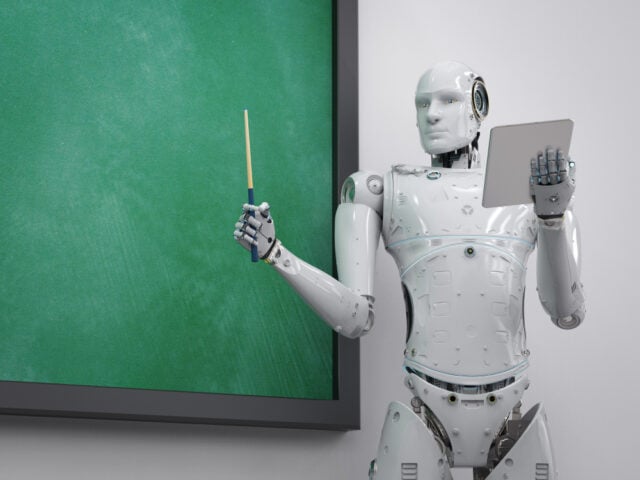
A New York school district made global headlines this week for plans to trial a humanoid robot named “Sally” in high school classrooms.
Sally has lifelike silicone skin, long brown hair, and the ability to move her arms, head, and face while seated. According to the manufacturer, she uses “natural conversation, facial expressions and real-time interaction”.
She is programmed to be a stationary classroom teaching assistant and would work as a chatbot to answer student and teacher questions. She would also be available to students 24/7 as a digital avatar online.
Following concerns about student privacy and data storage and tracking, the project has been paused.

But how far away are we from having human-like robots or AI-enhanced avatars as routine features of the school classroom?
Robots are not new to classrooms
Sally is not the first robot to be proposed for classrooms.
Non-humanlike robots (such as “Nao”) have been trialed in classrooms before. For example, they have been used to help students learning languages in Japan, South Korea, Europe and East Asia. They have also been used in technology classes when teaching skills such as coding.
Tools such as Alexa, which responds to voice commands, have also been trialed in primary classrooms in New Zealand. Here, results varied by age. Younger children had difficulty asking questions in the right format to get the answer they were seeking. Older students tested the limits of the technology, testing social interactions like joke telling or seeking unusual responses.
Teachers are also increasingly turning to generative AI for administrative tasks to save time, while chatbots are now regularly used in schools in Australia. For example, South Australia and New South Wales have introduced their own generative AI tool for students and teachers.
This growing day-to-day familiarity is likely to lower the barrier to more advanced, human-like technologies entering classrooms.
NY school to introduce first humanoid robot in US classroom – and vows ‘Sally’ will never replace teachers https://t.co/BxVX2fHgGl pic.twitter.com/T0PnCmFuxh
— New York Post Metro (@nypmetro) July 18, 2026
Here to help
Research on AI-based avatars (which chat like a human but only exist online) found they can have a positive effect on learning.
They can provide on-demand academic support by individualizing learning. For example, patiently going over a maths problem, step-by-step.
They can also help self regulation by teaching strategies and repeatedly encouraging students to apply these over time. For example, “before you start this equation, take a deep breath”.
Students have also reported experiencing less pressure and anxiety when interacting with AI tutors, which are often perceived as less judgemental than teachers.
https://t5evzd4g14-staging.onrocket.site/home-robot-will-clean-house-find-keys-bring-beer-video/
But we still need real teachers
A robot can simulate warmth, deliver curriculum flawlessly, and never get tired or need a break.
However, evidence indicates the most effective role for these technologies when they are used alongside teachers, rather than replacing them.
For example, a 2026 meta-analysis of 146 studies on social robots (robots that have a physical presence in the classroom) used to teach cognitive skills found they could improve learning outcomes, especially when they could personalize responses. But this was only when a teacher was present.
But robots used as teacher substitutes could not manage the complexity of the classroom content, respond to spontaneous student behaviors or handle unforeseen occurrences.
Research also tells us children and young people learn best when they are engaged not just cognitively, but with other people.
They need interactions that build trust and instill confidence that they are seen, known and cared about by their teachers and peers in human ways that make sense to all involved.
Data, privacy and beyond
There are safety concerns as well with this technology.
As a robot interacts with a child, the interaction is recorded. This allows the robot to provide targeted and personalized responses. When programmed with generative AI, the data may be accumulated and used to inform future interactions with other students.
But this creates risks around data privacy, storage and tracking.
It also raises other questions about who programs the robots and then controls the programs, and to what end? What happens if the program or data is hacked?
Can kids learn empathy from a robot?
Teachers are in a significant position of trust, in charge of vulnerable children and young people. There are legislative frameworks and teacher registration boards that regulate teachers’ professional behavior but do not extend to robots.
Teachers are obliged to identify, protect and foster students’ best interests. This requires them to make nuanced judgments about individual learning needs, behavior and wellbeing.
This can be difficult to capture in fixed rules or instructions, or robot programming.
As researchers have noted, this also raises concerns about children’s development if they are interacting with simulated rather than genuine care and empathy.
What’s next?
We are not going to have human-like robots in classrooms tomorrow. But the developments out of New York show how they might be a serious option for the future – particularly amid ongoing concerns about teacher shortages and workloads.
If we are going to move further in this direction, there are tough questions to answer. We will need teachers present to make sure they are being used in ways that help and protect students as they interact and learn.
Louise Starkey, Professor of Education, University of Tasmania and David Moltow, Lecturer in Education Philosophy and Ethics, University of Tasmania
This article is republished from The Conversation under a Creative Commons license. Read the original article.
Disclaimer
Artificial Intelligence Disclosure & Legal Disclaimer
AI Content Policy.
To provide our readers with timely and comprehensive coverage, South Florida Reporter uses artificial intelligence (AI) to assist in producing certain articles and visual content.
Articles: AI may be used to assist in research, structural drafting, or data analysis. All AI-assisted text is reviewed and edited by our team to ensure accuracy and adherence to our editorial standards.
Images: Any imagery generated or significantly altered by AI is clearly marked with a disclaimer or watermark to distinguish it from traditional photography or editorial illustrations.
General Disclaimer
The information contained in South Florida Reporter is for general information purposes only.
South Florida Reporter assumes no responsibility for errors or omissions in the contents of the Service. In no event shall South Florida Reporter be liable for any special, direct, indirect, consequential, or incidental damages or any damages whatsoever, whether in an action of contract, negligence or other tort, arising out of or in connection with the use of the Service or the contents of the Service.
The Company reserves the right to make additions, deletions, or modifications to the contents of the Service at any time without prior notice. The Company does not warrant that the Service is free of viruses or other harmful components.