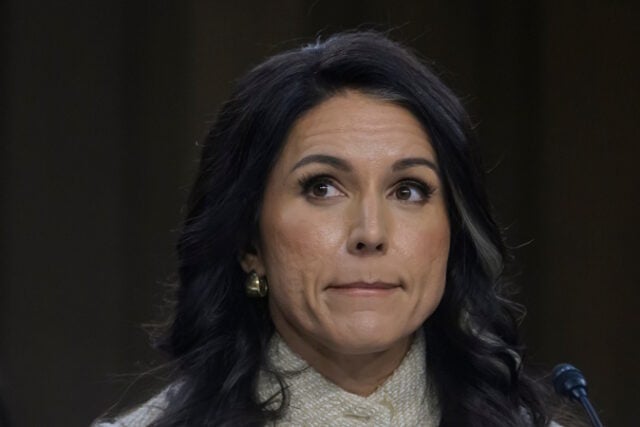
WASHINGTON — In a major shakeup to the United States intelligence community, Director of National Intelligence (DNI) Tulsi Gabbard formally submitted her resignation to President Donald Trump during an Oval Office meeting. Gabbard, who has served as the nation’s eighth DNI since her confirmation last year, announced that her departure is effective June 30, 2026. According to her formal resignation letter, the decision was driven entirely by a severe family health crisis: her husband, Abraham Williams, has recently been diagnosed with an extremely rare form of bone cancer.
Today, with great humility and sincere appreciation, I shared the below letter with President Trump. It has been a profound honor to serve the American people as DNI. pic.twitter.com/iBi6eURzvE
— DNI Tulsi Gabbard (@DNIGabbard) May 22, 2026
While administration officials have emphasized that Gabbard’s departure is structurally a voluntary step-down to care for her family, the resignation concludes a highly watched and tempestuous chapter at the Office of the Director of National Intelligence (ODNI). Gabbard’s tenure was marked by sharp ideological battles, friction with traditional intelligence agencies, and public policy rifts with the White House, making her one of the most polarizing and scrutinized figures in the administration.
A Sudden Exit for Family Reasons
The news of Gabbard’s resignation broke after details of her formal letter to President Trump were made public. In the text, Gabbard expressed deep gratitude for the opportunity to lead the nation’s 18 intelligence agencies over the past year and a half, but made it clear that her primary obligation had shifted to her home.

“My husband, Abraham, has recently been diagnosed with an extremely rare form of bone cancer,” Gabbard wrote in her resignation letter. “Abraham has been my rock throughout our eleven years of marriage. His strength and love have sustained me through every challenge. I cannot in good conscience ask him to face this fight alone while I continue in this demanding and time-consuming position. At this time, I must step away from public service to be by his side and fully support him through this battle.”
Gabbard noted that her husband faces major physical and medical challenges in the coming weeks and months, requiring her presence. In her letter, she promised to spend the next several weeks ensuring a seamless handoff of operations. “I am fully committed to ensuring a smooth and thorough transition over the coming weeks so that you and your team experience no disruption in leadership or momentum,” she added.
White House officials and close administration sources confirmed that President Trump accepted the resignation with understanding, noting that the departure was explicitly driven by her husband’s diagnosis rather than sudden job-performance disputes.
A Tumultuous Tenure at the ODNI
Despite the deeply personal and non-political catalyst for her departure, Gabbard leaves behind an intelligence apparatus that has been in a state of near-constant friction since she took the helm. From the moment of her nomination, Gabbard—a former Democratic congresswoman turned independent and conservative ally—faced intense pushback from legacy national security officials, lawmakers from both parties, and foreign allies.
Critics initially pointed to her unorthodox foreign policy views, particularly her past skepticism regarding mainstream intelligence assessments on Syria, Russia, and the Middle East, as reasons she was ill-suited to oversee the Central Intelligence Agency (CIA), the National Security Agency (NSA), and other clandestine bureaus. Once confirmed, Gabbard immediately sought to reshape the culture of the ODNI, an objective she alluded to in her farewell correspondence.
“I have made significant progress at the ODNI—advancing unprecedented transparency and restoring integrity to the intelligence community,” Gabbard asserted in her letter, referencing her efforts to challenge entrenched bureaucratic norms.
However, within the walls of the intelligence agencies, this approach was frequently perceived as adversarial. Intelligence veterans accused her office of politicizing analytical products and eroding the traditional firewall between raw espionage data and policy preferences. This internal tension reached a boiling point in recent months due to escalating global conflicts, where Gabbard’s independent stances placed her in direct opposition to both standard intelligence consensus and the commander-in-chief.
Public Fault Lines: The Iran Conflict and White House Rifts
The defining operational friction of Gabbard’s tenure materialized during the outbreak of the war involving Iran. As the administration leaned into an aggressive posture, conducting military strikes, Gabbard’s public testimony and internal briefs created significant waves across Washington.
Earlier this year, Gabbard testified before Congress that Iran had made “no efforts” to rebuild its nuclear program following initial strikes. This assessment ran counter to the primary rationale President Trump put forward for launching the military campaign. Furthermore, Gabbard broke ranks by refusing to declare that Iran posed an imminent threat to the United States at the time of the attacks.
The public divergence drew public ire from the Oval Office. President Trump openly criticized her analysis, stating that Gabbard was “softer” than he was on curbing Tehran’s nuclear ambitions.
National security insiders reported that following these policy clashes, Gabbard was increasingly marginalized from core wartime operations. Reports surfaced that the DNI was effectively “iced out” of high-level planning sessions regarding the ongoing war, with the White House relying more heavily on direct pipelines to individual military commanders and alternative intelligence advisers. This fractured dynamic turned her position into an isolating outpost, compounding the institutional turbulence that defined her months in office.
Part of a Broader Cabinet Exodus
Gabbard’s departure is not an isolated event but part of a remarkably volatile season for the executive branch’s top leadership. Her exit adds to a growing list of high-profile departures from the Cabinet, highlighting a distinct pattern of turnover among the administration’s senior female leaders.
Within the last few months, the administration has seen the exits of several high-ranking women:
- Pam Bondi, who stepped down or was removed from her role as Attorney General.
- Kristi Noem, who vacated her position as Secretary of Homeland Security.
- Lori Chavez-DeRemer, who left her post as the Secretary of Labor.
With Gabbard now stepping down, she becomes the fourth prominent female Cabinet member to exit in short succession. Political analysts note that this rapid turnover at the highest levels of national security and domestic policy has created a sense of instability across the federal government, just as the administration navigates delicate economic pressures and overseas military engagements.
What Lies Ahead for the Intelligence Community
The search for the nation’s ninth Director of National Intelligence will begin immediately, though the White House has not yet announced a short list of potential successors. The next nominee will inherit an ODNI that is fundamentally caught between a demanding White House that expects alignment with its policy goals and a career intelligence workforce protective of its analytical independence.
Furthermore, Gabbard’s successor will have to pick up the pieces of an ongoing transition during an active international conflict. Ensuring that the 18 disparate agencies of the intelligence community communicate effectively without a confirmed director at the top could complicate strategic planning regarding the Middle East and competitive posturing against China.
For Gabbard, the exit marks a definitive pause on a highly visible, unconventional political trajectory. Having completed military deployments in the Middle East during her time in the Army National Guard and served in the halls of Congress, her move into the pinnacle of the intelligence community was the most powerful post of her career. Now, her immediate focus shifts entirely from geopolitical threats to a private, medical battle at home.
Gabbard will remain in office until June 30, managing day-to-day operations and coordinating with the National Security Council to hand over control to an acting director or a newly named nominee.
News Sources and Links Utilized:
- CBS News: Tulsi Gabbard resigning as director of national intelligence, citing husband’s cancer diagnosis
- Axios: Tulsi Gabbard resigns as director of national intelligence
- The Guardian: Tulsi resigns as national intelligence director, reports say – US politics live
- Forbes: Tulsi Gabbard Becomes Fourth Trump Cabinet Member To Go—And They’ve All Been Women
- The Times of India: Tulsi Gabbard resigns as US spy chief, cites husband’s cancer diagnosis: Report
- The Indian Express: Tulsi Gabbard, US National Intelligence chief, resigns from Trump administration, report says
- The Jerusalem Post: US Director of National Intelligence, Tulsi Gabbard, resigns
- Investing.com / Fox News: Tulsi Gabbard resigns as intelligence chief for family reasons – Fox News
Disclaimer
Artificial Intelligence Disclosure & Legal Disclaimer
AI Content Policy.
To provide our readers with timely and comprehensive coverage, South Florida Reporter uses artificial intelligence (AI) to assist in producing certain articles and visual content.
Articles: AI may be used to assist in research, structural drafting, or data analysis. All AI-assisted text is reviewed and edited by our team to ensure accuracy and adherence to our editorial standards.
Images: Any imagery generated or significantly altered by AI is clearly marked with a disclaimer or watermark to distinguish it from traditional photography or editorial illustrations.
General Disclaimer
The information contained in South Florida Reporter is for general information purposes only.
South Florida Reporter assumes no responsibility for errors or omissions in the contents of the Service. In no event shall South Florida Reporter be liable for any special, direct, indirect, consequential, or incidental damages or any damages whatsoever, whether in an action of contract, negligence or other tort, arising out of or in connection with the use of the Service or the contents of the Service.
The Company reserves the right to make additions, deletions, or modifications to the contents of the Service at any time without prior notice. The Company does not warrant that the Service is free of viruses or other harmful components.