By Kat Troche
Depending on your locale, equinoxes can be seen as harbingers of longer nights and gloomy weather, or promising beacons of nicer temperatures and more sunlight. Observing and predicting equinoxes is one of humanity’s earliest astronomical skills. Many ancient observatories around the world observed equinoxes along with the more pronounced solstices. These days, you don’t need your own observatory to know when an equinox occurs, since you’ll see it marked on your calendar twice a year! The word “equinox” originates from Latin, and translates to equal (equi-) night (-nox). But what exactly is an equinox?
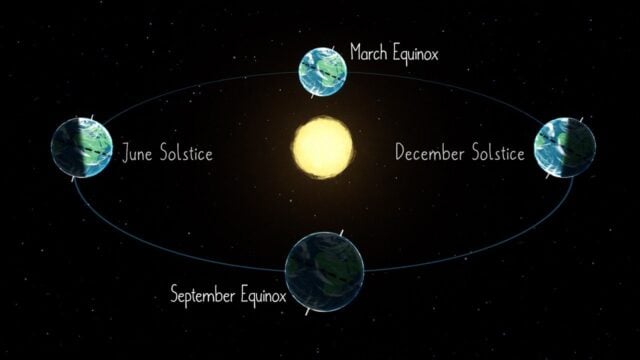
An equinox occurs twice every year, in March and September. In 2026, the equinoxes will occur on March 20, at exactly 14:46 UTC (or 7:46 AM EDT), and again on September 23, at 00:05 UTC (or September 22, 2026, at 5:05 PM PDT). The equinox marks the exact moment when the center of the Sun crosses the plane of our planet’s equator. The day of an equinox, observers at the equator will see the Sun directly overhead at noon. After the March equinox, observers anywhere on Earth will see the Sun’s path in the sky continue its movement further north every day until the June solstice, after which it begins traveling south. The Sun crosses the equatorial plane again during the September equinox, and continues traveling south until the December solstice, when it heads back north once again. This movement is why some refer to the March equinox as the northward equinox and the September equinox as the southward equinox.
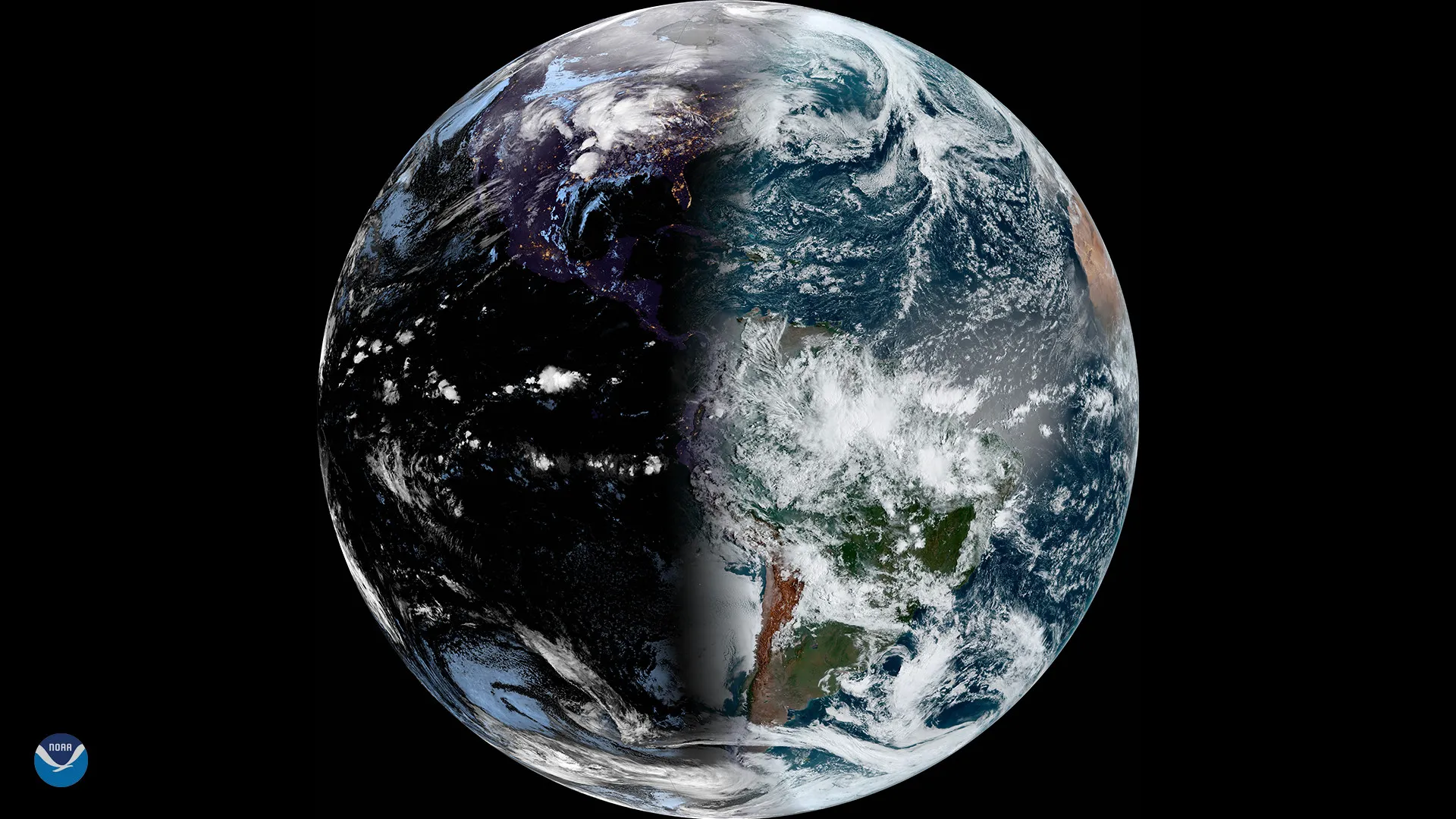
Our Sun shines equally on both the Northern and Southern Hemispheres during equinoxes, which is why they are the only times of the year when the Earth’s North and South Poles are simultaneously lit by sunlight. Notably, the length of day and night on the equinox isn’t precisely equal; the date for that split depends on your latitude, and may occur a few days earlier or later than the equinox itself. The complicating factors? Our Sun and atmosphere! The Sun itself is a sphere and not a point light source, so its edge is refracted by our atmosphere as it rises and sets, which adds several minutes of light to every day. The Sun doesn’t neatly wink on and off at sunrise and sunset like a light bulb, and so there isn’t a perfect split of day and night on the equinox – but it’s very close.

Equinoxes are associated with the changing seasons. In March, Northern Hemisphere observers welcome the longer, warmer days heralded by their vernal, or spring, equinox, but Southern Hemisphere observers note the shorter days – and longer, cooler nights – signaled by their autumnal, or fall, equinox. Come September, the reverse is true.
Originally posted by Dave Prosper: February 2022
Last Updated by Kat Troche: March 2026
Disclaimer
Artificial Intelligence Disclosure & Legal Disclaimer
AI Content Policy.
To provide our readers with timely and comprehensive coverage, South Florida Reporter uses artificial intelligence (AI) to assist in producing certain articles and visual content.
Articles: AI may be used to assist in research, structural drafting, or data analysis. All AI-assisted text is reviewed and edited by our team to ensure accuracy and adherence to our editorial standards.
Images: Any imagery generated or significantly altered by AI is clearly marked with a disclaimer or watermark to distinguish it from traditional photography or editorial illustrations.
General Disclaimer
The information contained in South Florida Reporter is for general information purposes only.
South Florida Reporter assumes no responsibility for errors or omissions in the contents of the Service. In no event shall South Florida Reporter be liable for any special, direct, indirect, consequential, or incidental damages or any damages whatsoever, whether in an action of contract, negligence or other tort, arising out of or in connection with the use of the Service or the contents of the Service.
The Company reserves the right to make additions, deletions, or modifications to the contents of the Service at any time without prior notice. The Company does not warrant that the Service is free of viruses or other harmful components.