
The IRS announced the 2027 federal income tax brackets on Thursday. It’s good news for over 160 million individual taxpayers: The brackets are indexed to inflation, and because of rising prices, most people will be able to shield more of their income from higher tax rates next year.
On Jan. 1, the income thresholds for the brackets will increase by an average of 3.2%. The adjustments apply to income earned in 2027. (Most Americans will file those tax returns in early 2028.)
Federal income taxes are calculated using seven tax brackets, with rates ranging from 10% to 37%. The tax rates themselves are set by Congress and generally stay the same from year to year. It’s the underlying brackets, meaning the income ranges that determine how much you owe at each rate, that change annually.
Must Read
- You’re probably eligible to save money on car insurance. Compare rates for your ZIP code with this free — and fast — tool from Money.
- These 6 hacks can help retirees save money on things they’re already buying.
- A $10,000 investment 10 years ago would be worth over $30,000 today. It wasn’t a stock. See how investors are adding gold to their IRAs with Goldco’s free guide.
The inflation rate climbed to 3.7% as of September as gas prices continue to drive up household costs. A sizable adjustment to the tax brackets was expected, and the announced increases were in line with forecasts.

Here’s what you need to know about the tax bracket changes and the just-announced standard deduction amounts for 2027.
Federal income tax brackets for 2027
When the IRS adjusts brackets for inflation, the resulting tax savings can feel like a raise.
For example, a single filer who earns $100,000 and claims the standard deduction would typically owe about $12,890 in 2027, a $281 drop from 2026, assuming other circumstances are unchanged.
That’s because the bracket adjustments cause less of a person’s income to be taxed at higher rates. Some taxpayers will even move into lower tax brackets.
The U.S. uses what’s called a graduated-rate tax system in which a person’s tax bracket is the highest income range (and tax rate) that their taxable income falls in. The taxpayer does not pay that rate on all of their income. For each portion of your income, it is taxed at the rate for that bracket.
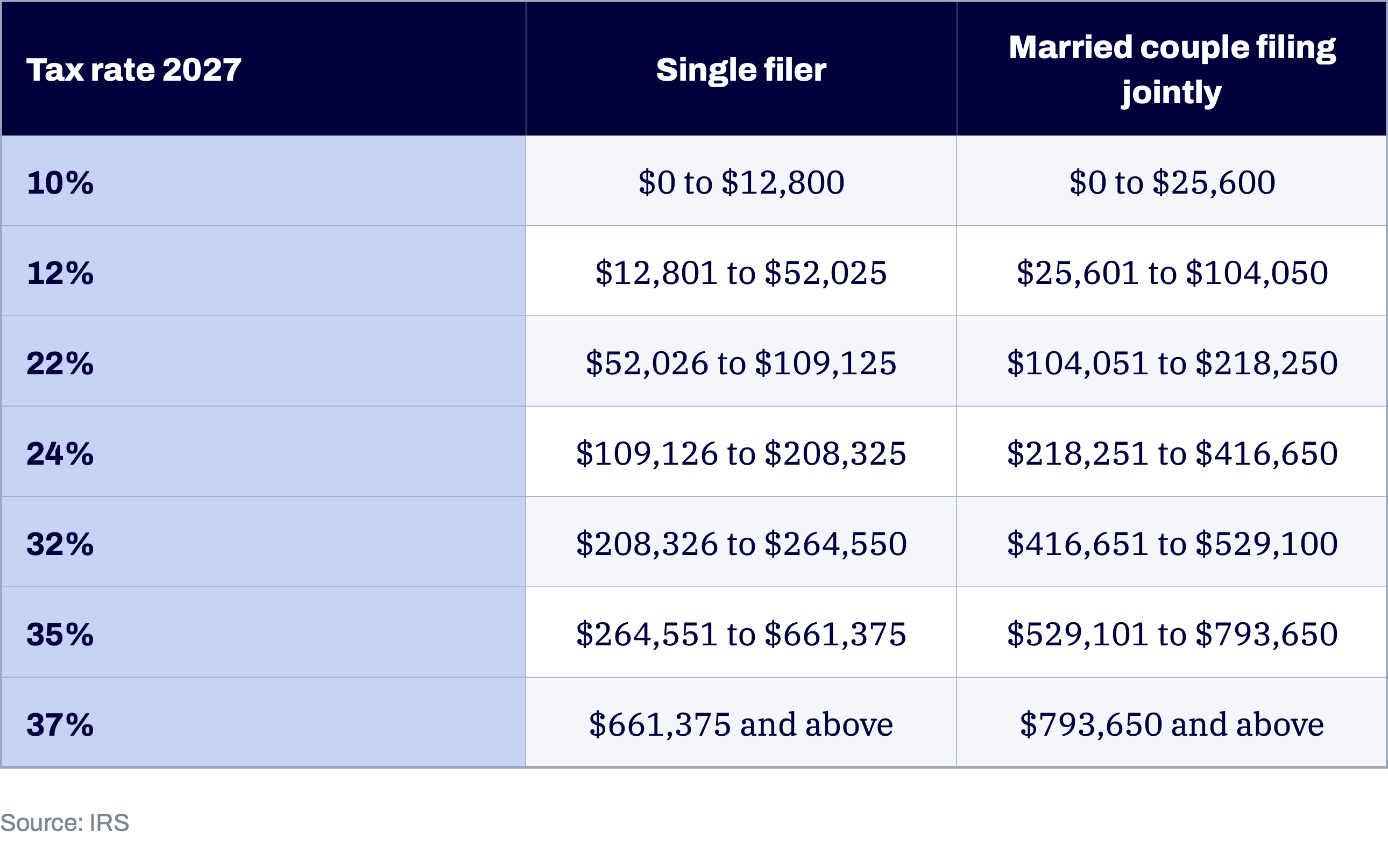
Inflation adjustments to the tax brackets are designed to prevent “bracket creep,” meaning a larger share of income falling in a higher-rate bracket simply due to cost-of-living pay adjustments.
The tax brackets are indexed for inflation with the chained consumer price index, or the chained CPI, which has been used for the calculation since 2018.
Standard deduction for 2027
The IRS announced that the standard deduction will be $16,600 for single filers, $24,925 for heads of household and $33,200 for married couples filing jointly in 2027.
That is a $500 increase from the 2026 standard deduction of $16,100 for single filers. Married couples filing jointly can deduct double that: an increase of $1,000 from this year’s $32,200 standard deduction.
The standard deduction is a set amount of income that taxpayers can deduct without itemizing their taxes. It simplifies tax preparation for millions of Americans by removing the need to log expenses for the IRS.
Since the 2017 Tax Cuts and Jobs Act became law, most taxpayers — nearly 86% in 2026 — take the standard deduction. Itemizing can still make sense for people who qualify for significant deductions, such as taxpayers eligible for large state and local tax (SALT) deductions or mortgage interest deductions, according to the IRS.
Other IRS inflation adjustments for 2027
The IRS said in the announcement that almost 70 tax provisions are impacted by the inflation adjustments.
Notably, the child tax credit will increase from $2,200 to $2,300 per qualifying child, and the maximum refundable portion — the additional child tax credit — will rise from $1,700 to $1,800.
The maximum earned income tax credit, or EITC, will increase from $8,231 to $8,496 for taxpayers with three or more qualifying children.
Disclaimer
Artificial Intelligence Disclosure & Legal Disclaimer
AI Content Policy.
To provide our readers with timely and comprehensive coverage, South Florida Reporter uses artificial intelligence (AI) to assist in producing certain articles and visual content.
Articles: AI may be used to assist in research, structural drafting, or data analysis. All AI-assisted text is reviewed and edited by our team to ensure accuracy and adherence to our editorial standards.
Images: Any imagery generated or significantly altered by AI is clearly marked with a disclaimer or watermark to distinguish it from traditional photography or editorial illustrations.
General Disclaimer
The information contained in South Florida Reporter is for general information purposes only.
South Florida Reporter assumes no responsibility for errors or omissions in the contents of the Service. In no event shall South Florida Reporter be liable for any special, direct, indirect, consequential, or incidental damages or any damages whatsoever, whether in an action of contract, negligence or other tort, arising out of or in connection with the use of the Service or the contents of the Service.
The Company reserves the right to make additions, deletions, or modifications to the contents of the Service at any time without prior notice. The Company does not warrant that the Service is free of viruses or other harmful components.