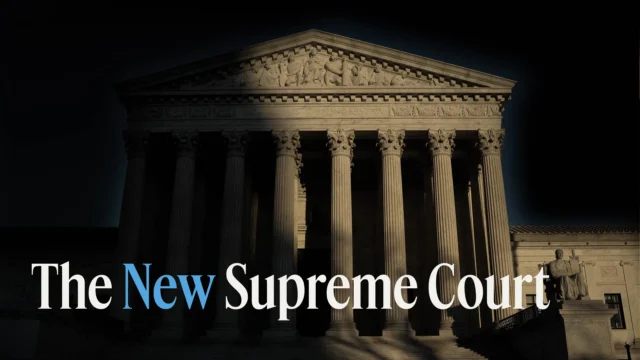
The Supreme Court continues to make consequential rulings in the shadows. I analyzed tens of thousands of case files from the court’s online archives, parsing through filings to separate simple requests for deadline extensions from challenges to long-established constitutional rights. I discovered that in the term that ended in 2025, the justices issued more substantive decisions on their emergency docket than in cases argued in open court. Experts told me this was likely the first time this has happened in the court’s modern history.
Representatives from the Supreme Court did not respond to my questions.

Since I reported that story in July, more major rulings have been made on the emergency docket, often called the “shadow docket,” where justices rarely hear arguments and often issue unsigned orders that don’t explain how they arrived at their decisions or even how they voted.
These decisions are continuing to come down even after the court began its summer recess. For example:
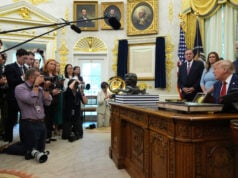
- On Aug. 31, the court allowed construction to continue on a ballroom at the White House. Requests like this one from the president are a big reason why the number of cases being handled on the court’s shadow docket has been so high.
- On Sept. 10, a decision blocked Missouri from using a redrawn congressional map crafted by the state’s Republican-controlled legislature. The legislature had redrawn the maps at President Donald Trump’s request — part of a string of middecade redistricting efforts that could determine control of Congress. Like most shadow docket decisions, no opinion was issued and there is no record of how the justices voted.
- On Sept. 14, the court stopped the U.S. Postal Service from imposing new regulations on voting by mail that the Trump administration was seeking to impose. Less than a month earlier, the court had said it was too early for states to challenge those regulations. The court rulings came just weeks before most states begin sending out ballots by mail.
Though experts told me rulings on the shadow docket have generally enabled Trump, he has not won them all. The USPS ruling, for one, has not pleased the president. Last week, in a post on Truth Social, the social media website he owns, Trump criticized the justices he nominated, writing that they “are not the people I interviewed to serve.”
“It is a Court that will go down as having rendered some of the most destructive, hurtful, and damaging decisions in our Country’s history,” Trump wrote.
Every decision the court has made since July has been on its shadow docket. That will remain the case until the court starts its new term on Oct. 5.
Watch our explainer to learn more about what I uncovered and how the shadow docket works.
The post Watch: The New Supreme Court appeared first on ProPublica.
Disclaimer
Artificial Intelligence Disclosure & Legal Disclaimer
AI Content Policy.
To provide our readers with timely and comprehensive coverage, South Florida Reporter uses artificial intelligence (AI) to assist in producing certain articles and visual content.
Articles: AI may be used to assist in research, structural drafting, or data analysis. All AI-assisted text is reviewed and edited by our team to ensure accuracy and adherence to our editorial standards.
Images: Any imagery generated or significantly altered by AI is clearly marked with a disclaimer or watermark to distinguish it from traditional photography or editorial illustrations.
General Disclaimer
The information contained in South Florida Reporter is for general information purposes only.
South Florida Reporter assumes no responsibility for errors or omissions in the contents of the Service. In no event shall South Florida Reporter be liable for any special, direct, indirect, consequential, or incidental damages or any damages whatsoever, whether in an action of contract, negligence or other tort, arising out of or in connection with the use of the Service or the contents of the Service.
The Company reserves the right to make additions, deletions, or modifications to the contents of the Service at any time without prior notice. The Company does not warrant that the Service is free of viruses or other harmful components.