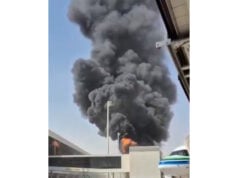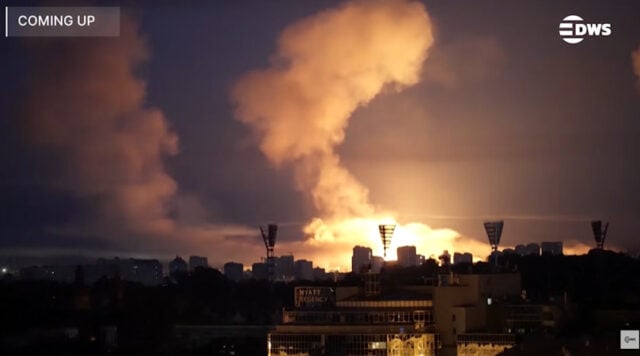
Ukrainian missiles and drones recently hammered critical infrastructure across the Moscow region. These deep strikes hit major oil refineries. The attacks sparked major fuel shortages inside Russia. In response, Russia launched a brutal retaliatory strike against Kyiv. The overnight aerial assault lasted for eleven grueling hours. Russian forces fired seventy-four missiles and nearly five hundred drones. Explosions shook the Ukrainian capital until dawn. At least twenty civilians died in the burning rubble. More than ninety people suffered severe injuries. The strike damaged thirty locations across the city.
This is raw unedited video
The Strategy of Long-Range Attrition
Ukrainian forces have dramatically shifted their strategy in 2026. They now focus on long-range aerial attacks. This strategy targets the economic heart of Russia. Ukrainian drones and missiles fly deep into enemy territory. A major strike recently hit a large oil refinery near Moscow. Another attack targeted a critical facility in Nizhny Novgorod. These strikes disrupted Russian fuel supplies significantly.
President Volodymyr Zelenskyy called this a forty-day blitz. The strategic goal is clear. Kyiv wants to force Moscow to the negotiating table. They believe economic pain will alter Russian calculations. However, the Russian military chose massive escalation instead.

A Night of Horrors in the Capital
The retaliation against Kyiv was swift and devastating. Sirens wailed across the city for hours. Thousands of residents fled into underground metro stations. Families spent the night huddled on cold concrete platforms. The sky lit up with intense anti-aircraft fire. Air defense teams intercepted most of the incoming drones. Yet, many ballistic missiles broke through the defensive shield. They struck residential neighborhoods across the capital city.
Volunteer groups handed out warm blankets and hot tea. Many people could not sleep due to the loud explosions. Children cried inside the crowded subway stations. This night became one of the worst of the year.
One missile scored a direct hit on a tall apartment block. Six floors of the residential building collapsed instantly. Rescue workers dug through the debris all day long. They pulled terrified survivors from the smoking ruins. Mayor Vitali Klitschko announced a formal day of mourning. He called the attack a war crime against civilians. Foreign Minister Andrii Sybiha described it as a night of horror. Ambulances and fire trucks raced through the dark streets. The city administration opened emergency centers for displaced residents.
Automated Warfare and Tech Evolution
Both nations now rely heavily on automated systems. Air power has entered a completely new paradigm. Ukraine uses artificial intelligence to guide its long-range drones. These smart systems bypass dense Russian air defense networks. They can travel hundreds of miles with extreme precision.
Russia uses similar tech for its mass saturation assaults. The sheer volume of weapons tests modern air defenses daily. Shooting down hundreds of targets requires immense financial resources. Western allies continue to resupply Ukraine with interceptor missiles. Still, the heavy demand far outpaces global manufacturing supply. This dynamic leaves civilian areas vulnerable to sudden breakthroughs.
The Stagnant and Bloody Frontlines
While the skies burn, the ground war remains slow. Frontlines in eastern Ukraine have barely shifted this year. The Institute for the Study of War tracks these movements closely. Russian forces made minor tactical gains in June 2026. They captured a few small villages in the Donetsk region. This included the small settlement of Piskunovka.
However, their overall rate of advance has slowed dramatically. It is a small fraction of their 2025 pace. The conflict has become a grueling war of attrition. Russia relies on costly pincer movements to gain ground. They are currently targeting the Donbas fortress belt. Specifically, they want to capture the Kostyantynivka area. Ukrainian defenders are holding their lines at great human cost.
The Mounting Cost in Human Lives
The human toll of this conflict is truly staggering. Reliable estimates show massive military casualties on both sides. Western intelligence reports that hundreds of thousands have died. The Center for Strategic and International Studies provided data.
Russia has suffered over one million battlefield casualties since 2022. This includes up to 450,000 deaths. Ukraine has also lost tens of thousands of brave soldiers. Civilian fatalities continue to rise with every aerial bombardment. Furthermore, the war has displaced millions of innocent people. Nearly six million Ukrainians live as international refugees. Another 3.7 million are internally displaced. An entire generation faces profound psychological trauma.
Domestic Pressures and Sputtering Economies
The conflict is reshaping daily life inside Russia too. Everyday citizens face a sputtering domestic economy. Grocery prices have risen significantly over the past year. The Kremlin has imposed new tax increases to fund the military. Strict internet restrictions limit access to independent information. An oppressive crackdown targets anyone who speaks against the war.
President Vladimir Putin even scaled back the May military parade. He feared long-range Ukrainian drone strikes on Moscow. Meanwhile, attacks on Crimea have disrupted local tourism. Power outages hit the peninsula regularly now. Many young professionals have fled the country to avoid conscription. Labor shortages are now affecting key manufacturing sectors. The value of the local currency fluctuates wildly every week. Ordinary families suffer the most from these economic shifts.
The International Diplomatic Deadlock
Diplomatic efforts to end the war remain completely stalled. Recent international initiatives have failed to produce results. Even pressure from the United States has not shifted positions. Both capitals maintain incompatible conditions for peace.
Kyiv demands a full withdrawal of all Russian troops. They also insist on the return of all occupied lands. Moscow demands that Ukraine cede large territories. They also want Ukraine to reject NATO membership forever. Neither side is willing to back down yet. Therefore, the bloody stalemate looks set to continue.
Global Security and Future Risks
The war continues to threaten wider European stability. Neighboring countries remain on high military alert. During the Kyiv attack, Poland scrambled its fighter jets. This was a preventive measure to protect NATO airspace.
Western nations are constantly tightening economic sanctions on Moscow. They seek to choke off Russia’s war machine. However, trade workarounds keep the Russian economy afloat. The global energy market feels the constant strain. Shipping routes in the Black Sea remain highly dangerous. Uncrewed surface vessels routinely attack naval targets there. The risk of a wider confrontation remains elevated. The world watches as the conflict enters another dark phase.
Sources and Links:
- The Guardian: At least 20 dead as Russia launches massive drone and missile attack on Kyiv
- Center for Strategic and International Studies (CSIS): Russian Blood and Treasure: The Ballooning Costs of Putin’s War
- Institute for the Study of War (ISW): Russian Offensive Campaign Assessment, July 1, 2026
- WGLT (NPR): A major Russian attack kills 17 in Kyiv as Ukraine keeps striking Moscow’s oil sector
- India Today: Russia’s 11-hour strike on Kyiv kills 18 after Ukraine hits oil refineries
Disclaimer
Artificial Intelligence Disclosure & Legal Disclaimer
AI Content Policy.
To provide our readers with timely and comprehensive coverage, South Florida Reporter uses artificial intelligence (AI) to assist in producing certain articles and visual content.
Articles: AI may be used to assist in research, structural drafting, or data analysis. All AI-assisted text is reviewed and edited by our team to ensure accuracy and adherence to our editorial standards.
Images: Any imagery generated or significantly altered by AI is clearly marked with a disclaimer or watermark to distinguish it from traditional photography or editorial illustrations.
General Disclaimer
The information contained in South Florida Reporter is for general information purposes only.
South Florida Reporter assumes no responsibility for errors or omissions in the contents of the Service. In no event shall South Florida Reporter be liable for any special, direct, indirect, consequential, or incidental damages or any damages whatsoever, whether in an action of contract, negligence or other tort, arising out of or in connection with the use of the Service or the contents of the Service.
The Company reserves the right to make additions, deletions, or modifications to the contents of the Service at any time without prior notice. The Company does not warrant that the Service is free of viruses or other harmful components.