|
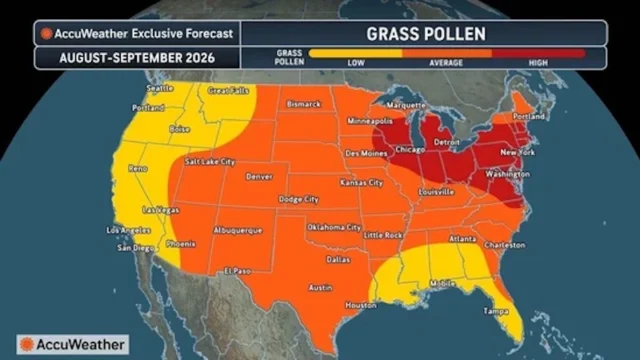
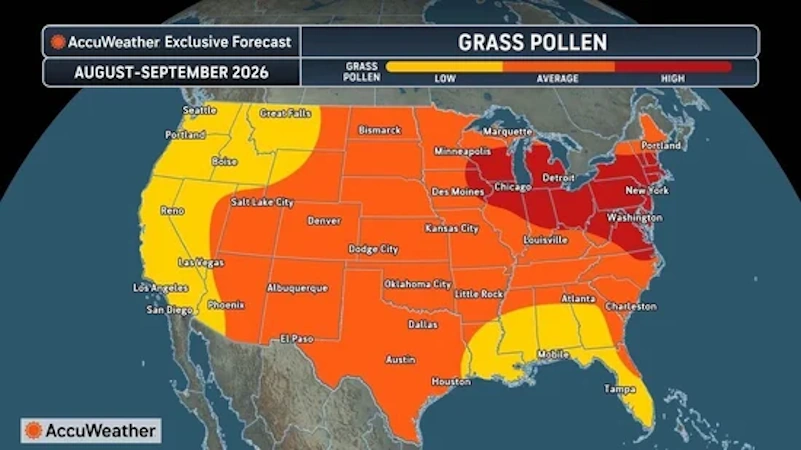
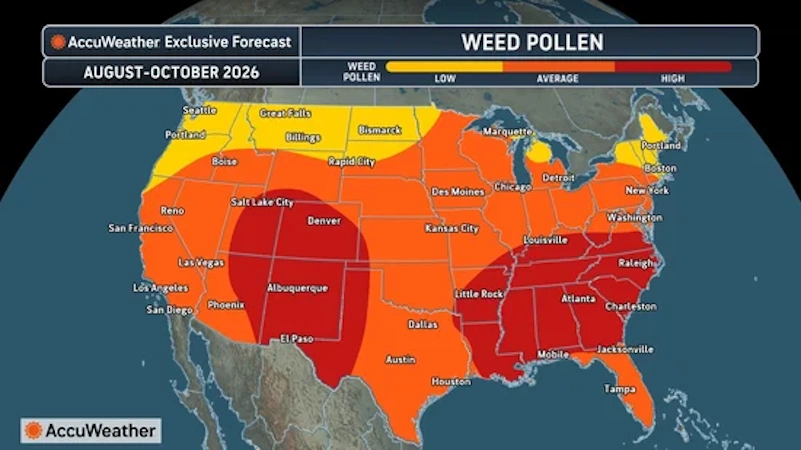
Fall allergy season is ramping up across the United States, with warm and wet weather helping pollen levels climb in parts of the country. Grass and weed pollen are the biggest concerns during the end of summer and start of fall. AccuWeather’s 2026 U.S. Fall Allergy Forecast shows grass pollen gradually declining during August and early September, while weed pollen is expected to become more widespread into October. “For grass pollen, we start to lose the worst of it in August and early September, but things can still be high in parts of the East due to ample moisture and warm overnight temperatures,” AccuWeather Senior Meteorologist Alan Reppert said. The highest grass pollen levels are forecast across parts of the Midwest, Great Lakes, Northeast, and mid-Atlantic, including Chicago, Detroit, New York City and Philadelphia. Increasing dryness across much of the West is expected to slow grass growth outside of irrigated areas, while much of the Southeast should have some dry stretches which will keep grass pollen below the historical average. |

 |
 |
Disclaimer
Artificial Intelligence Disclosure & Legal Disclaimer
AI Content Policy.
To provide our readers with timely and comprehensive coverage, South Florida Reporter uses artificial intelligence (AI) to assist in producing certain articles and visual content.
Articles: AI may be used to assist in research, structural drafting, or data analysis. All AI-assisted text is reviewed and edited by our team to ensure accuracy and adherence to our editorial standards.
Images: Any imagery generated or significantly altered by AI is clearly marked with a disclaimer or watermark to distinguish it from traditional photography or editorial illustrations.
General Disclaimer
The information contained in South Florida Reporter is for general information purposes only.
South Florida Reporter assumes no responsibility for errors or omissions in the contents of the Service. In no event shall South Florida Reporter be liable for any special, direct, indirect, consequential, or incidental damages or any damages whatsoever, whether in an action of contract, negligence or other tort, arising out of or in connection with the use of the Service or the contents of the Service.
The Company reserves the right to make additions, deletions, or modifications to the contents of the Service at any time without prior notice. The Company does not warrant that the Service is free of viruses or other harmful components.